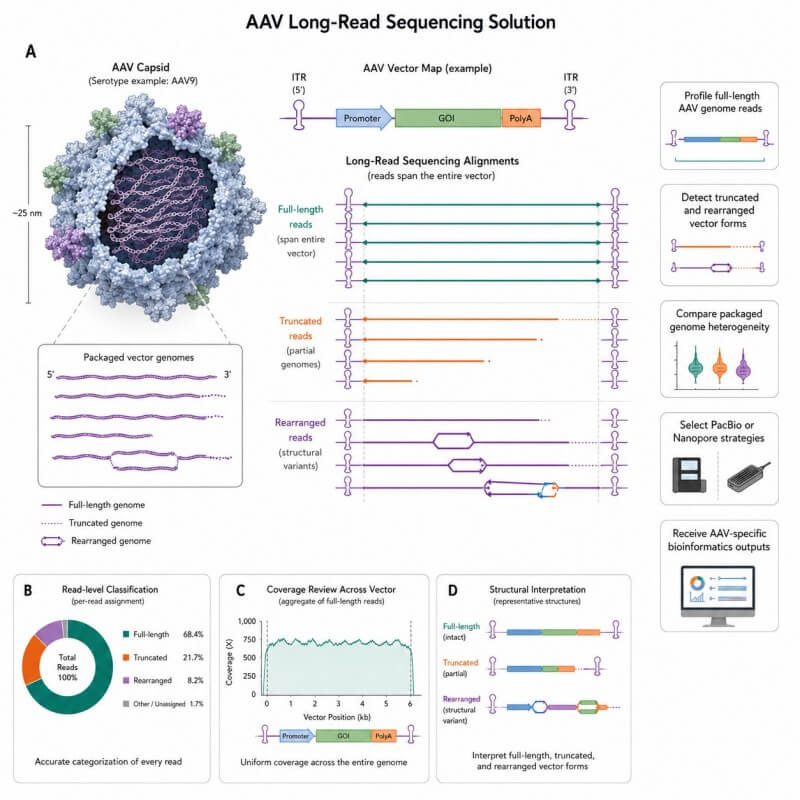
AAV vector samples are not always a single, uniform genome population. Full-length genomes, partial genomes, truncated products, rearranged molecules, concatemers, and unexpected packaged forms may exist in the same preparation. CD Genomics provides an AAV Long-Read Sequencing Solution to help research teams study packaged vector genome structure with long-read sequencing and AAV-specific bioinformatics.
We help you move from raw sequencing reads to organized evidence your team can review, compare, and use for research decisions. This solution connects AAV sample review, vector map evaluation, PacBio or Nanopore sequencing strategy, read-level classification, vector structure annotation, visualization, and report-ready deliverables.
Short-read sequencing is useful for local sequence review, coverage analysis, and variant-level evidence. However, many AAV research questions are not only local sequence questions. They are structure questions.
An AAV preparation may contain reads that match the expected construct, but it may also include partial genomes, truncated forms, rearranged molecules, concatemers, or other unexpected packaged DNA patterns. When the evidence is split into short fragments, these larger structures can be difficult to interpret with confidence.
Long-read sequencing gives your team a broader view of the vector genome. Reads that span longer regions can help show how different parts of the vector are connected. This is especially useful when your study needs to understand whether packaged genomes are full-length, where truncation patterns occur, or whether unexpected structures are present.
For many AAV vector research teams, the key question is not only, "Is the designed sequence present?" A more useful question is: what genome forms are actually represented in the packaged vector population?
Our solution is designed to answer that question through long-read sequencing, vector-aware mapping, read-level classification, structure annotation, and clear reporting.

![]() Full-length AAV genome read profile This output shows long-read alignments across the expected AAV vector map. It can help your team review whether reads span key regions and how many reads support full-length or near-full-length structures. | ![]() Vector form classification summary This output groups reads into interpretable categories, such as expected full-length reads, partial reads, truncated forms, rearranged reads, concatemer-like structures, or unexpected forms when supported by the data. | ![]() Truncated or rearranged genome structure view This output highlights read patterns that suggest truncation, rearrangement, or unexpected structure. It may include genome browser-style tracks, alignment diagrams, and annotated structure summaries. |