Genomic DNA sequencing is a sophisticated method that relies on superior high-throughput sequencing strategies to thoroughly investigate the entirety of an organism's genomic DNA. The core objective of this scientific modus operandi is to attain a profound comprehension of the genetic information encapsulated within the organism. This technique bears exceptional significance in biological research, providing a solid data-based foundation for dissecting the intricate nexus between genes, diseases, and phenotypes. The deployment of genomic DNA sequencing enhances our perception of an organism's biological functionality, the undercurrents driving disease pathogenesis, and the directional progression of biological evolution.
What is the Genomic DNA Sequencing Method?
Currently, DNA sequencing technologies can be succinctly divided into three principal clusters. The initial category encompasses the conventional Sanger Sequencing technology, commonly referred to as first-generation sequencing, extensively recognized as the gold standard in the clinical diagnostic sector. The subsequent category integrates high-throughput sequencing (HTS) or next-generation sequencing (NGS) technologies, both demonstrated to promptly process a massive volume of DNA molecules showcasing unparalleled efficiency. The final category includes single-molecule sequencing technologies, which, devoid of PCR amplification reliance, can directly sequence individual DNA molecules. This latter category is often termed as third-generation sequencing technology.
Sanger sequencing
The Sanger Sequencing Method, an archetypal technique in DNA sequencing, hinges on the close coupling between specific primers and template DNA molecules. Throughout the sequencing process, DNA polymerase catalyzes the progressive addition of the four types of deoxyribonucleotide triphosphates (dNTPs) onto the primer-bonded template DNA. The synthesis of new DNA strands is facilitated by the formation of covalent bonds between the 3' carbon atom of a deoxyribose molecule and the 5' carbon atom of the subsequent nucleotide. This process perpetuates until encountering a terminator, ddNTP, which lacks an oxygen atom at the 3' end, leading to the cessation of DNA strand synthesis.
NGS
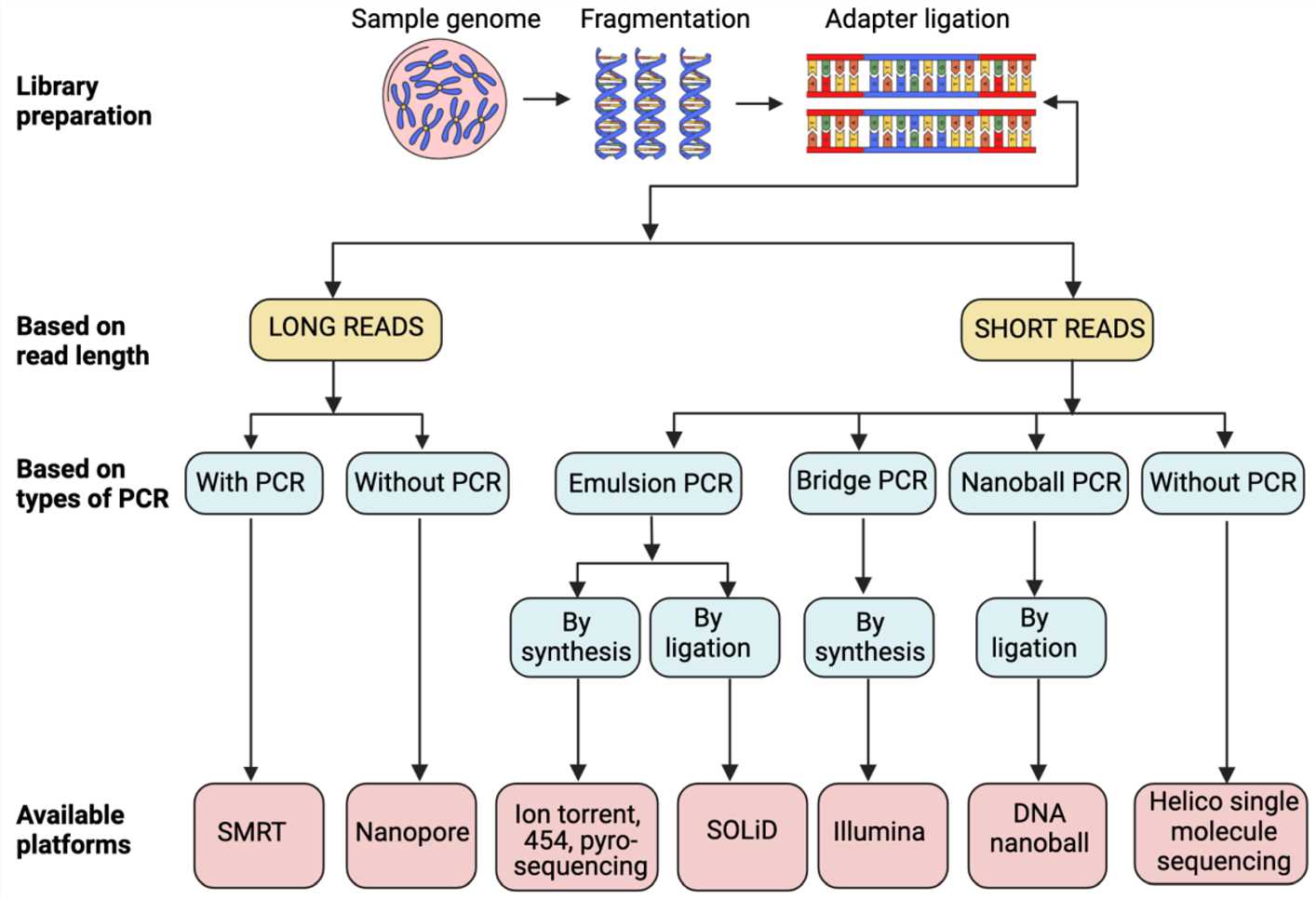
Compared to the Sanger sequencing method, high-throughput sequencing technologies such as Illumina sequencing demonstrate superior efficiency, throughput, and cost-effectiveness. Presently, it has emerged as a prevalent method in modern genomics research, finding widespread applications across various fields.
Leveraging NGS technology has successfully facilitated the simultaneous execution of millions of sequencing reactions, marking a notable technical breakthrough. In the past, reliable nucleotide sequences could only be obtained through the coordinated operation of eight different reaction mixtures. Now, however, base sequence information can be directly identified during the synchronous process of sequence extension and detection.
With the advent of NGS technology, the application scope of genomics has significantly expanded. Currently, DNA sequencing has become an integral component in multiple domains, including basic science, translational research, medical diagnosis, and forensic science. Despite notable successes of the NGS technology in cost and time reduction, the relatively short "read length" it generates contributes to demanding computational requirements for subsequent genome assembly. Nonetheless, we remain optimistic that with continuous technological advancement and optimization, these challenges will gradually be resolved.
Overview of various NGS technologies (Heena Satam et al., Biology2023)
Single Molecule Sequencing
Single molecule sequencing, also known as long-read sequencing, is gathering increasing attention from the scientific community owing to its superiority in the domain of long sequence reading. Technologies of this kind primarily fall into two categories: Single-Molecule Real-Time (SMRT) sequencing and nanopore sequencing.
Whole Genome Sequencing (WGS), a revolutionary technique, is now widely used in Human/animal genome research. Its fundamental task is to comprehensively examine and order the complete genome sequence within a biological cell, meticulously capturing all types of mutations from the first to the last DNA. This holds significant implications for deepening our understanding of an organism's genetic information, disease mechanisms, and the relationships between genes and traits.
The development and application of Whole Genome Sequencing extend beyond humankind into other biological sectors. In organisms with an absence of suitable reference genomes or those with low quality reference genomes, de novo sequencing and assembly techniques are markedly valuable. Through WGS, researchers can obtain the complete genome information of an organism, providing important foundations for further investigation into gene functions, genome evolution, gene regulation networks, and more.
In practical applications, Whole Genome Sequencing has achieved globally recognized achievements. For instance, WGS has successfully deciphered the genome sequences of various animals and plants, supplying robust support for research in fields such as agriculture and medicine. Furthermore, WGS is playing a crucial role in pathogenic microbe detection, forensic genetics, and biodiversity studies, among others.
Within the human genome, the number of exons approximates 180,000, constituting 1-2% of the total genomic entity, around 30MB in computational terms. Pathogenic mutations in the protein-encoding regions of the human genome account for about 85% of the total pathological alterations. Whole Exome Sequencing (WES) is an instrumental technique that privileges the amplification of DNA sequences from exon regions through probe hybridization, prior to undertaking high-throughput sequencing methodologies. The primary objective here is to identify and investigate genetic mutations associated with disease and evolutionary metrics within coding and regulatory regions (Untranslated Regions, UTR). Collating this with publicly-available exome data aids the deeper interpretation of the relationship between various mutations and subsequent diseases mechanisms.
Relative to WGS, Whole Exome Sequencing brings several advantages to the fore: a) Cost-effectiveness: compared with WGS, Whole Exome Sequencing offers superior coverage depth and enhanced data precision, making it an economically preferable choice; b) Depth of sequencing: Sequencing depth can reach an excess of 120x; c) High-throughput capacity: WES is aptly suited for large-scale studies involving numerous target regions; d) High precision: Profound sequencing coverage accompanies high data accuracy, delivering well-optimized outcomes.
Targeted resequencing is a technique primarily involving multiplex amplicon sequencing and hybrid capture sequencing. It isolates specific genes or genomic regions for sequencing. When compared with WGS and WES, targeted resequencing exhibits the following advantages:
It allows high precision sequencing of vital genes with a deep sequencing exceeding 500x, thereby leading to accurate identification of rare variations.
It is economically efficient, facilitating the study of disease-associated genes.
Capable of identifying variations of allele frequencies as low as 5%.
During a single detection, trustworthy identification of hereditary mutations can be accomplished.
Advantages of Our DNA Sequencing Services
Adherence to the highest standards in providing complete genomics solutions.
Expertise in various aspects of sequencing such as experiment design, target enrichment library construction, and customized bioinformatics analysis.
Delivery of fast, accurate, reliable, and affordable sequencing services.
Capability to provide genomic sequencing services for a wide range of samples including human, mouse, plant, animal and microbe.
Mission to facilitate genomics research by providing access to the latest technologies in the field.
Flexibility to customize services to fit individual project needs and provide specifically tailored analysis.
A consultative approach to identify the best and most economical solutions to meet specific research needs.