Get Your Quote
ATAC-Seq Home  > ATAC-Seq

CD Genomics is now able to provide Assay for Transposase-Accessible Chromatin with high-throughput sequencing (ATAC-seq), a method for mapping chromatin accessibility genome-wide. The method is a fast and sensitive alternative to DNase-seq (DNase I hypersensitive sites sequencing) or MNase-seq (micrococcal nuclease sensitive sites sequencing). By using our service, you can detect genome-wide profiles of open and accessible regions of chromatin that are indicative of active regulatory regions.

The Introduction of ATAC-Seq

The eukaryotic genome is highly packaged to fit into the very limited nuclear space. As a result, access to genomic information is tightly regulated based on cellular state. What regions of the genome are accessible reveals a great deal about the state of the cell. ATAC-seq is a technique to locate accessible chromatin regions.

The acronym ATAC-seq stands for Assay for Transposase Accessible Chromatin using sequencing, a technique that examines chromatin accessibility by transposase through sequencing. This approach involves the cleavage of open chromatin regions in specific temporal and spatial contexts by transposase, thereby capturing regulatory sequences of actively transcribed genes within the genome at that specific interval. Requiring only a small number of cells, this method provides real-time information on the regulatory sequences controlling genome-wide activity. Its applications include transcription factor binding analysis, nucleosome positioning, and the distribution of regulatory elements, offering vast prospects in the field of epigenetic research.

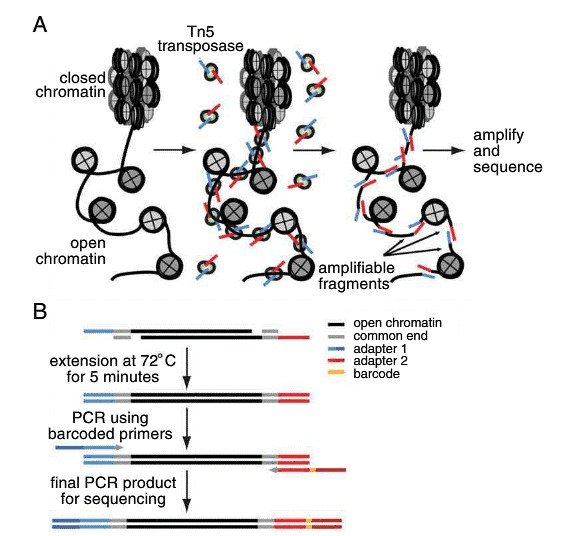
ATAC-seq is an innovative technique in epigenetic research that utilizes Tn5 transposase to cleave and label open chromatin sites, enabling efficient sequencing of chromatin accessibility maps. The Tn5 transposase binds randomly and cuts DNA in open chromatin regions, simultaneously inserting adapter sequences at the cleavage sites. By introducing the transposase complex carrying known DNA sequence tags (i.e., Tn5 transposase with red and green sequence tags) into the nucleus for co-incubation, followed by PCR amplification using the known sequence tags, a library can be generated, and sequencing can provide information on open chromatin regions.

Advantages of ATAC-Seq

  • Gain mechanistic insight into gene regulation, cellular response to treatment or disease
  • Identify which transcription factors are driving cell fate, disease, or response
  • Limited patient samples
  • Low requirements on the amount of the biological sample, and the whole protocol requires 3 hours in total

Applications of ATAC-Seq

  • Nucleosome positioning
  • Identification of key transcription factors
  • Detection of promoter regions, potential enhancers, or silencers
  • Integration of multi-omics data
  • Mapping chromatin accessibility
  • Identification of transcription factor-regulated target genes

ATAC-Seq Workflow

The key part of the ATAC-seq procedure is the action of the transposase Tn5 on the genomic DNA of the sample. Transposases are enzymes catalyzing the movement of transposons to other parts of the genome. While naturally occurring transposases have a low level of activity, ATAC-seq employs a mutated hyperactive transposase. The high activity allows for highly efficient cutting of exposed DNA and simultaneous ligation of specific sequences, called adapters. Adapter-ligated DNA fragments are then isolated, amplified by PCR and used for next generation sequencing. The experimental pipeline of ATAC-seq is demonstrated in Figure 1.

Figure 1. Workflow schematic of the ATAC-seq process.

Figure 1. Schematic workflow of ATAC-seq process.

Workflow Diagram of ATAC-Seq.

Service Specification

Sample Requirements

  • Sample type: Human, mouse and rat tissues, Live cells, not genomic DNA.
  • Cell≥ 1 x10⁶, Minimum Quantity: 5 x10⁴
  • Tissue ≥ 500 mg, Minimum Quantity: 200 mg

Note: Sample amounts are listed for reference only. For detailed information, please contact us with your customized requests.


Click

Sequencing Strategies

  • Illumina HiSeq PE50 or PE150.
  • For some applications such as nucleosome mapping, paired end sequencing is preferred. Illumina HiSeq PE150.
  • ≥50M Reads.

Data Analysis
We provide multiple customized bioinformatics analyses:

  • Quality control
  • Reference genome mapping
  • Peak calling
  • Annotation
  • Differential analysis
  • Motif discovery

Note: Recommended data outputs and analysis contents displayed are for reference only. For detailed information, please contact us with your customized requests.

Analysis Pipeline

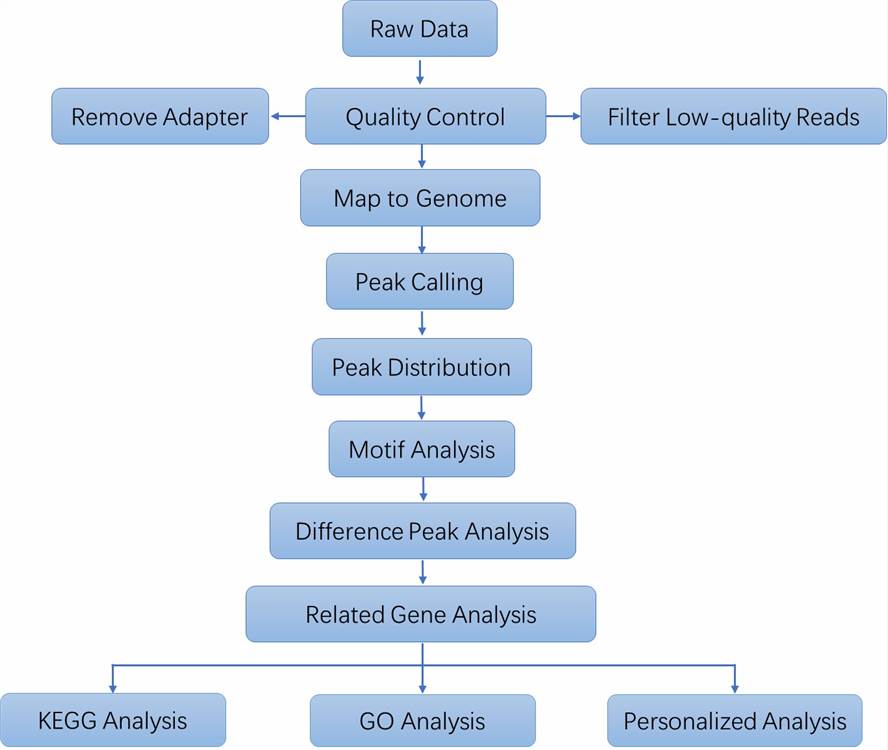
The Data Analysis Pipeline of ATAC-Seq.

Deliverables

  • The original sequencing data
  • Experimental results
  • Data analysis report
  • Details in ATAC-Seq for your writing (customization)

CD Genomics assure that we will provide high-quality service, and our professional team will not let you down. Being experienced with more than 10 years in serving researchers all over the world for NGS, I think we could be. Please do not hesitate if you have any questions about our service.

Demo Results

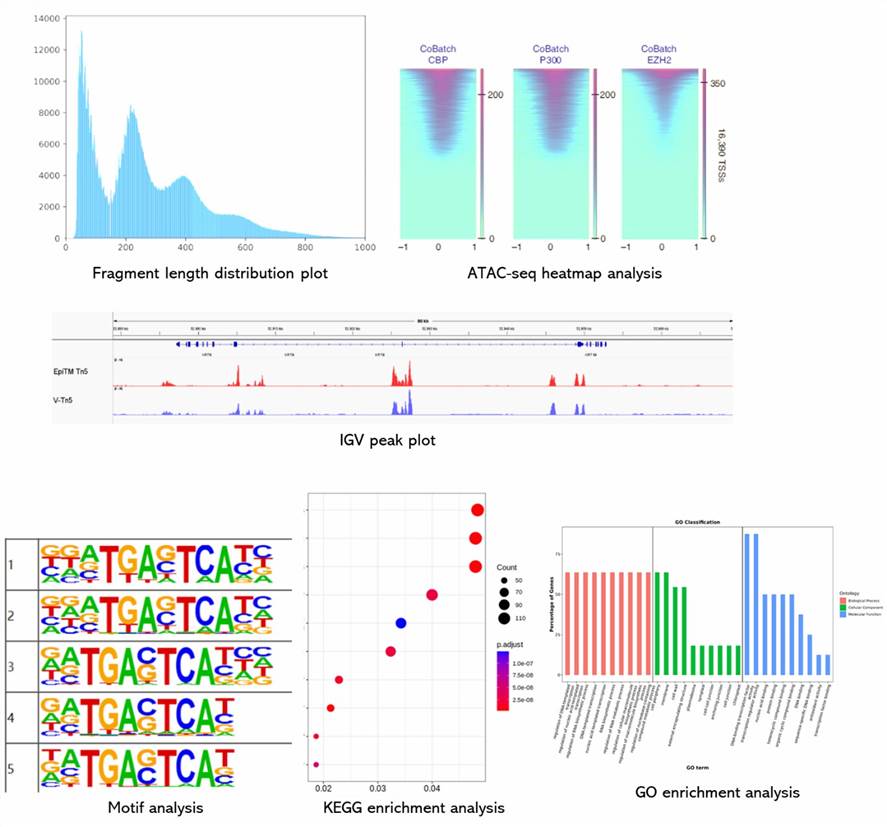
Partial results are shown below:

The ATAC-Seq Results Display Figure.


ATAC-Seq FAQs

1. What type of controls are necessary for ATAC-Seq experiments?

In the realm of ATAC-Seq experiments, the incorporation of diverse controls is imperative to uphold precision and dependability. The utilization of an input DNA control serves the purpose of normalizing potential biases in DNA preparation and sequencing processes. Technical replicates play a crucial role in confirming the reproducibility and reliability of the outcomes. The inclusion of positive controls, representing established open chromatin regions, acts as a mechanism to authenticate the protocol. On the other hand, negative controls, indicative of anticipated closed chromatin regions, aid in the detection and mitigation of background noise.

2. How does ATAC-Seq compare to other chromatin accessibility assays like DNase-Seq and FAIRE-Seq?

DNase-Seq, ATAC-Seq, and FAIRE-Seq are all techniques utilized for studying open chromatin regions. DNase-Seq employs the use of DNase I endonuclease to identify accessible chromatin regions, FAIRE-Seq involves sonication followed by phenol-chloroform enrichment, and ATAC-Seq utilizes Tn5 transposase for enrichment and amplification. The high activity of Tn5 transposase makes ATAC-Seq a straightforward, efficient method requiring only 500-50,000 cells. The sensitivity and specificity of ATAC-Seq are comparable to DNase-Seq and superior to FAIRE-Seq.

3. What techniques are commonly combined with ATAC-seq for research?

ATAC-seq + RNA-seq: Generally, RNA-seq is performed prior to ATAC-seq to identify differentially expressed genes and enriched pathways, which suggest correlations. To determine which factors regulate these target genes, motif analysis via ATAC-seq can identify potential regulatory elements. Subsequent validation can be carried out through additional experiments or ChIP-seq.

ATAC-seq + Hi-C: For studies investigating the effects of higher-order chromatin structures on biological processes, ATAC-seq is often used alongside Hi-C. Hi-C provides information on higher-order structures like compartment A/B, TADs, and loops, which indicate correlations. ATAC-seq can further identify promoters, enhancers, and other elements, elucidating how these structures influence gene expression.

ATAC-seq + Histone Modifications: While ATAC-seq can predict the accessibility of specific sites and potential transcription factor binding, it does not reveal whether these factors promote or inhibit gene expression. Combining ATAC-seq with histone modification data (e.g., H3K27ac for activation or H3K27me3 for repression) can provide a more comprehensive understanding, making the data more robust and reliable.

Address: Billing Address:: 150, Patparganj Industrial Area, New Delhi – 110092
Email: info@n2jenomicslab.com
Phone: +91-8287121443
1 Total Visitors
Copyright © 2026 | All rights reserved N2 Jenomics | Developed by Him Soft Solution