Get Your Quote
Nanopore Sequencing Home  > Nanopore Sequencing
Oxford Nanopore Sequencing Services — Ultra-Long Reads, Real-Time Decisions, Direct RNA

The only sequencing technology that delivers Mb-class ultra-long reads, streams data in real time, and sequences native RNA directly — without reverse transcription or amplification. CD Genomics' Oxford Nanopore platform gives you the longest reads in genomics, the ability to stop a run when you have enough data, and direct access to RNA modifications that other platforms miss.

What we provide:

  • Ultra-long reads (Mb-class) for gap-free genome assembly and complex repeat resolution
  • Direct RNA sequencing — native RNA, no reverse transcription, no amplification bias
  • Real-time sequencing control — monitor yield live, stop when targets are met
  • End-to-end project support: library prep → sequencing → bioinformatics → publication-ready reports

Problems we solve:

  • Resolve telomeres, centromeres, and segmental duplications — regions where short reads give up
  • Sequence full-length isoforms and detect RNA modifications directly from native RNA molecules
  • Monitor sequencing progress live and terminate runs the moment you have sufficient data

Trust: SOP-driven QC · FASTQ plus optional FAST5/POD5 · consultative study design

Oxford Nanopore Sequencing Services — Ultra-Long Reads, Real-Time Decisions, Direct RNA

1 Nanopore vs PacBio HiFi vs Illumina — Platform Comparison

Choosing the right platform for your project? Here is how Nanopore compares to PacBio HiFi and Illumina on the dimensions that matter for research outcomes.

DimensionNanopore (ONT)PacBio HiFiIllumina
PrincipleIonic current through a protein nanopore; neural-network basecallingOptical detection in ZMWs; circular consensus (CCS)Sequencing-by-synthesis; cluster imaging
Read length (typical)10–100 kb routine; ultra-long to 2 Mb+~15–20 kb HiFi reads; subreads up to ~100 kbUp to 2×300 bp
Per-read accuracy (raw)Q10–Q20 raw; improving with R10.4.1 + Dorado; high accuracy with consensus depthQV ≥30 (≥99.9%) via CCS consensus≥99.9% raw
Data timingReal-time streaming; stop or extend a run liveBatch (analysis after run completes)Batch
Native biologyDirect RNA sequencing; 5mC/6mA from raw signal; RNA modifications without RT or amplification5mC from polymerase kinetics; no bisulfite neededNo native modification detection (standard workflows)
Where it shinesUltra-long span (telomeres, massive SVs, gap closure); real-time/field work; Direct RNAHighest long-read accuracy; assemblies and methylation from one datasetDeep SNV/indel cohorts; cost-efficient large studies
Trade-offsRaw accuracy lower than HiFi or Illumina; signal-aware bioinformatics requiredLonger run times; no real-time control or streamingNo long-range context; cannot detect native modifications

Quick decision guide:

  • Need reads longer than 100 kb or field-deployable sequencing → Nanopore.
  • Need the highest accuracy in long reads for assemblies and variant calling → PacBio HiFi.
  • Need direct RNA sequencing or real-time data → Nanopore is the only option.
  • Large SNV/indel cohorts on a budget → Illumina for depth; add Nanopore long reads for SVs and phasing.
  • Hybrid designs: Nanopore ultra-long + PacBio HiFi for complete T2T assemblies; Nanopore long reads + Illumina short reads for SV detection with deep SNV validation.

Actual performance varies with sample quality, library preparation, sequencing depth, and analysis pipeline.

How Nanopore Sequencing Works

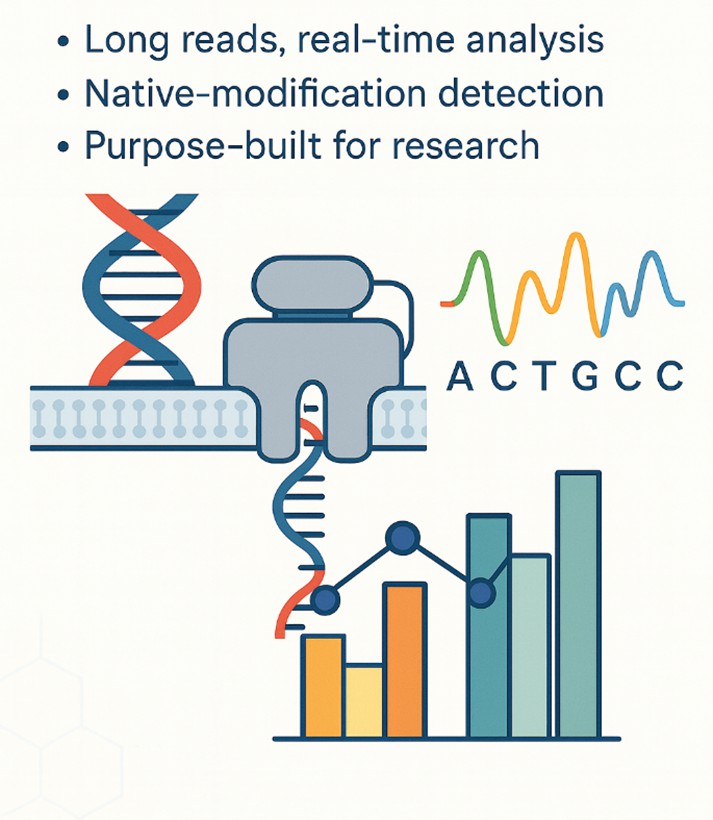
Nanopore sequencing passes a single DNA or RNA molecule through a protein nanopore embedded in an electrically resistant membrane. As each nucleotide transits the pore, it disrupts the ionic current in a sequence-specific manner. These current changes are recorded in real time and decoded into nucleotide sequences (A, T, C, G — or RNA bases) by a neural-network basecaller such as Dorado.

Unlike Illumina (sequencing-by-synthesis with cluster amplification) or PacBio (optical detection of fluorescently labeled nucleotides in zero-mode waveguides with circular consensus), Nanopore reads the native molecule directly. No amplification, no synthesis, and no optical measurement are involved. The raw signal carries not only base identity but also modification information (5mC, 6mA, and RNA modifications), which can be extracted bioinformatically without additional sample preparation.

Why it matters for your research:

  • Ultra-long reads (exceeding 1 Mb routinely, with record reads surpassing 2 Mb). Span telomeres, centromeres, segmental duplications, and large structural variants that cannot be resolved with short or mid-length read platforms.
  • Real-time data streaming. Sequencing results are generated as the molecule passes through the pore, enabling live yield monitoring, adaptive sampling (enrich or deplete target regions on-the-fly), and immediate run termination when sufficient data is collected.
  • Direct RNA and native modification detection. Sequence RNA molecules without reverse transcription or amplification bias. Detect DNA methylation (5mC, 6mA) from genomic reads and RNA modifications (m6A, pseudouridine, inosine) from direct RNA reads — all from the raw signal, with no bisulfite conversion or enrichment steps required.

When Ultra-Long Reads and Real-Time Matter

If your project requires reads longer than 20 kb — to span large structural variants, close genome gaps, or resolve full-length transcript isoforms — Oxford Nanopore is your best option. Nanopore holds the record for the longest sequencing reads ever produced (exceeding 2 Mb). It is also the only platform that streams data in real time — allowing you to stop a run as soon as you have enough coverage — and the only platform that sequences native RNA molecules directly, preserving modification information that cDNA-based methods lose.

Of course, raw nanopore reads trade some per-read accuracy for these capabilities (typically Q10–20 raw, improving with latest chemistry and Dorado basecallers). For projects requiring the highest per-read accuracy, consider PacBio HiFi; for the longest read spans, real-time monitoring, and direct RNA analysis, Nanopore has no equal.

Nanopore Sequencing Protocol


  • Infographic showing six steps of the Nanopore Sequencing Protocol with icons for Intake & QC, Library Prep, Flow Cell & Barcodes, Basecalling and Demux, Post-run QC, and Documentation.


    • Intake & QC: Qubit quant; A260/280 ~1.8–2.0, A260/230 ≥2.0. HMW gDNA for Ultra-Long; RNA RIN ≥8.
    • Library prep (by application): Standard WGS; Ultra-Long (gentle HMW handling); Amplicon; Targeted (Cas9 or adaptive sampling); Full-length cDNA/lncRNA; Direct RNA; Pore-C; TAIL Iso-Seq.
    • Flow cell & barcodes: Sized to yield/targets; balance barcoded inputs.
    • Sequencing & control: 1–72 h typical; live monitoring; stop/extend or reload as needed; enable adaptive sampling where supported.
    • Basecalling & demux: MinKNOW + Dorado → FASTQ; optional FAST5/POD5 for modification-aware reanalysis.
    • Post-run QC: yield/pass-fail; read-length N50/N90; Q-score distribution; mapping/coverage & on/off-target (if aligned).
    • Documentation & hand-off: protocol memo (kits/chemistry/software), QC report, scoped analysis outputs; optional review call.
Address: Billing Address:: 150, Patparganj Industrial Area, New Delhi – 110092
Email: info@n2jenomicslab.com
Phone: +91-8287121443
1 Total Visitors
Copyright © 2026 | All rights reserved N2 Jenomics | Developed by Him Soft Solution