Unlock Comprehensive CNV Insights with Cost-Effective Low-Pass WGS
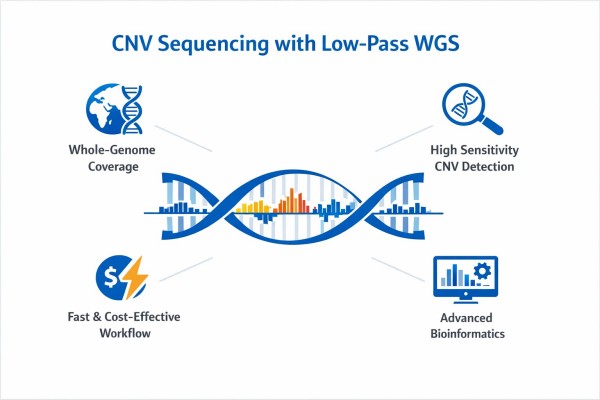
CD Genomics utilizes advanced low-pass Whole Genome Sequencing (WGS) to detect Copy Number Variations (CNVs) across the entire genome with superior sensitivity and specificity. Unlike traditional microarrays that are limited by probe coverage, our NGS-based approach provides a robust, scalable solution for detecting genome-wide structural variants. This service is optimized for research into prenatal diagnostics, reproductive health, genetic disorders, and oncology, delivering reliable data faster and more affordably than standard deep sequencing.
What You'll Receive:
Table of Contents
Copy Number Variation (CNV) is a prevalent form of structural variation in the human genome, involving duplications or deletions of DNA segments ranging from thousands to millions of base pairs. CNVs are critical biomarkers strongly linked to developmental delays, autism spectrum disorder (ASD), congenital malformations, and various cancers. While large CNVs (>100 kb) are often associated with rare genetic disorders, smaller CNVs (<100 kb) play a significant role in population diversity and complex disease susceptibility.
Our CNV Sequencing service leverages Low-Pass Whole Genome Sequencing (WGS). By sequencing the genome at a coverage depth typically between 0.1x and 5x, we obtain a representative fraction of the genome sufficient for structural analysis. Advanced computational algorithms analyze read depth across genomic "bins" to identify regions with statistically significant deviations—indicating duplications (high depth) or deletions (low depth). This method offers a streamlined, genome-wide alternative to targeted approaches.

Copy number variation between two human individuals . (Chao Xie ,et al., 2009)
While Chromosomal Microarray Analysis (CMA) has historically been the standard for CNV detection, it is limited by fixed probe design and lower throughput. Low-Pass WGS has emerged as the superior alternative, offering higher resolution and unbiased genome-wide coverage at a comparable or lower cost.
| Feature | Low-Pass WGS (CNV-Seq) |
|---|---|
| Coverage | Genome-wide (Unbiased) |
| Resolution | High (Detects >50-100 kb reliably) |
| Sensitivity | High (Fewer false negatives) |
| Cost | Low (Decreasing with NGS scale) |
| Novel Variants | Yes (Detects unknown variants) |

Comparison of aCGH and CNV-seq for Detecting Copy Number Variations. (Chao Xie ,et al., 2009)
CNV Sequencing is a powerful tool in medical research and diagnostics with applications including:

CD Genomics follows a rigorous Quality Control (QC) pipeline to ensure data integrity.
1
Sample QC: Purity and concentration verification.
2
Library Prep: Fragmentation and indexing.
3
Sequencing: High-throughput Illumina sequencing (PE150).
4
Bioinformatics: Data filtering, mapping, and variant calling.

Overview of the workflow for CNV sequencing services.
CD Genomics offers comprehensive and flexible bioinformatics analysis services, from basic data processing to advanced custom analyses. Our solutions help you deeply explore genomic variations and functions.
For custom bioinformatics analysis or specific research needs, please reach out to our experts. We provide professional advice and support tailored to your project.

Pipeline for bioinformatics analysis in whole genome sequencing and CNV detection.
| Sample Type | DNA Requirement |
| Genomic DNA | ≥500 ng,10 ng/μL |
| Whole Blood | 2 mL (EDTA tube, fresh); 4 mL (EDTA tube, frozen) |
| Fresh Frozen Tissue | ≥10 mg |
| Cells | ≥1 × 10⁶ cells |
From high-sensitivity detection to clinically actionable insights, CD Genomics delivers precise, end-to-end CNV sequencing solutions powered by optimized low-pass WGS and advanced bioinformatics. Whether you're investigating neurodevelopmental disorders or profiling cancer genomics, our team ensures reliable, publication-ready data with dedicated scientific consultation.

References:
Partial results are shown below:

Partial analysis output showing Copy Ratio (log2) variations across chromosomes.
1. How does CNV-seq detect copy number variations in genomes using next-generation sequencing technologies?
CNV-seq detects CNVs using next-generation sequencing (NGS) through the following steps:
a. DNA Fragmentation: The genome is fragmented into smaller pieces, and short DNA reads are generated through high-throughput sequencing technologies.
b. Read Mapping: The generated reads are aligned to a reference genome and read depth (coverage) at each genomic position is calculated.
c. Sliding Window Analysis: CNVs are identified by comparing the read depth in sliding windows across the genome. Variations in the number of reads in specific regions suggest the presence of deletions (lower coverage) or duplications (higher coverage).
d. Statistical Modeling: A statistical model assesses the significance of observed variations, adjusting for biases such as sequencing errors, and calculates the likelihood that these variations represent true CNVs rather than random fluctuations.
2. What are the limitations of using CNV-seq for detecting copy number variations?
a. Coverage-Dependent Sensitivity: The accuracy of CNV detection is dependent on sequencing depth. Low coverage can lead to false negatives, particularly for smaller CNVs.
b. Computational Complexity: CNV-seq involves complex bioinformatics pipelines for data analysis, which require significant computational resources and expertise in bioinformatics tools.
c. Potential for False Positives: Sequencing errors, mapping biases, and uneven coverage can lead to false positives, especially in regions with high repetitive sequences or low sequence complexity.
3. How can CNV-seq be used to identify genetic variations associated with complex diseases such as cancer and autism?
CNV-seq can be used to identify genetic variations linked to complex diseases in the following ways:
a. Cancer Genomics: CNV-seq is invaluable for identifying somatic CNVs in cancer genomes. These CNVs can reveal critical oncogenes and tumor suppressor genes involved in cancer development, metastasis, and response to treatment, providing essential information for targeted therapies and prognostic assessments.
b. Neurodevelopmental Disorders: CNV-seq helps detect CNVs that affect neurodevelopmental genes, which are often implicated in diseases such as autism, intellectual disability, and schizophrenia. Identifying these CNVs aids in understanding the genetic architecture of these disorders and facilitates early diagnosis.
c. Disease Pathogenesis: By comparing CNV profiles between healthy and diseased individuals, CNV-seq can identify genetic variations that contribute to disease susceptibility, progression, and response to treatments, making it a powerful tool for biomarker discovery.
d. Precision Medicine: CNV-seq enables the identification of CNVs that influence an individual's response to specific treatments, allowing for the development of personalized medicine strategies.

Source: Ghorbani Tajani A, Sharma A, Blouin N & Bisha B (2024). Genome sequence, antibiotic resistance genes, and plasmids in a monophasic variant of Salmonella typhimurium isolated from retail pork. Microbiology Resource Announcements. DOI: https://doi.org/10.1128/mra.00754-23
Antimicrobial resistance (AMR) in foodborne pathogens such as Salmonella typhimurium is a growing global public health concern. Accurate detection of resistance genes and mobile genetic elements like plasmids is critical for surveillance, outbreak tracking, and risk assessment in the food supply chain. In this case, researchers characterized a monophasic S. typhimurium isolate obtained from retail pork in Wyoming, USA, using high accuracy whole-genome sequencing.
This case study demonstrates how high-resolution whole-genome sequencing empowers detection of clinically relevant resistance genes and plasmids in foodborne pathogens, providing actionable genomic insights for surveillance and risk mitigation. Compared with traditional genetic profiling methods, CD Genomics' comprehensive WGS workflow delivers higher sensitivity, broader genomic coverage, and detailed structural variant detection, enabling researchers and regulatory labs to understand AMR mechanisms more clearly and make data-driven decisions.
Key Benefits Highlighted:
✔ Whole-genome resolution enables fine-scale detection of ARGs and plasmids.
✔ High-throughput sequencing ensures rapid turnaround time.
✔ our advanced bioinformatics supports confident annotation and interpretation of structural variation.