Isoform and Alternative Splicing Discovery
Home
> Isoform and Alternative Splicing Discovery
Isoform Discovery and Alternative Splicing Analysis Solution
soform diversity and alternative splicing can explain transcript-level patterns that gene-level RNA-seq may miss. CD Genomics provides an Isoform Discovery and Alternative Splicing Analysis Solution that connects full-length transcript sequencing, splicing event detection, isoform quantification, visualization, and custom bioinformatics into one research-focused workflow.
We help you move from gene expression signals to transcript-level evidence your team can review, compare, and interpret. This solution supports RNA biology, disease mechanism research, oncology studies, developmental biology, plant and animal transcriptomics, single-cell follow-up, and multi-omics projects.
When Gene-Level RNA-Seq Misses Transcript Complexity
Standard RNA-seq is a strong tool for measuring gene expression, but gene-level counts do not always show how a gene is being used. One gene can produce several transcript isoforms, and those isoforms may differ in exon structure, coding sequence, untranslated regions, regulatory elements, or biological function.
That is where isoform discovery and alternative splicing analysis can add value. In some projects, total gene expression looks unchanged, but transcript usage changes in ways that matter. One isoform may increase, another may decrease, or a splicing event may change how your team interprets a candidate gene or pathway.
These transcript-level changes can be important in studies of gene regulation, cell state, tissue specificity, treatment response, stress response, development, and complex phenotypes.
Short-read RNA-seq can support splice junction analysis and expression quantification, but short reads often cannot reconstruct full-length transcript structures with high confidence. Long-read transcript sequencing gives another layer of evidence by reading longer transcript molecules, which can help resolve transcript structures, novel isoforms, and complex splicing patterns.
For many research teams, the useful question is not only whether a gene is expressed. The more practical question is: which transcript isoforms are present, how are they spliced, and how does isoform usage change across the study design?
Our solution is built to answer that question through sequencing strategy review, RNA quality assessment, transcript-level bioinformatics, visualization, and report-ready deliverables.
What This Solution Helps You Discover
Our Isoform Discovery and Alternative Splicing Analysis Solution is designed for projects where gene-level expression does not give enough resolution.
Novel isoforms and transcript variants
Long-read transcript sequencing can help reveal transcript structures that are difficult to assemble from short reads alone. This can be useful when your project needs to identify novel isoforms, refine gene annotations, discover transcript variants, or study complex transcript architecture in a candidate gene or genome-wide dataset.
For non-model organisms, plants, animals, or species with incomplete annotations, isoform discovery can also improve transcriptome annotation and support downstream functional studies.
Alternative splicing events and splicing patterns
Alternative splicing can generate multiple transcript forms from the same gene. We can support detection and interpretation of major splicing event types.
Exon skipping
Intron retention
Alternative 5′ splice sites
Alternative 3′ splice sites
Mutually exclusive exons
Complex splicing patterns, when supported by the data
Differential isoform usage across conditions
A useful isoform project often needs more than a list of transcripts. You may need to know whether different groups use different transcript isoforms from the same gene.
We can support transcript-level quantification and differential isoform usage analysis when the study design and data support it.
Transcript-level clues for biomarkers, targets, and pathways
Isoform and splicing results become more valuable when they are connected to biological interpretation. Depending on your project, we can link transcript-level outputs with functional annotation, pathway enrichment, coding potential, gene families, candidate regions, fusion transcript review, or multi-omics interpretation.
Our Service Capabilities for Isoform and Splicing Projects
We do not treat isoform discovery as a single fixed sequencing service. The right plan depends on your RNA sample, species, research goal, study design, existing data, and the level of transcript detail you need.
Our team helps you combine sequencing and analysis modules into a workflow that fits your research question.
Full-length transcript discovery with long-read sequencing
When full-length transcript structure is central to your project, long-read transcript sequencing can provide direct evidence across transcript isoforms. We can support projects that use Full-Length Transcripts Sequencing (Iso-Seq) or Nanopore Full-Length Transcripts Sequencing to resolve transcript structures, novel isoforms, alternative splicing patterns, and transcript annotation.
For projects involving native RNA features or poly(A)-related questions, Nanopore Direct RNA Sequencing, polyA Sequencing, or TAIL Iso-seq-related strategies may be considered when appropriate.
Short-read RNA-seq and hybrid transcriptome support
Short-read RNA-Seq, mRNA Sequencing, and Total RNA Sequencing remain valuable for expression profiling, splice junction support, and group-level quantification.
In many projects, a hybrid strategy is practical. Long reads can help define transcript structures, while short reads can strengthen quantification across larger sample sets.
Alternative splicing and isoform-level bioinformatics
Single-cell, spatial, and multi-omics optional integration
When cell context matters, isoform interpretation may need to connect with Single-cell RNA Sequencing, single-cell isoform analysis, spatial transcriptomics, or Multi-Omics Analysis. These options can help when bulk transcriptome data does not explain cell-type-specific isoform usage or tissue-region differences.
We can prepare outputs that help your team review and communicate transcript-level results, including isoform structure diagrams, splicing event tables, differential isoform usage summaries, sashimi-style plots, genome browser tracks, expression matrices, annotation tables, and project reports.
The goal is to give your team organized results that are easier to interpret, reuse, and discuss.
Technology Strategy: Short-Read, Long-Read, Single-Cell, or Hybrid?
No single transcriptomics method is best for every isoform or splicing project. The right strategy depends on the question you need to answer: gene expression, transcript structure, native RNA features, cell-type-specific isoform usage, or downstream interpretation.
A 2024 Nature Communications benchmark, Comprehensive assessment of mRNA isoform detection methods for long-read sequencing data, evaluated 13 methods from 9 tools for long-read isoform detection. The study showed that isoform detection performance can vary with read depth, transcriptome complexity, read completeness, sequencing error, annotation completeness, and software choice.
That evidence supports an important point for project planning: isoform discovery is not only a sequencing decision. It is a full workflow decision.
Good fit when read length and flexible long-read transcript evidence matter
Nanopore Direct RNA Sequencing
Native RNA analysis and transcript-level evidence without cDNA conversion
Useful for native transcript reads
Can support isoform and RNA feature questions
Project-dependent
Sensitive to RNA integrity and input quality
Direct RNA-aware processing and interpretation
Useful when native RNA features, poly(A)-related questions, or amplification-free evidence are important
Single-cell isoform analysis
Cell-type-specific isoform usage and heterogeneity
Useful when transcript diversity depends on cell state
Can reveal cell-context splicing patterns
More complex and study-design dependent
Sample handling and cell quality are critical
Single-cell-aware transcript and isoform analysis
Best when bulk data hides cell-type-specific transcript patterns
Hybrid strategy
Long-read isoform discovery plus short-read quantification
Strong when long reads define structures and short reads support quantification
Useful for discovery plus group-level comparison
Strong when existing RNA-seq data can be reused
Depends on both data types
Data integration, transcript model refinement, quantification, differential usage
Useful when the project needs both transcript structure and group-level confidence
How we help select the strategy
Before recommending a workflow, we review your research goal, RNA sample condition, species and annotation status, existing data, and deliverable needs. This review helps us build a strategy that fits the project instead of forcing every project into the same sequencing workflow.
End-to-End Workflow with RNA QC Checkpoints
From RNA sample review to transcript-level discovery and final report delivery
We start by reviewing your species, sample type, number of samples, experimental groups, RNA source, reference genome status, and main research question. At this stage, we clarify whether the project is focused on novel isoform discovery, alternative splicing event detection, transcript annotation, differential isoform usage, single-cell follow-up, or integration with existing RNA-seq data.
RNA quality is reviewed before library construction. For full-length transcript discovery, RNA integrity is especially important because degraded RNA can reduce the ability to reconstruct complete transcript structures. If the sample type or RNA quality does not match the planned workflow, we review possible adjustments before moving forward.
Depending on the strategy, samples move into short-read RNA-seq, long-read transcript sequencing, direct RNA sequencing, single-cell analysis, or a hybrid workflow. Reads are processed, filtered, aligned or mapped, and used for transcript reconstruction when appropriate.
Known and novel isoforms are classified and annotated. Alternative splicing events are detected when supported by the data. Isoform-level quantification and differential isoform usage analysis can be added when the study design includes suitable groups or conditions.
You receive output files and a project report that summarize the workflow, QC results, analysis logic, and key output types. When included in the project scope, we can prepare isoform diagrams, sashimi-style plots, heatmaps, genome browser tracks, and figure-ready summaries.
Sample Requirements and Project Intake Information
Sample quality has a direct effect on isoform discovery and alternative splicing analysis. RNA integrity is especially important for long-read transcript workflows because incomplete or degraded RNA can affect transcript reconstruction.
Final sample requirements depend on species, sample type, RNA quality, platform, and project goal. Before project confirmation, our team reviews the information below and recommends the most suitable workflow.
Sample or input type
What we review
Quality focus
Typical QC checkpoints
Notes
Total RNA or poly(A)+ RNA
RNA source, extraction method, concentration, purity, integrity, sample history
Suitability for RNA extraction and downstream sequencing
Sample inspection, extraction feasibility review, RNA QC after extraction
Extraction support may be considered when direct RNA submission is not available
Bioinformatics Analysis and Deliverables
The main value of this solution is not only sequencing. The value comes from turning transcript evidence into organized, reusable, and interpretable results.
We focus on outputs your team can actually use: transcript models, event tables, expression matrices, annotation files, visualization tracks, and reports that explain what was done.
Minimum deliverables
Raw data QC summary
Read length and read quality distribution
Transcript reconstruction results
Full-length isoform catalog
Known and novel isoform classification
Alternative splicing event table
Isoform-level expression matrix
Optional add-ons
Differential splicing analysis
Fusion transcript detection
Alternative polyadenylation analysis
Coding potential prediction
Functional annotation and enrichment
Single-cell isoform analysis
Multi-omics integration
Output file types
FASTQ, BAM, or CRAM files where applicable
GTF or GFF transcript annotation files
FASTA transcript sequences
TSV or CSV isoform and splicing event tables
Isoform expression matrix
Genome browser tracks
PDF or HTML-style project report
How to Choose the Right Isoform and Splicing Discovery Strategy
A strong strategy starts with the transcriptomics question. We help you decide what evidence layer and analysis depth are needed before moving into project execution.
Choose long-read-first when transcript structure is central
A long-read-first strategy is often appropriate when your project focuses on full-length transcript models, novel isoforms, complex splicing patterns, fusion transcript review, or annotation refinement.
Choose short-read support when expression depth matters
Short-read RNA-seq remains useful when your project needs strong group-level expression profiling, broad sample coverage, or quantification support. It can also support hybrid analysis when long reads define transcript structures and short reads strengthen expression comparison.
Add single-cell or spatial analysis when cell context matters
If isoform usage may differ by cell type, cell state, or tissue region, single-cell or spatial transcriptomics can add context that bulk data may miss.
Add custom bioinformatics when interpretation is the real challenge
A transcript model file or splicing event table may not answer your research question by itself. Custom bioinformatics can help connect isoforms and splicing events to genes, pathways, candidate mechanisms, group differences, or visualization-ready summaries.
Demo Results
Demo results help your team understand what final analysis outputs may look like before starting the project. These examples show result types, not fixed biological conclusions.
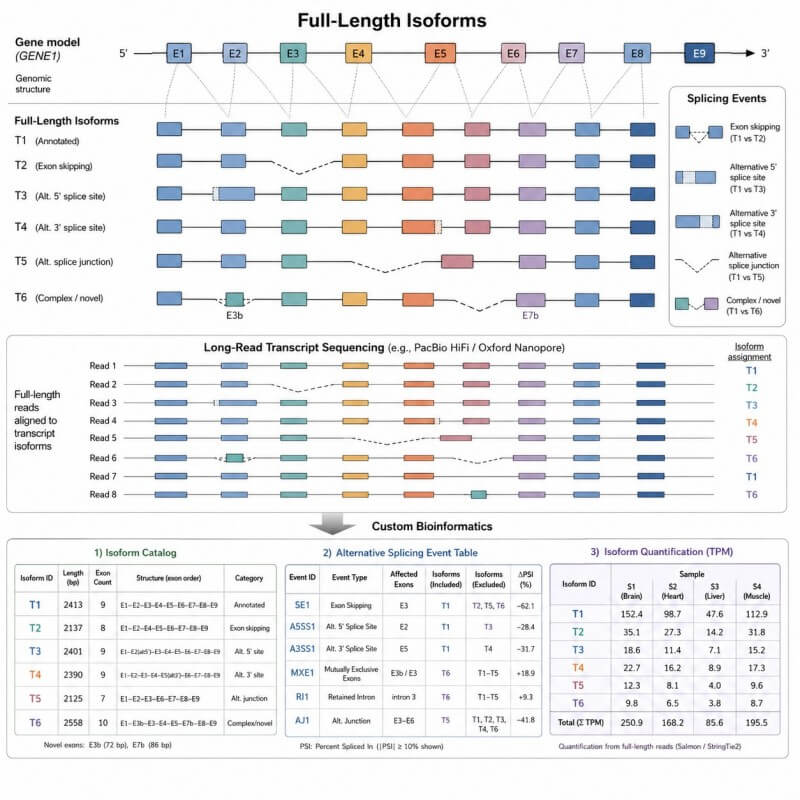
Full-length isoform structure view
This output shows transcript models for known and novel isoforms from the same gene, including exon-intron structure, transcript length, coding regions, untranslated regions, and annotation status.
Alternative splicing event visualization
This output shows splicing event patterns, such as exon skipping, intron retention, alternative splice sites, or mutually exclusive exons.
Differential isoform usage and interpretation view
This output compares transcript usage across groups and links isoform patterns with candidate genes, pathways, or functional annotations.
FAQ
1. What is isoform discovery and alternative splicing analysis?
Isoform discovery identifies full-length transcript structures and novel transcript variants. Alternative splicing analysis detects how exons and introns are included, skipped, or rearranged across transcript forms. Together, they help explain transcript diversity beyond gene-level expression.
2. When is short-read RNA-seq not enough for transcriptomics?
Short-read RNA-seq may not be enough when the main question depends on full-length transcript structure, novel isoforms, complex splicing, transcript switching, or isoform-level interpretation. In those cases, long-read or hybrid strategies may provide better transcript structure evidence.
3. What is the difference between isoform discovery and alternative splicing event detection?
Isoform discovery reconstructs transcript models and identifies known or novel transcript isoforms. Alternative splicing event detection focuses on specific splicing patterns, such as exon skipping, intron retention, or alternative splice sites.
4. How do PacBio Iso-Seq and Nanopore full-length transcript sequencing differ?
PacBio Iso-Seq is often used for high-confidence full-length cDNA isoform discovery. Nanopore full-length transcript sequencing provides long-read transcript evidence and flexible workflow options. The best choice depends on RNA quality, research goal, sample number, transcript complexity, and downstream analysis needs.
5. When should I consider Nanopore Direct RNA Sequencing?
Nanopore Direct RNA Sequencing may be useful when native RNA evidence, amplification-free sequencing, poly(A)-related questions, or RNA feature analysis matters to the project. It should be selected based on sample quality and research goals.
6. Can this solution work for non-model organisms or plant and animal samples?
Yes. Many non-model organism, plant, and animal transcriptome projects can benefit from isoform discovery and annotation refinement. Workflow design depends on RNA quality, reference genome status, annotation completeness, and sample type.
7. What RNA sample information is needed before recommending a workflow?
We usually need species, sample type, extraction method, RNA quality information, number of samples, experimental groups, reference genome status, existing sequencing data, and the main research question.
8. What deliverables can I expect from isoform and splicing analysis?
Deliverables may include QC summaries, transcript reconstruction results, full-length isoform catalogs, novel isoform tables, alternative splicing event tables, isoform expression matrices, differential isoform usage results, annotation files, genome browser tracks, and a project report.
9. Can isoform results be integrated with existing RNA-seq or single-cell data?
Yes. Existing RNA-seq data can support quantification and group comparison. Single-cell or spatial data can help interpret cell-type-specific or tissue-region-specific isoform usage when the study design supports integration.
10. Do you provide visualization-ready outputs such as sashimi plots or genome browser tracks?
Yes. We can prepare isoform structure diagrams, sashimi-style plots, transcript usage heatmaps, genome browser tracks, and figure-ready summaries when these outputs are included in the analysis plan.
11. How should I choose between sequencing-only and a full discovery solution?
Sequencing-only may be enough if your team already has a validated transcript-level analysis pipeline. A full discovery solution is more useful when you need help with platform selection, RNA QC, transcript reconstruction, splicing analysis, isoform quantification, annotation, visualization, and interpretation-ready reporting.