Get Your Quote
PacBio SMRT Sequencing Home  > PacBio SMRT Sequencing
PacBio SMRT Sequencing Services — Long-Read Accuracy Without Compromise

The only long-read platform that delivers both single-molecule resolution and QV ≥30 accuracy. CD Genomics' PacBio HiFi sequencing service gives you complete genomes, full-length isoforms, and genome-wide 5mC methylation — all from one run.

What makes HiFi different:

  • Every read is a consensus — each molecule sequenced 3+ times for QV ≥30 accuracy
  • One run, two data types — variants AND methylation, no extra prep
  • True full-length isoforms — TSS to polyA tail in a single read, not an assembly guess
PacBio SMRT Sequencing Services — Long-Read Accuracy Without Compromise

Why PacBio HiFi — Accuracy That Short Reads and Other Long Reads Can't Match

If you work with Illumina data, you know the trade-off: high per-base accuracy, but reads too short to span repeats or resolve isoforms. If you've explored nanopore sequencing, you've gained length — but at the cost of raw accuracy. PacBio HiFi is the only platform that eliminates this compromise.

What happens inside a ZMW

PacBio Single Molecule, Real-Time (SMRT) sequencing takes place inside Zero-Mode Waveguides — nanoscale observation chambers where a single DNA polymerase incorporates fluorescent nucleotides one at a time. Unlike nanopore sequencing (which infers bases from ionic current) or Illumina (which builds reads from clusters of identical fragments), SMRT watches a single molecule in real time.

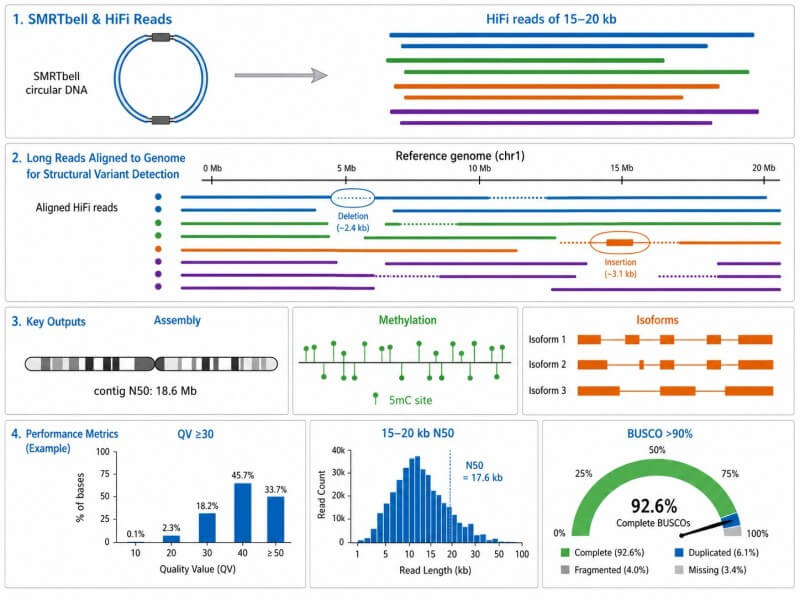
The HiFi difference: SMRTbell adapters circularize each DNA molecule. The polymerase then reads around the circle multiple times. These multiple passes are combined into one HiFi consensus read — giving you both the length of a long read and the accuracy of multiple independent observations.

PacBio HiFi sequencing: ZMW, circular consensus, and kinetic methylation detection

PacBio SMRTbell → ZMW → circular consensus → HiFi read with QV ≥30

Three capabilities you get from one SMRT Cell

  • QV ≥30 long reads (~15–20 kb) — accurate enough for variant calling, long enough for assembly and phasing.
  • Simultaneous 5mC methylation — polymerase kinetics reveal modified bases during the same run. No bisulfite. No separate library.
  • Full-length isoforms without assembly — Iso-Seq/Kinnex captures each transcript from transcription start site to polyA tail as a single read. The isoform is measured, not reconstructed.

Where HiFi beats the alternatives

  • vs Illumina short reads: Spans repeats, SVs, and full isoforms. Assembles complete genomes instead of fragmented contigs.
  • vs Nanopore long reads: Single-molecule QV ≥30 accuracy with no polishing. Methylation detection built in, not retrofitted.
  • vs running multiple experiments: One SMRT Cell gives you variants + methylation + isoforms. No parallel workflows to coordinate.

Our PacBio SMRT Sequencing Services

Every service below runs on the same HiFi platform — same accuracy, same methylation capability, same data quality.

PacBio SMRT service categories

1

Whole Genome de novo Sequencing

Reference-free genome assembly for microbial, plant, animal, and human genomes. HiFi reads span repeats and deliver contiguous assemblies with BUSCO completeness >90%.

Best for: Novel organism sequencing, pan-genome projects, T2T finishing.

2

Human Whole Genome Sequencing

HiFi-based human WGS for comprehensive variant detection — SNVs, indels, SVs, and phased haplotypes from one dataset.

Best for: Rare disease, SV discovery, pharmacogenomics, population studies.

3

Plant/Animal Whole Genome de novo

Multi-platform assemblies (HiFi + Hi-C + RNA-seq) for complex genomes including polyploids and large repetitive genomes.

Best for: Large genomes, polyploid species, agri-genomics, evolutionary biology.

4

Telomere-to-Telomere (T2T) Sequencing

Gap-free chromosome-scale assemblies using HiFi + ultra-long ONT reads. Captures centromeres, telomeres, and segmental duplications.

Best for: Reference-grade genomes, centromere biology, complete assembly finishing.

5

Full-Length Transcript Sequencing (Iso-Seq / Kinnex)

Complete isoform catalogs from TSS to polyA. Resolve splice variants, fusion genes, and APA — without short-read assembly ambiguity.

Best for: Isoform discovery, alternative splicing, fusion detection, transcript annotation.

6

Full-Length 16S/18S/ITS Amplicon Sequencing

Species-level taxonomic resolution with full-length rRNA gene amplicons. Accurate to the strain level where short amplicons stop at genus.

Best for: Microbial ecology, environmental samples, strain-level identification.

7

Long-Read Metagenomic Sequencing

HiFi metagenomics for MAG recovery, functional annotation, and strain-level community profiling. PacBio or Nanopore methods available.

Best for: Complex communities, MAG binning, functional gene discovery.

8

CiFi Sequencing  |  Pre-Made Library Sequencing  |  Long Amplicon Analysis (LAA)

Specialized workflows: CiFi for phased variant analysis, Pre-Made Library for customer-prepared SMRTbell libraries, LAA for targeted haplotype resolution.


Where PacBio HiFi Adds the Most Value

Below are the research areas where HiFi long reads solve problems that short reads or lower-accuracy long reads cannot. Each application maps to the right PacBio service.

De novo genome assembly & finishing

Span repeats and complex regions to produce complete, contiguous assemblies. Combine HiFi with Hi-C for chromosome-scale scaffolds.

Recommended services: De novo WGS, T2T Sequencing, Plant/Animal WGS.

Structural variant & rearrangement detection

Identify large insertions, deletions, inversions, and translocations with breakpoint-level resolution.

Recommended services: Human WGS, De novo WGS.

Haplotype phasing & allele-specific analysis

Long HiFi reads preserve linkage across distant variants — generate haplotype-resolved assemblies and variant calls.

Recommended services: Human WGS, CiFi Sequencing, LAA.

Full-length transcriptomics (isoforms & fusions)

Capture complete isoform catalogs from TSS to polyA tail — no computational assembly guesswork.

Recommended services: Iso-Seq/Kinnex Full-Length Transcript Sequencing.

DNA methylation (5mC) — simultaneous with sequencing

Genome-wide 5mC profiles from SMRT kinetics — no bisulfite conversion. One run = variants + methylation.

Recommended services: Any WGS service (methylation extracted from standard HiFi data).

Microbiome & metagenomics

Full-length 16S/18S/ITS for species-level taxonomy. HiFi metagenomics for MAG recovery and functional profiling.

Recommended services: Full-Length Amplicon, Long-Read Metagenomics.

Targeted sequencing & validation

Deep coverage of specific loci for variant phasing, repeat expansion analysis, and allele-specific characterization.

Recommended services: LAA, CiFi Sequencing, Pre-Made Library.

Pan-genome & population genomics

Build comprehensive pan-genome references with HiFi assemblies capturing SVs across populations.

Recommended services: De novo WGS, T2T Sequencing, Plant/Animal WGS.


What You'll Receive — Data Built for Publication

Every project ships with the raw data, processed results, and documentation you need to move straight to analysis — and straight into your manuscript.

Data CategoryWhat You GetWhy It Matters
HiFi ReadsFASTQ/BAM, QV ≥30, per-read QC tagsReady for assembly, alignment, or variant calling — no polishing step needed
Subreads (BAM)Raw polymerase reads with kinetic informationEnables methylation re-analysis and custom CCS parameter tuning
QC ReportYield, read-length N50, Q-score distribution, CCS passes, barcode balanceTransparent evidence that your run met agreed-upon targets
AssemblyFASTA/GFA, N50/NG50, BUSCO completenessPublication-ready genome with statistics reviewers expect
VariantsVCF with SNV/indel/SV, phased where applicablePhased variants from long reads — no statistical imputation needed
MethylationbedMethyl/TSV, DMR summaries, genome-wide tracks5mC calls from the same run as your variants — zero extra prep
IsoformsGTF/GFF3 isoform catalog, expression tables, fusion listComplete isoform models, each supported by full-length reads
Project MemoProtocol, kit/chemistry details, software versions, run parametersEverything a reviewer needs to evaluate your methods section

How Your Project Runs — The PacBio SMRT Workflow

  • Sample Intake & QC: Qubit + spectrophotometry. gDNA: A260/280 1.8–2.0, ≥30 kb modal length. RNA: RIN ≥8 for Iso-Seq.
  • SMRTbell Library Prep: Adapter ligation, size selection per application. Kinnex concatenation for multiplexed Iso-Seq. Barcoded adapters for sample pooling.
  • SMRT Cell Sequencing: Sequel II/IIe or Revio systems. Run times 10–30 hours depending on target yield and SMRT Cell type (8M or 25M).
  • CCS → HiFi Generation: Subreads from each ZMW are processed through the CCS algorithm. HiFi reads require ≥3 full passes and meet QV ≥30 threshold.
  • Analysis & QC: Assembly, variant calling, methylation detection, or isoform analysis per your selected service. Post-analysis QC with mapping rate and coverage metrics.
  • Delivery: Structured data folders, full project memo, QC report, and optional results walkthrough with our bioinformatics team.
PacBio SMRT sequencing workflow overview

Sample Requirements

ServiceAmount & IntegrityPurityShippingNotes
WGS (Microbial)≥1 μg gDNA, ≥30 kbA260/280 1.8–2.0−20 °C
WGS (Plant/Animal)≥3–5 μg HMW gDNA, ≥30 kbA260/280 1.8–2.0; A260/230 ≥2.0−20 °CWide-bore tips, no vortexing
WGS (Human)≥1–3 μg gDNA, ≥30 kbA260/280 1.8–2.0−20 °C
T2T Genome≥3–5 μg HMW gDNA, ≥50 kbA260/280 1.8–2.0−20 °CMinimize all shearing
Iso-Seq / Kinnex≥500 ng–1 μg total RNA, RIN ≥8A260/280 ~2.0; A260/230 ≥2.0−80 °C (dry ice)DNase if needed
16S/18S/ITS Amplicon≥50–200 ng pooled ampliconsNo primer dimers4 °CProvide primer info
Metagenomics≥500 ng–1 μg gDNAA260/280 1.8–2.0−20 °CNote host depletion
CiFi / LAA≥1–2 μg HMW gDNA / ≥100 ng ampliconsPer application−20 °C / 4 °CProvide target regions
Pre-Made Library≥50 ng SMRTbell libraryQC report required−20 °CWe QC on arrival
  • General: Avoid phenol, heparin, EDTA, polysaccharides. Minimize freeze-thaw. Contact us for FFPE or low-input samples.

Demo Results

PacBio HiFi read Q-score distribution showing median QV ≥30

HiFi Read Q-Score Distribution — median QV ≥30 across all passes

PacBio HiFi read length distribution with N50 ~15–20 kb

HiFi Read Length Distribution — N50 typically 15–20 kb per SMRT Cell

Genome assembly metrics: N50, NG50, BUSCO completeness

De Novo Assembly Metrics — contig N50, scaffold N50, and BUSCO completeness

PacBio SMRT Sequencing FAQ

1. What makes PacBio HiFi different from other long-read sequencing?

HiFi is the only long-read technology that delivers single-molecule QV ≥30 accuracy. It achieves this through circular consensus sequencing — each molecule is read multiple times and the passes are combined. By contrast, nanopore raw reads have lower per-base accuracy and typically require consensus or polishing steps. HiFi also detects 5mC methylation from polymerase kinetics in the same run, with no additional chemistry required.

2. How does HiFi accuracy compare to Illumina?

HiFi reads match Illumina's per-base accuracy (≥99.9%) while being 50–100× longer. This means you can call SNVs with the same confidence as short reads — but also detect structural variants, phase haplotypes, and assemble genomes without gaps. HiFi is not a trade-off between accuracy and length; it gives you both.

3. Can I detect methylation from my PacBio run?

Yes — and you don't need to do anything extra. PacBio polymerases slow down at methylated bases, producing kinetic signatures that the basecaller interprets as 5mC calls. These calls are generated during standard CCS analysis. No bisulfite conversion, no separate library, no parallel sequencing run. You get variants and methylation from one SMRT Cell.

4. What is Iso-Seq and when should I use it instead of short-read RNA-seq?

Iso-Seq (now also available as Kinnex for higher throughput) sequences full-length cDNA molecules from transcription start site to polyA tail in single reads. Use it when you need to identify complete isoform structures, detect fusion transcripts, or quantify isoform usage — tasks where short-read RNA-seq guesses at isoform assembly. Kinnex concatenates multiple transcripts per read, increasing throughput per SMRT Cell ~5-fold.

5. How much DNA do I need?

Standard WGS: ≥1–5 μg HMW gDNA at ≥30 kb modal length. T2T projects: ≥3–5 μg at ≥50 kb. Iso-Seq: ≥500 ng–1 μg total RNA at RIN ≥8. Lower inputs may be possible — contact us with your sample constraints.

6. How long does a project take?

Project timelines depend on library preparation, sequencing configuration, and bioinformatics scope. We provide a detailed timeline during project consultation based on your specific requirements.

7. What instruments do you use?

PacBio Sequel II/IIe and Revio systems, SMRT Cell 8M and 25M formats. All runs are monitored by experienced technicians with SOP-driven QC gates.

8. Can I send my own SMRTbell libraries?

Yes. Our Pre-Made Library Sequencing service accepts customer-prepared libraries. We QC on arrival, load onto the appropriate SMRT Cell, and deliver CCS data plus optional bioinformatics.

9. How is this different from the PacBio services I can get elsewhere?

Three differences: (1) We optimize each SMRT Cell for multiple data types — you get variants AND methylation AND assembly metrics from the same run. (2) Every project includes a publication-ready QC report with metrics reviewers expect. (3) We provide cross-platform guidance — if a hybrid HiFi + ONT or HiFi + Illumina design would serve your question better, we'll recommend it.

Case Study — Isoform-Resolution Analysis of Nonsense-Mediated mRNA Decay

Published Research

Uncovering the isoform-resolution kinetic landscape of nonsense-mediated mRNA decay with EZbakR

Methods: PacBio Iso-Seq  |  Published: 2025  |  PMC11952489

Background

Nonsense-mediated mRNA decay (NMD) is a quality-control pathway that eliminates mRNAs with premature termination codons. While bulk-level NMD targets are known, isoform-level NMD dynamics — which specific splice variants are targeted and how rapidly they decay — remain poorly understood because short-read RNA-seq cannot resolve full-length isoforms.

Materials & Methods

Experimental Design

  • Metabolic labeling (EZbakR)
  • Time-course sampling
  • Biological replicates

Sequencing

  • PacBio Iso-Seq
  • Full-length cDNA
  • Kinnex concatenation

Analysis

  • Isoform discovery
  • Kinetic modeling
  • Differential decay rates

Results

  1. Isoform-specific NMD targeting
    • A single gene produces both NMD-sensitive and NMD-resistant isoforms depending on alternative splicing.
    • Isoform-resolution kinetic modeling revealed a hierarchy of decay rates invisible to bulk RNA-seq methods.
  2. Kinetic landscape of NMD

    Kinetic landscape of isoform-resolution NMD decay rates
  3. Transcript-specific decay rate quantification
    • EZbakR + Iso-Seq enabled direct measurement of isoform half-lives.
    • Identified NMD escape mechanisms at the isoform level that cannot be detected by gene-level analysis.
Isoform-specific NMD targeting and decay kinetics

Conclusion

This study demonstrates that PacBio full-length Iso-Seq enables isoform-resolution kinetic studies impossible with short-read RNA-seq. For researchers studying alternative splicing, post-transcriptional regulation, or isoform-level gene expression, Iso-Seq provides the molecular resolution to ask mechanistic questions — and get answers at the level of individual transcript isoforms.

Related Publications

Here are publications from researchers who have used our PacBio SMRT sequencing services or related platforms:

The first high-quality genome assembly and annotation of Lantana camara, an important ornamental plant and a major invasive species

Journal: Horticulture Advances

Year: 2024

DOI: 10.1007/s44281-024-00043-6

Complete Genome Sequence of the Lignocellulose-Degrading Actinomycete Streptomyces albus CAS922

Journal: Microbiology Resource Announcements

Year: 2020

DOI: 10.1128/mra.00227-20

A chromosome-scale and haplotype-resolved genome assembly of tetraploid blackberry (Rubus L. subgenus Rubus)

Journal: Horticulture Research

Year: 2025

DOI: 10.1093/hr/uhaf052

See more articles published by our clients.

Address: Billing Address:: 150, Patparganj Industrial Area, New Delhi – 110092
Email: info@n2jenomicslab.com
Phone: +91-8287121443
1 Total Visitors
Copyright © 2026 | All rights reserved N2 Jenomics | Developed by Him Soft Solution