Get Your Quote
ddRAD-seq Home  > ddRAD-seq

With CD Genomics' extensive proficiency in next-generation sequencing (NGS), we are now pleased to offer Double Digest Restriction-site Associated DNA (ddRADseq) services for comprehensive genome-wide SNP discovery, even in the absence of prior genomic sequence information. ddRADseq facilitates the sequencing of genome-scale data from non-model species, enabling cost-effective development of extensive datasets that encompass broad taxonomic and geographic sampling.

What is ddRAD Sequencing

ddRADseq has gained considerable popularity among molecular ecologists for the development of novel SNP markers utilizing NGS platforms. This method leverages the cut-site specificity of restriction endonuclease enzymes to generate library fragments from distinct genomic regions that are conserved across individuals of the same species. This conservation enables the sequencing and comparative analysis of identical genomic regions across different individuals. Consequently, ddRADseq facilitates the rapid and efficient development of a substantial number of genetic markers.

What is the Principle of ddRAD Sequencing

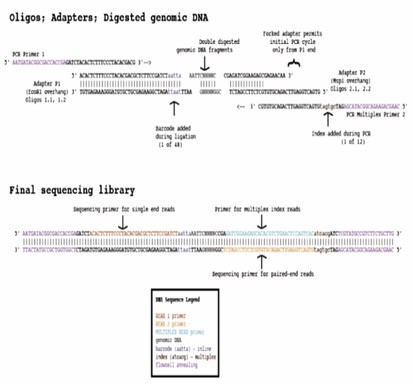
ddRADseq is an enhanced variation of the traditional RAD sequencing protocol, specifically designed for SNP discovery and genotyping. Instead of fragment shearing, ddRAD-seq incorporates a secondary restriction digestion, thereby enhancing both the tunability and accuracy of the size-selection step. In brief, the process begins with the digestion of genomic DNA using a restriction enzyme, followed by the ligation of a barcoded P1 adaptor to the resulting fragments. These adaptor-ligated fragments from various samples are subsequently pooled, and a second restriction enzyme is applied for further digestion. The digested fragments are then subjected to size-selection and purification. Thereafter, P2 primers are ligated, and the fragments are amplified. Ultimately, sequence data are analyzed to assess and score genetic variations within the samples of interest.

ddRAD-seq Library Construction Diagram.

What are the Advantages of ddRAD Sequencing Service

  • Reusability of Samples: Multiple samples can be reused, maximizing resource efficiency.
  • Efficient Workflow: The library preparation process is simpler and faster, streamlining the overall experimental procedure.
  • Consistent Fragment Length: Ensures uniform fragment lengths across samples at identical digestion sites, improving accuracy.
  • SNP Density Flexibility: Offers flexibility in SNP density, allowing customization based on specific research needs.
  • High Sequence Coverage: Achieves high sequence coverage, enhancing data reliability.
  • Cost-Effectiveness: Lowers experimental costs while maintaining robust data output.
  • No Reference Genome Required: Enables SNP discovery without the need for a reference genome.
  • Advanced Multi-Technology Platform: Provides dependable data results, meeting both reliability and cost-efficiency requirements.
  • Technical Support: Comprehensive support services cater to all project needs, ensuring customer satisfaction.
  • Streamlined Experimental Process: Simplifies the experimental process and ensures rapid turnaround. Multi-locus projects can be conducted in multiplexed assays with typing completed in a single tube.
  • Real-Time Project Updates: Offers real-time project progress updates, allowing customers to track each step clearly.
  • Customized Protocols: Flexibility to tailor experimental protocols to project-specific needs, with expert customization for optimal results.

Applications of ddRAD Sequencing

  • Population Genetics
  • Genome-Wide Association Studies (GWAS)
  • Conservation Biology
  • Evolutionary Biology
  • Genomic Mapping
  • Breeding Programs

ddRAD Sequencing Workflow

The workflow of ddRAD Sequencing at CD Genomics involves several key steps:

The Workflow of ddRAD-seq.

Service Specifications

Sample Requirements

Sample Requirements

  • Genomic DNA≥300 ng, Minimum Quantity: 100 ng, concentration≥10 ng/µL
  • DNA samples require an OD260/280 as close to 1.8~2.0 as possible.
  • All DNA should be RNase-treated and should show no degradation or contamination.

Note: Sample amounts are listed for reference only. For detailed information, please contact us with your customized requests.


Click

Sequencing Strategy

  • Illumina Hiseq, PE150
  • Sequencing Depth: at least 1x (assembly samples at least 5x)

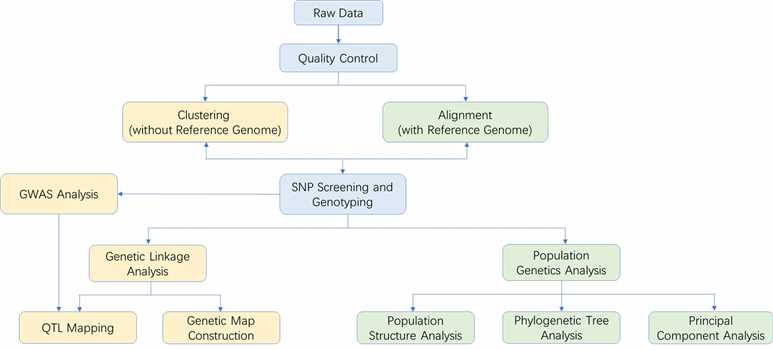
Bioinformatics Analysis
We provide multiple customized bioinformatics analyses:

  • Data preprocessing
  • Sequence alignment
  • SNP calling
  • Variant detection
  • Population genetics analysis
  • Association analysis

Note: Recommended data outputs and analysis contents displayed are for reference only. For detailed information, please contact us with your customized requests.

Analysis Pipeline

The Data Analysis Pipeline of ddRAD-seq.

Deliverables

  • The original sequencing data
  • Experimental results
  • Data analysis report
  • Details in ddRAD-seq for your writing (customization)

CD Genomics delivers a complete ddRAD-seq service, handling everything from initial DNA quality checks to detailed SNP analysis. We also offer customized solutions designed to fit your specific project needs. For further information or to discuss your requirements, please contact our team.

Demo Results

Partial results are shown below:

ddRAD-seq FAQs

1. How long does it take to get results from ddRAD-seq?

The typical turnaround time for ddRAD-seq results varies depending on project size and complexity but usually ranges from 4 to 8 weeks.

2. Can we customize the ddRAD-seq service for specific needs?

Yes, we offer tailored solutions to meet unique project requirements, including custom protocol adjustments and data analysis options.

3. What types of samples are suitable for ddRAD-seq?

ddRAD-seq can be applied to various sample types, including blood, tissue, and other genomic DNA sources from plants, animals, and microorganisms.

4. Can ddRAD-seq be used without a reference genome?

Yes, ddRAD-seq does not require a reference genome, making it suitable for species where reference genomes are not available.

5. How to choose the appropriate reduced-representation genome technology?

When selecting the appropriate simplified genomics technology, consider the following four factors to design your research strategy:

Reference Genome

  • With Reference Genome: Using a reference genome helps reduce errors due to homologous or repetitive sequences, facilitates LD analysis, selection analysis, and GWAS. This is suitable for conventional RAD sequencing and PE151 sequencing.
  • Without Reference Genome: ddRAD-seq is recommended.

Sequencing Strategy

  • Double Digest: For short fragments, paired-end (PE) sequencing may result in significant adapter overlap and is not ideal for long read lengths; single-end (SE) sequencing is recommended for short fragments.
  • Long Fragments: Long reads can detect more variant information but require sufficient coverage.
  • Short Reads: Improves sequencing depth per restriction site, enhancing SNP detection accuracy.
  • Non-Reference Species: SE sequencing is recommended to avoid data wastage.

Number of Markers

  • High Marker Density: Conventional RAD sequencing is suitable for analyses requiring high-density markers.
  • Complex Genomes and Large Sample Sizes: GBS sequencing is ideal for complex genomes and large sample volumes.

PCR Amplification Artifacts

  • PCR Bias: May lead to heterozygous sites being misidentified as homozygous or introduce errors. Conventional RAD sequencing can remove PCR duplicates using fragment sequence information, while GBS and ddRAD-seq cannot.

Address: Billing Address:: 150, Patparganj Industrial Area, New Delhi – 110092
Email: info@n2jenomicslab.com
Phone: +91-8287121443
76 Total Visitors
Copyright © 2026 | All rights reserved N2 Jenomics | Developed by Him Soft Solution