Unlock Genomic Complexity with Advanced eccDNA Sequencing
N2Jenomics Lab Pvt. Ltd eccDNA sequencing is a revolutionary approach to studying extrachromosomal circular DNA (eccDNA), a unique genetic element found in various organisms. N2Jenomics Lab Pvt. Ltd offers advanced eccDNA Sequencing Services for diverse species. Our service empowers researchers to detect, quantify, and analyze these distinct genetic elements, which are implicated in critical processes such as cancer evolution, drug resistance, and gene regulation. Uncover key drivers of disease and biological heterogeneity in your model organism or system.
Highly Efficient eccDNA Enrichment
Compatibility with diverse sample types and species
End-to-End High-Performance Solution
Comprehensive service with rapid technical support
Extrachromosomal circular DNA (eccDNA) denotes circular double-stranded DNA molecules existing independently of canonical chromosomes. These structures range in size from tens of base pairs (bp) to millions of base pairs (Mb). eccDNA is ubiquitously present across eukaryotic organisms, including healthy human tissues, neoplastic lesions, and normal blood specimens.
While the precise molecular pathways remain incompletely characterized, current research posits four primary hypotheses: a) Breakage-Fusion-Bridge (BFB) Cycle model, b) Chromothripsis model, c) Translocation-Deletion-Amplification model, d) Episome model.
fig 1: Mechanisms of eccDNA formation. (Yiheng Zhao, et al. ,2022)
eccDNA can carry diverse genetic components including gene fragments, non-coding repetitive sequences, exons, introns, promoters, and enhancers. Through chimeric circularization and reintegration into the linear genome, eccDNA participates in genomic remodeling. Its multifaceted functions may critically regulate gene expression, form super-enhancers, engage in DNA repair processes, and contribute to cancer pathogenesis.
N2Jenomics Lab Pvt. Ltd eccDNA Sequencing is a high-throughput method specifically designed to identify, characterize, and analyze eccDNA existing independently of chromosomes in the nucleus. eccDNA are ubiquitously present in both healthy and diseased tissues, with particularly significant biological roles in cancer—such as facilitating oncogene amplification, enhancing chromatin accessibility, and participating in gene regulatory networks. This sequencing technology thus provides an essential technological approach for in-depth characterization of eccDNA structure, origins, functions, and disease implications.
eccDNA Sequencing Strategies
We offer several strategies for eccDNA sequencing based on your research needs:
Sequences all DNA (Linear + Circular) without distinction.
Enriches circular DNA (removes linear DNA) before sequencing.
Detection Sensitivity
Low. Only detects high-copy number or large ecDNAs (e.g., in cancer). Misses rare or microDNAs.
Ultra-High. Detects trace amounts, rare eccDNAs, and microDNAs (<1kb) that WGS misses.
Linear DNA Background
High (>95%). Vast majority of data is wasted on linear chromosomes.
Minimal. Linear DNA is enzymatically removed, focusing reads on eccDNA.
Data Efficiency
Low. Requires high depth (30X-60X, >90Gb) to "stumble upon" circles.
High. Achieves circle-level deep coverage with only 24Gb (Low-Pass) data.
Breakpoint Precision
Moderate. Hard to identify precise junctions due to background noise.
Precise. High enrichment allows clear identification of "head-to-tail" junctions.
Cost Effectiveness
Expensive for eccDNA research (paying for the whole genome).
Cost-Effective. You pay only for the relevant circular data.
Best Application
General genomic profiling (SNVs, Indels) & large CNV detection.
Focused eccDNA research, biomarker discovery, and mechanism studies.
Applications of eccDNA Sequencing
Our eccDNA sequencing has numerous applications in various fields of research:
Cancer Research: Study genetic alterations that contribute to cancer progression.
Gene Regulation Studies: Understand how eccDNA influences gene expression and cellular functions.
Infectious Disease: Investigate viral genomes or identify circular DNA in pathogens.
Genetic Disorders: Identify novel genetic factors contributing to diseases.
Agricultural Biology:Leverage engineered eccDNA for crop improvement and biotech gene delivery.
Evolutionary Biology: Study genetic variations across different species.
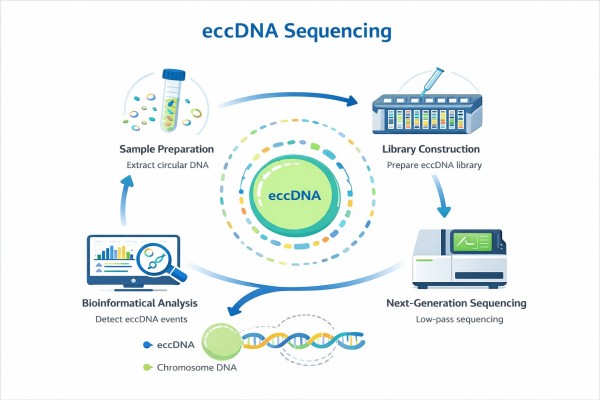
eccDNA Sequencing Service Workflow
At N2Jenomics Lab Pvt. Ltd , we offer a seamless, end-to-end eccDNA sequencing service designed to ensure consistent, high-quality results. Our standardized workflow—from sample submission to data delivery—is built to support reproducibility, streamline research, and accelerate discovery across all types of genomic studies.
Overview of the workflow for eccDNA sequencing services.
eccDNA Sequencing Bioinformatics Analysis
N2Jenomics Lab Pvt. Ltd offers comprehensive and flexible bioinformatics analysis services, ranging from basic data processing to advanced customized analyses. Our solutions facilitate in-depth exploration of genomic variations and functionalities.
Raw Data Acquisition & QC: Acquisition of paired-end sequencing data from the sequencer, followed by initial quality assessment using the Q30 threshold.
Data Preprocessing: Adapter trimming and low-quality read filtering performed using cutadapt.
Genome Alignment: Alignment of processed clean reads to the reference genome (HG38/hg38) using bwa.
eccDNA Detection: Detection of eccDNA across all samples using circle-map, leveraging alignment signatures (e.g., discordant alignments, soft-clipped reads) to infer circular molecule existence and breakpoint positions.
Soft-clipped Reads Counting: Quantification of raw soft-clipped reads at breakpoint junctions using samtools.
Differential eccDNA Filtering: Normalization via edgeR, followed by identification of differentially expressed circular DNA based on p-value and fold change thresholds.
eccDNA Annotation: Genomic annotation of circular DNA features using bedtools.
Functional Enrichment Analysis: Gene Ontology (GO) enrichment analysis of genes associated with differentially expressed circular DNA.
Methylation Analysis (Optional): Statistical evaluation of eccDNA methylation levels.
Custom Reports: Tailored summaries presenting analyzed data in a clear, actionable format.
Sample Requirements for eccDNA Sequencing
Sequencing Type
Sample Requirements
Cells
2× 10⁷ cells
Tissue
200mg
DNA
≥10μg, Dissolved in nuclease-free H₂O or TE buffer (pH 8.0); 260/280= 1.7–2.0; Absence of RNA, cross-species, or cross-individual contamination
Serum
5 mL
Plasma
5 mL
Urine
5~10mL
Cerebrospinal Fluid
mL
If you wish to process other types of samples, please contact us.
Why Choose N2Jenomics Lab Pvt. Ltd for eccDNA Sequencing?
From advanced sequencing platforms to high-quality data delivery, N2Jenomics Lab Pvt. Ltd offers an efficient, end-to-end eccDNA solution tailored to diverse research needs. Our team ensures reliable results with flexible support.
Expertise: Over 10 years of experience in DNA sequencing and analysis.
Cutting-Edge Technology: We use the latest sequencing platforms and bioinformatics tools.
Reliable Results: Our rigorous quality control ensures highly accurate and reproducible data.
Flexible Service: Supports everything from single samples to high-throughput, multi-project parallel processing.
References:
Møller, Hans D., et al. "Circular DNA elements of chromosomal origin are common in healthy human somatic tissue." Nature Communications 9 (2018): 1069. https://doi.org/10.1038/s41467-018-03369-8
Deshpande, Vineet, et al. "Exploring the landscape of focal amplifications in cancer using AmpliconArchitect." Nature Communications 10 (2019): 392. https://doi.org/10.1038/s41467-018-08200-y
Mann, Lena, et al. "ECCsplorer: a pipeline to detect extrachromosomal circular DNA (eccDNA) from next-generation sequencing data." BMC Bioinformatics 23 (2022): 40. https://doi.org/10.1186/s12859-021-04545-2
Zhao, Yiheng, et al. "Extrachromosomal circular DNA: Current status and future prospects." eLife 11 (2022): e81412. https://doi.org/10.7554/eLife.81412
Yang, Zhenzhen, et al. "Extrachromosomal circular DNA: biogenesis, structure, functions and diseases." Signal Transduction and Targeted Therapy 7 (2022): 342. https://doi.org/10.1038/s41392-022-00978-7
Hung, King L., et al. "Coordinated inheritance of extrachromosomal DNAs in cancer cells." Nature 635 (2024): 201–210. https://doi.org/10.1038/s41586-024-07861-8
Demo Results
eccDNA Seq FAQs
Can I use FFPE samples for eccDNA sequencing?
Yes, but with caveats. FFPE DNA is often fragmented, potentially impacting eccDNA recovery and detection sensitivity, especially for larger circles. Fresh frozen tissue is strongly preferred. We optimize protocols for FFPE, but results may vary. Contact us to discuss feasibility.
What bioinformatics tools do you primarily use for eccDNA detection?
We utilize a combination of established algorithms (like Circle-Map, AmpliconArchitect) and proprietary tools optimized for sensitivity and specificity. Our pipeline focuses on junctional read evidence and circle-specific mapping patterns to minimize false positives.
Does N2Jenomics Lab Pvt. Ltd help with downstream functional validation of identified eccDNA?
While our core service is sequencing and bioinformatics, we also offer validation services like FISH, inverse PCR, Droplet Digital PCR, Sanger sequencing.
How do you ensure the specificity of your eccDNA enrichment?
Our optimized protocol combines ATP-dependent exonuclease digestion (degrading linear DNA) with column-based size selection tailored to enrich circular DNA molecules. We perform rigorous QC checks to confirm enrichment efficiency.
Can eccDNA sequencing detect other structural variations (SVs)?
Yes, the analysis inherently identifies breakpoints, and structural variations present within the eccDNA themselves. However, it is specifically optimized for circular structures and may not capture all linear SVs genome-wide as effectively as dedicated WGS SV calling.
eccDNA Seq Case Studies
Title: Extrachromosomal circular DNA as a novel biomarker for the progression of colorectal cancer
Journal: Molecular Medicine
Impact Factor: 6.4(2024)
Published: 2025
DOI: 10.1186/s10020-025-01164-y
Background
Early diagnosis of colorectal cancer (CRC) presents significant challenges. Colonoscopy, while effective, is invasive, and fecal occult blood tests (FOBT) often lack sufficient sensitivity and specificity. Additionally, circulating tumor DNA (ctDNA) liquid biopsies struggle with low capture rates, limiting their diagnostic reliability. In this context, extrachromosomal circular DNA (eccDNA) has emerged as a promising new biomarker. eccDNA appears during the early stages of tumorigenesis, and its abundance correlates with cancer progression, making it a potentially valuable tool for early CRC detection.
Project Objectives
Characterize dynamic eccDNA changes throughout CRC progression (from healthy tissue to polyp, adenoma, and carcinoma).
Evaluate the potential of eccDNA as an early diagnostic biomarker for CRC.
Materials and Methods
Sample Collection
Clinical Samples:Healthy human intestinal epithelial tissues (n=5); CRC patient tissues: Polyps (n=17), Adenomas (n=14), Tumors (n=29), Adjacent normal tissues (n=5).
Animal Models: AOM/DSS-induced mouse CRC models at 0, 5, 8, and 11-week timepoints.
Nucleic Acid Prepare and Sequence
DNA extraction, linear DNA depletion, Rolling Circle Amplification (RCA), DNA library preparation.
RNA extraction, RNA library preparation.
Sequencing on Illumina NovaSeq™ 6000 (PE150).
Bioinformatic Analysis
Data filtering and alignment.
eccDNA identification, annotation, and abundance calculation.
2.Cancer-Associated Gene Carriage: eccDNA's harbor genes enriched in tumorigenic pathways (e.g., nucleotide salvage and EGFR signaling).
3.High-Performance Diagnostic Model: A random forest classifier using 10 eccDNA-related genes (TAFA5/ADA/CRISPLD2) achieved an AUC of 0.91 for distinguishing precancerous lesions from tumors.
4.Formation Mechanism: 73% of eccDNA breakpoints contain direct or inverted repeats (DR/RR-eccDNA), facilitating circularization .
Figures Referenced
A: EccDNA abundance after removal of linear DNA in intestinal epithelial tissues from healthy individuals (Healthy), colorectal polyp (Polyp) and adenoma tissues (Adenoma), as well as tumor tissues from CRC patients (Tumor). B: Density distributions of eccDNA in intestinal epithelial tissues from healthy individuals, colorectal polyp and adenoma tissues, as well as tumor tissues from CRC patients
Genomic functional annotation of small eccDNA.
Presence of repetitive sequences near the termini breakpoint of eccDNA.
The diagnostic value of eccDNA for CRC.
Implications
Early Detection Potential: Elevated eccDNA levels in precancerous stages support its utility as a liquid biopsy tool.
Technical Superiority: eccDNA's stable circular structure allows for more efficient enrichment and detection compared to ctDNA.
Clinical Translation: Foundation for eccDNA-based CRC screening kits (e.g., TAFA5/CRISPLD2 biomarkers).
Reference:
Qiu, Quanpeng, Yi Ding, Xiaolong Guo, Jing Han, Jiaqi Zhang, Yaping Liu, Junjun She, and Yinnan Chen. "Extrachromosomal circular DNA as a novel biomarker for the progression of colorectal cancer." Molecular Medicine 31.123 (2025). https://doi.org/10.1186/s10020-025-01164-y
Address:Registered Office: 150, Patparganj Industrial Area, New Delhi – 110092, India
Operational Address:National Institute of Plant Genome Research (BRIC - NGGF)
Lab No. 206 and 207, Aruna Asaf Ali Marg, P.O. Box No. 10531,
New Delhi – 110067, India