ASO and siRNA Drug Development Omics Solution
Home
> ASO and siRNA Drug Development Omics Solution
ASO and siRNA Drug Development Omics Solution
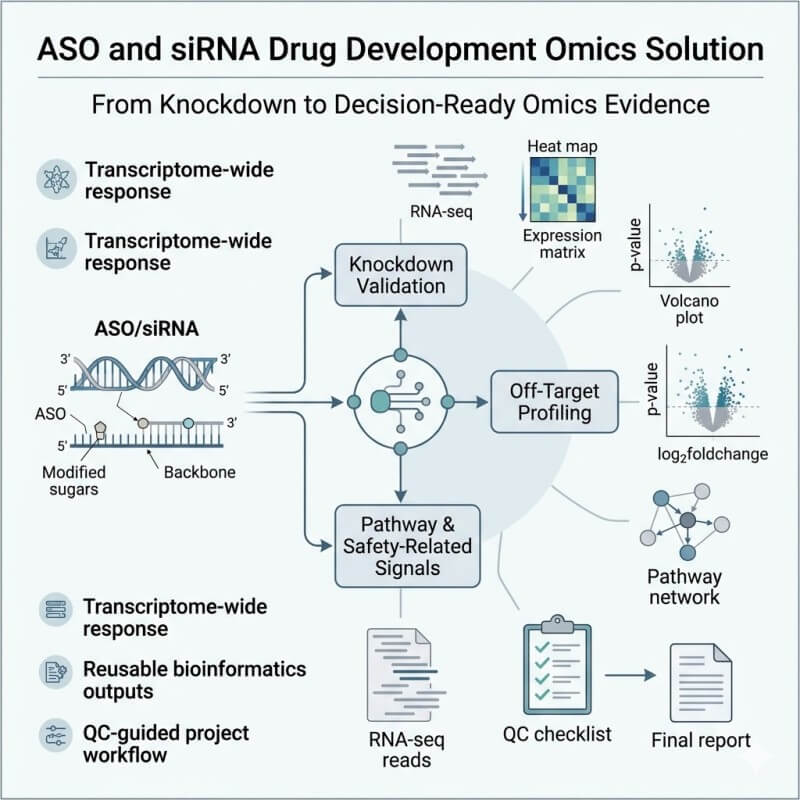
N2Jenomics Lab Pvt. Ltd. provides an ASO and siRNA drug development omics solution for research teams that need more than a single knockdown readout. We help you connect target modulation with transcriptomic response, pathway-level changes, off-target signals, and safety-related molecular patterns through sequencing, QC, and custom bioinformatics.
Validate knockdown beyond single-gene readouts
Profile transcriptome-wide off-target changes
Explore immune and inflammatory pathway responses
Compare candidates across dose and time points
Receive reusable files and analysis-ready reports
ASO and siRNA Drug Development Omics Solution
N2Jenomics Lab Pvt. Ltd. provides an ASO and siRNA drug development omics solution for research teams that need more than a single knockdown readout. We help you connect target modulation with transcriptomic response, pathway-level changes, off-target signals, and safety-related molecular patterns through sequencing, QC, and custom bioinformatics.
Build Molecular Evidence for ASO and siRNA Candidate Decisions
ASO and siRNA projects often begin with a simple question: did the candidate reduce the intended target? For early screening, that answer may be enough. For lead selection, mechanism work, or safety-related research, your team usually needs a broader molecular view.
We help you look beyond the target gene. With transcriptomics, small RNA-related profiling, targeted validation support, and custom bioinformatics, our team helps you understand how an ASO or siRNA candidate changes the system around the target.
That means you can examine whether downstream pathways shift as expected, whether non-target transcripts change, and whether immune, inflammatory, stress, or toxicity-associated signatures appear in the tested model.
From Gene Silencing to Interpretable Omics Evidence
Target knockdown is only one part of the story. One candidate may reduce the intended transcript but create broad expression shifts elsewhere. Another may show moderate knockdown but produce a cleaner pathway profile. Omics data helps bring those differences into view.
Our ASO and siRNA drug development omics solution connects candidate design, sample grouping, sequencing data, and interpretation-ready outputs. We focus on helping your team answer not only "what changed?" but also "which changes matter for the next research decision?"
Where This Solution Fits in Discovery and Safety Research
This solution is useful when your team needs molecular evidence for candidate screening, target validation, off-target review, dose or time comparison, model selection, or safety-related mechanism exploration.
We can support in vitro studies, cell model studies, tissue-based studies, animal-model research, and multi-condition comparison designs. The final workflow depends on your modality, sample type, species, candidate number, dose groups, time points, and biological endpoint.
What N2Jenomics Lab Pvt. Ltd. Helps You Evaluate
Whether ASO or siRNA treatment produces the expected target response
Which downstream genes and pathways change after treatment
Whether transcriptome-wide off-target signals are present
Whether immune, inflammatory, stress, or toxicity-associated pathways are activated
How candidates compare across dose, time point, tissue, or model
Which genes, pathways, or signatures should be prioritized for follow-up validation
Our Service Capabilities for ASO / siRNA R&D Support
We support ASO and siRNA research as a project workflow, not as a single isolated assay. Your team may come to us with extracted RNA, treated cell pellets, tissue samples, a candidate panel, or an existing experimental design. We help map those inputs to the most useful sequencing and analysis plan.
The final goal is a data package your team can actually use: QC summaries, expression matrices, differential expression results, pathway outputs, figures, candidate comparison tables, and method notes that can be reviewed by biology, pharmacology, safety, and bioinformatics teams.
Transcriptomics for Knockdown and Pathway Response
RNA-Seq is often the main data layer for ASO and siRNA response profiling. It can show whether the intended target is reduced, how downstream genes respond, and whether treatment creates broader transcriptional shifts.
For ASO and siRNA studies, transcriptomics can be used to compare treated versus control groups, multiple candidates, dose levels, time points, tissues, or cell models. We also help identify genes and pathways that may deserve targeted validation.
Small RNA and miRNA-Related Profiling for siRNA Research
For siRNA studies, small RNA biology can become important when the project involves seed-region effects, miRNA-like regulation, endogenous small RNA perturbation, or RNA regulatory shifts. In those cases, Small RNA Sequencing may add a useful layer.
This module is not required for every project. We usually consider it when the research question involves small RNA abundance, regulatory RNA changes, miRNA-related pathways, or a deeper review of siRNA-associated molecular response.
Targeted Validation and Candidate Comparison Support
After transcriptome-wide profiling, many teams need a shorter list of genes or pathways for follow-up. N2Jenomics Lab Pvt. Ltd. can help prepare candidate lists for targeted validation based on differential expression, pathway relevance, off-target concern, immune-response signatures, or project-specific biology.
For focused follow-up, Targeted RNA Sequencing may be useful when your team wants to track selected transcripts across additional samples, candidate designs, or study conditions.
Custom Bioinformatics for Off-Target and Safety-Related Signals
ASO and siRNA studies often need more than a standard differential expression table. Our Bioinformatics Services help connect expression changes with candidate design, treatment group, pathway biology, dose, time point, and model-specific response.
We can support custom review of siRNA seed-related patterns, ASO hybridization-related candidate genes, immune pathway enrichment, inflammatory signaling, stress response, tissue response, and cross-candidate comparison when these analyses fit the study design.
Research Questions This Solution Can Address
Different stages of ASO and siRNA research require different kinds of evidence. Early discovery may focus on target reduction. Candidate screening may focus on ranking. Safety-related research may focus on unwanted pathway activation or broad transcriptome disturbance.
We help translate those questions into a practical sequencing and analysis design.
Supports interpretation of safety-related molecular response in the tested model
Which candidate looks cleaner across endpoints?
Multi-candidate transcriptomics and comparison matrix
Candidate-by-endpoint ranking table
Helps compare knockdown, pathway response, off-target signal, and QC status together
Is the Candidate Producing the Intended Knockdown Response?
We compare treated and control samples to measure target expression and downstream expression changes. This helps your team determine whether observed knockdown is consistent, biologically relevant, and worth extending into further study conditions.
Are There Transcriptome-Wide Off-Target Changes?
Transcriptome-wide profiling can reveal expression changes beyond the intended target. For siRNA, one concern is seed-mediated off-target regulation. For ASO, one concern is hybridization-dependent interaction with unintended transcripts. The analysis design should reflect the oligonucleotide type, sequence design, and study model.
Are Immune or Inflammatory Pathways Activated?
Some ASO and siRNA candidates may produce stress, immune, or inflammatory molecular signatures in specific models or treatment settings. RNA-seq can help identify whether these pathways are changing and which genes contribute to the signal.
How Do Dose, Time Point, Tissue, or Model Change the Response?
A single condition may not reveal the full response pattern. Dose-response or time-course transcriptomics can help separate early treatment effects, sustained pathway response, and condition-specific expression changes.
Workflow from Sample Intake to Reusable Data Package
Once your samples enter the project, we move through a combined service and technical workflow: project review, sample and metadata check, RNA quality control, library preparation, sequencing, primary data QC, bioinformatics analysis, report delivery, and follow-up interpretation.
This workflow is designed to protect sample-to-data traceability. At each stage, we check whether the data are ready for the next step and whether the final outputs will be useful for your internal review.
1
Project Intake and Endpoint Mapping
We begin by reviewing your ASO or siRNA modality, target gene, species, model, treatment groups, dose levels, time points, sample type, and intended endpoint. This helps us decide whether your project needs RNA-seq, small RNA sequencing, targeted RNA sequencing, custom bioinformatics, or a combined workflow.
We also clarify the comparison structure. Your project may compare treated versus untreated samples, multiple candidates against one control, several dose groups, different tissues, or time points after treatment.
2
Sample Planning and Group Design
Before sample submission, we review sample type, extraction status, estimated input amount, RNA integrity, storage condition, and metadata. For ASO and siRNA studies, metadata is especially important because interpretation depends on candidate ID, dose, exposure time, treatment condition, replicate group, tissue or cell model, and control type.
Clear metadata helps us build the analysis matrix correctly and reduces ambiguity when the results are interpreted.
3
RNA Quality Control and Library Preparation
After samples arrive, we assess RNA amount, concentration, purity, and integrity. Samples that meet the agreed project criteria move into library preparation.
For transcriptome profiling, the technical process may include RNA fragmentation or enrichment/depletion steps as appropriate, cDNA synthesis, adapter ligation or amplification, library QC, and sequencing. For small RNA sequencing, the workflow is adjusted to capture small RNA species and prepare size-appropriate libraries.
Library QC helps confirm whether the prepared libraries are suitable for sequencing before data generation begins.
4
Sequencing and Primary Data QC
Sequencing produces raw reads that are processed into clean data. Primary QC may include read quality review, adapter trimming, read length distribution, base quality, mapping or alignment summary, duplication review where relevant, and sample-level consistency checks.
These QC steps help identify technical issues before biological interpretation begins.
5
Differential Expression, Pathway Review, and Off-Target-Focused Analysis
After primary processing, we generate expression matrices and compare the planned sample groups. Differential expression analysis identifies genes that change between conditions. Pathway enrichment helps organize those changes into biological themes.
For ASO and siRNA studies, we can add focused analysis for off-target-related patterns, immune or inflammatory pathways, stress response, candidate comparison, dose trend, time trend, or tissue-specific response when the study design supports it.
6
Report Delivery and Follow-Up Interpretation
Your final package can include raw data, processed data, QC files, result tables, visualizations, pathway outputs, software or parameter notes, and a report. We aim to provide files that your internal team can reuse, inspect, and integrate with other project information.
After delivery, we can help your team review the structure of the outputs and identify which genes, pathways, or candidate-level signals may be useful for follow-up validation.
Sample Requirements and Study Design Inputs
Sample needs vary by sample type, extraction status, sequencing strategy, and study goal. The table below gives practical starting values for project discussion. Final input requirements should be confirmed before sample submission.
Sample Type
Recommended Input
Quality Checks
Required Metadata
Notes
Total RNA for RNA-seq
≥1 μg preferred; ≥100 ng may be reviewed for low-input workflows
Concentration, purity, integrity; RIN ≥7 preferred for high-quality RNA
Candidate ID, dose, time point, control, replicate, species, tissue/cell type
Best for transcriptome-wide knockdown and pathway response profiling
Cell pellets
≥1 × 10⁶ cells preferred
Cell status, storage condition, RNA extraction QC after processing
Treatment condition, candidate ID, exposure time, replicate group
Suitable when RNA extraction is included in the project workflow
Fresh frozen tissue
≥30 mg preferred where available
RNA yield, purity, integrity, degradation risk
Tissue type, collection method, treatment group, dose, time point
Useful for tissue-response and safety-related molecular profiling
Small RNA sequencing sample
≥1 μg total RNA preferred
Small RNA fraction suitability, total RNA quality, purity
siRNA design, treatment group, model, dose, time point
Consider when small RNA or miRNA-related response is central
We review feasibility before recommending a workflow
Sample Types Commonly Used in ASO / siRNA Studies
Common starting materials include extracted RNA, cell pellets, treated cell models, fresh frozen tissues, and model-specific biological samples. For each sample type, we confirm extraction method, storage condition, expected RNA quality, and grouping metadata before project initiation.
Metadata That Improves Interpretation
For ASO and siRNA studies, metadata is not a formality. It directly affects interpretation. At minimum, please provide candidate ID, sequence or design group where appropriate, target gene, treatment group, dose, time point, control group, biological replicate, species, tissue or cell type, and any observed phenotype or assay endpoint.
Demo Results: What Your ASO / siRNA Omics Data May Show
The exact result pattern depends on your candidate, model, sample quality, and study design. The examples below show the types of outputs that can be included in an ASO and siRNA omics data package.
Knockdown and Pathway Response Overview
A volcano plot can show genes that are changed between treatment and control groups. A pathway enrichment panel can then group those genes into biological themes, such as target-associated pathways, immune signaling, stress response, metabolic response, or disease-relevant processes.
This helps your team move from a single target readout to a broader view of treatment response.
Off-Target Expression Shift Visualization
A heatmap, cumulative distribution plot, or seed-match-aware expression shift plot can help highlight whether a subset of genes shows broad downregulation or unexpected expression movement after treatment.
For siRNA studies, this can be useful when reviewing potential seed-mediated effects. For ASO studies, a focused review may look at candidate transcripts with sequence complementarity or relevant expression changes.
Candidate Ranking Summary
When multiple candidates are tested, a candidate-by-endpoint matrix can bring key signals together. For example, rows can represent candidates and columns can summarize target knockdown, pathway response, off-target signal, immune pathway activation, sample QC, and follow-up priority.
This format gives project teams a clearer view of which candidates may deserve further study.
FAQ
1. How can RNA-seq support ASO and siRNA candidate evaluation?
RNA-seq can show whether the intended target changes and how the broader transcriptome responds. For ASO and siRNA studies, this helps connect target modulation with pathway response, off-target review, immune-related signatures, and candidate comparison.
2. Can this solution help distinguish on-target response from off-target transcriptomic changes?
It can help your team review the pattern. We compare planned treatment groups, identify differentially expressed genes, review pathway behavior, and add off-target-focused analysis when supported by the candidate design and study structure. The result is a clearer molecular profile for follow-up research decisions.
3. When should we add small RNA sequencing to an siRNA project?
Small RNA sequencing is most useful when small RNA abundance, miRNA-like regulation, seed-region biology, or RNA regulatory shifts are part of the research question. It is not required for every siRNA project.
4. What sample information should we provide before project design?
Please provide sample type, species, target gene, ASO or siRNA candidate information, treatment group, dose, time point, control group, replicate number, tissue or cell model, and any known assay results. This information helps us recommend a suitable workflow.
5. Can N2Jenomics Lab Pvt. Ltd. compare multiple ASO or siRNA candidates?
Yes. We can support multi-candidate designs when the grouping structure is clear. Typical comparisons may include target knockdown, pathway response, transcriptome-wide expression shift, immune or inflammatory pathway signal, and QC status.
6. What deliverables will our internal team receive?
Depending on the project scope, deliverables may include raw data, processed reads, QC summaries, expression matrices, differential expression tables, enrichment results, figures, candidate comparison tables, method notes, and an analysis report.
7. Can immune or inflammatory pathway activation be reviewed from transcriptomics data?
Yes, if the study design and sample quality support the analysis. We can review immune-related genes, inflammatory pathways, stress response signatures, and enrichment results to help your team understand treatment-associated molecular response in the tested model.
8. Is targeted validation still needed after RNA-seq?
Often, yes. RNA-seq is useful for broad discovery and ranking. Targeted validation is useful when your team wants to confirm selected genes or pathways across more samples, conditions, or candidate designs.
9. Can this workflow support dose-response or time-course studies?
Yes. Dose-response and time-course designs can be built into the sample grouping structure. These designs are useful when your team needs to understand whether a response is dose-associated, transient, sustained, or model-specific.
10. How do we start a project discussion?
Share your modality, sample type, candidate number, species, model, dose groups, time points, and research endpoint. Our team can then help map your study goal to a sequencing and bioinformatics workflow.
Address:Registered Office: 150, Patparganj Industrial Area, New Delhi – 110092, India
Operational Address:National Institute of Plant Genome Research (BRIC - NGGF)
Lab No. 206 and 207, Aruna Asaf Ali Marg, P.O. Box No. 10531,
New Delhi – 110067, India