Nanopore Amplicon sequencing
Home
> Nanopore Amplicon sequencing
Nanopore Amplicon Sequencing Service
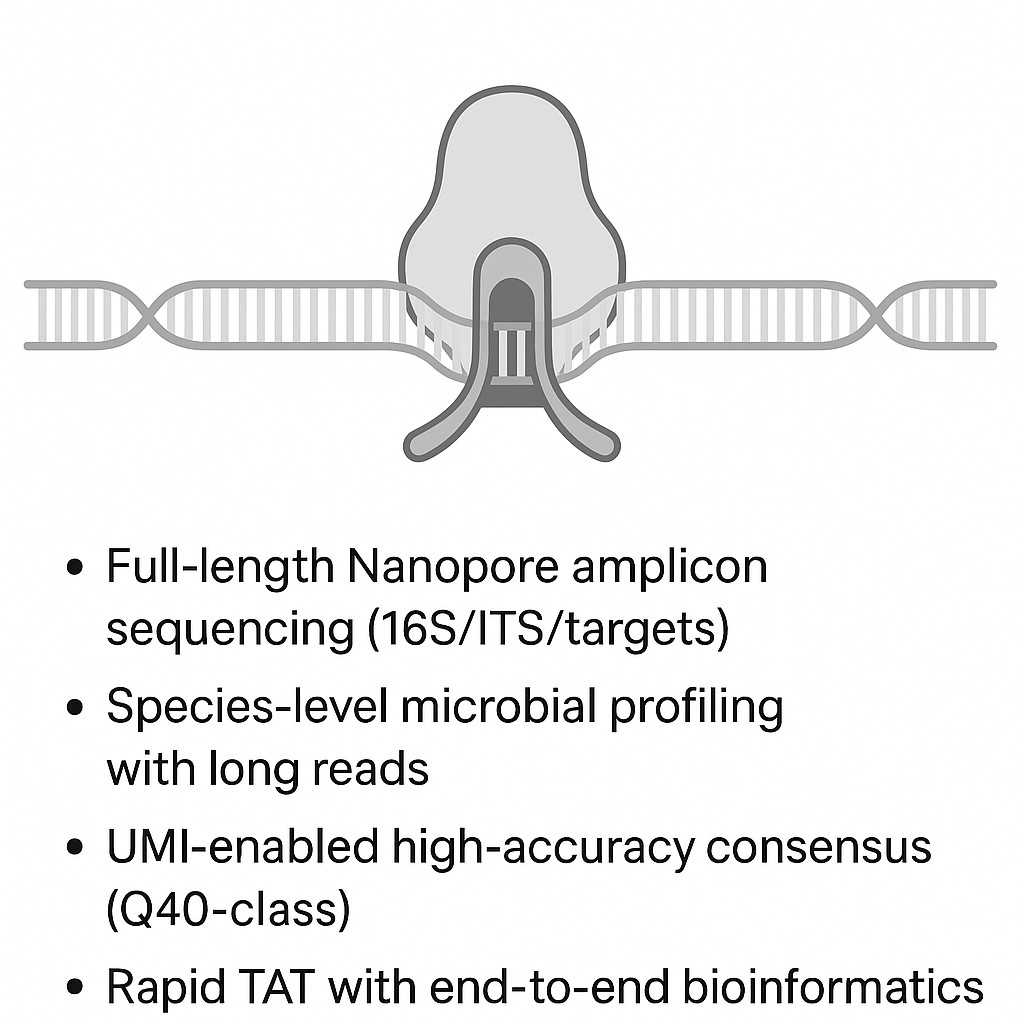
N2 Jenomics Lab Pvt. Ltd. provides Nanopore Amplicon Sequencing to capture full-length targets such as 16S rRNA, ITS, and custom gene regions. Our service overcomes the limitations of short-read sequencing, delivering species-level microbial profiling, variant confirmation, and comprehensive data analysis.
This solution is designed for academic researchers, CROs, biotech teams, and pharmaceutical clients who require reliable amplicon data with rapid turnaround and end-to-end support.
Short-read limits at species level and repetitive regions
Slow cycles and fragmented analysis across vendors
Short-read methods, such as Illumina panels targeting V3–V4 regions, often fail to distinguish closely related species. This can limit downstream research in microbiome analysis, pathogen detection, and clonal validation.
Nanopore sequencing addresses these gaps by producing long reads across the full gene length, such as V1–V9 of 16S or the entire ITS region. These reads provide higher taxonomic resolution, reduce errors in community analysis, and enable confident species- or strain-level identification.
For researchers needing broader context, Nanopore Ultra-Long Sequencing supports telomere-to-telomere genome assemblies, while Nanopore Direct RNA Sequencing links structure with expression.
Workflow for the two-step PCR approach in Nanopore amplicon sequencing library preparation. (This figure was adapted from Yoshiyuki Matsuo (https://dx.doi.org/10.17504/protocols.io.8epv5zrodv1b/v4)
Technical Specifications
N2 Jenomics Lab Pvt. Ltd. provides a reliable, end-to-end workflow for Nanopore Amplicon Sequencing, optimised for both clonal and community-based projects. Our laboratory protocols, sequencing platforms, and bioinformatics pipelines are designed to maximise read accuracy and ensure species- or strain-level resolution.
Parameter
Specification
Amplicon size range
0.5–25 kb (extended support available upon request)
Platforms
Oxford Nanopore PromethION / GridION
Chemistry
Kit 14 with R10.4.1 flow cells for improved accuracy
Read depth
≥50,000 reads per sample recommended for community profiling
Turnaround time
1–3 business days (clonal projects); ~14 days (community profiling)
Data accuracy
Standard polishing pipelines; optional barcode-based consensus workflow for higher fidelity
Deliverables
FASTQ/FASTA files, quality control reports, taxonomy/variant tables, interactive HTML and PDF reports
Quality assurance: All sequencing projects undergo strict QC, including DNA integrity checks, read-length distribution analysis, and error-rate monitoring.
Applications
Nanopore Amplicon Sequencing is widely applied in microbial research, gene validation, and comparative genomics. By providing long reads that span entire amplicons, it enables confident interpretation of complex datasets and reduces the ambiguity often found in short-read methods.
Microbial Community Profiling
Full-length 16S rRNA (V1–V9) and ITS regions deliver species-level identification.
Suitable for environmental samples, human microbiomes, and industrial microbiology projects.
Supports diversity analysis, population structure evaluation, and comparative studies.
Pathogen Surveillance and Risk Assessment
Detect potential pathogens in water, soil, food, and indoor environments.
Enables tracking of microbial shifts in response to seasonal or environmental changes.
Enhances biosafety monitoring in clinical and agricultural research.
Food Safety and Agriculture
Identify spoilage organisms and beneficial strains in food production chains.
Support breeding programs by profiling microbial communities linked to crop resilience.
Facilitate agricultural biotechnology studies by resolving strain-level diversity.
Clonal Verification and Variant Detection
Confirm single-gene amplicons, edited constructs, or plasmid inserts.
Generate high-fidelity consensus for clonal samples using barcode-based strategies.
Rapid turnaround enables iterative design and testing cycles.
Comparative and Evolutionary Genomics
Resolve closely related species and strain-level variants.
Support population genetics and microbial evolution studies with full-length coverage.
Combine with Nanopore Target Sequencing for focused analysis of specific loci.
Workflow: End-to-End Service
Primer strategy: select target regions (16S, ITS, custom genes)
High-fidelity PCR: with optional barcode tagging for error correction
Library preparation: ONT Kit 14, minimal fragmentation
Sequencing: PromethION/GridION with R10.4.1 flow cells
Data processing: basecalling, consensus generation, chimera filtering
N2 Jenomics Lab Pvt. Ltd. provides a complete bioinformatics pipeline for Nanopore Amplicon Sequencing, ensuring high-confidence results and publication-ready outputs. Our analysis covers quality control, taxonomic classification, variant detection, and customised reporting.
Standard Analysis
Basecalling & demultiplexing: conversion of raw signals to FASTQ with sample separation.
Quality control: read length distribution, coverage depth, and accuracy statistics.
Taxonomic assignment: species-level classification for 16S and ITS datasets using curated reference databases.
Diversity analysis: alpha- and beta-diversity indices with visualisations such as PCoA or NMDS plots.
Advanced Analysis (Optional)
Differential abundance: comparative statistics across experimental groups.
Variant detection: identify sequence variants within clonal amplicons.
Barcode-consensus workflow: enhanced accuracy with error suppression and chimera filtering.
Strain-level resolution: clustering and fine-scale variant calling.
Proven Case Applications
Our Nanopore Amplicon Sequencing service has been successfully applied across diverse research fields. Below are selected examples that demonstrate practical outcomes.
Project
Research Goal
Key Results
Urban Water Microbiome
Assess seasonal changes and pollution impact on river communities
Species-level resolution of Arcobacter and Aeromonas; revealed source-specific contributions in wet vs. dry seasons
Indoor Environment Study
Characterise microbial populations linked to human occupancy
Identified 21 key species, including 11 potential pathogens; higher abundance of beneficial bacteria indoors
Clonal Gene Verification
Confirm engineered constructs and plasmid sequences
High-fidelity consensus achieved; reduced false positives using barcode-based strategy
Agricultural Microbiome
Investigate crop-associated microbial diversity in soil samples
Improved strain-level profiling; supported resilience analysis in breeding research
Note: These applications are for research use only and are not intended for diagnostic procedures.
Deliverables
Raw sequencing data: FASTQ and optional FASTA files.
QC reports: yield, read length distribution, and accuracy metrics.
Taxonomy/variant tables with abundance profiles.
Interactive HTML and PDF reports with publication-ready figures (SVG/PNG).
Methods text and pipeline parameters to support reproducibility.
Choosing the Right Sequencing Platform
N2 Jenomics Lab Pvt. Ltd. supports multiple long- and short-read technologies, ensuring that each project receives the most suitable approach. Whether your goal is high-accuracy variant detection, full-length amplicon analysis, or population-scale studies, we can recommend the right platform.
Feature
PacBio SMRT
Oxford Nanopore
Illumina
Read length
Long (10–25 kb; HiFi ~15–20 kb)
Ultra-long (kb to Mb range)
Short (100–500 bp)
Accuracy
Very high (HiFi >99.9%)
High with consensus/error-suppression
Very high (>99.9%)
Turnaround
Moderate
Flexible, portable, real-time
High-throughput, batch-based
Strengths
Low error, ideal for repeat regions
Longest reads, species-level amplicons, direct RNA/DNA
Cost-effective for large cohorts
Limitations
Higher cost, DNA quality critical
Raw error rate higher without correction
Limited resolution for long repeats
Best suited for
De novo assemblies, repeat regions
Amplicons, microbiomes, rapid analysis
SNP detection, large sample studies
Our commitment:
We provide sequencing services on all three platforms—PacBio, Oxford Nanopore, and Illumina—so you don't need to worry about choosing the wrong method. Our experts evaluate your samples and research goals, then recommend the platform that maximises data quality, efficiency, and cost-effectiveness.
Sample Requirements for Nanopore Amplicon Sequencing
From advanced sequencing platforms to high-quality data delivery, N2 Jenomics Lab Pvt. Ltd. offers an efficient, end-to-end solution tailored to diverse research needs. Whether you're studying rare variants or sequencing ancient DNA, our team ensures reliable results with flexible support.
Expertise: Our team has deep expertise in utilizing Oxford Nanopore’s technology for diverse sequencing applications.
Cutting-edge Technology: We use the latest advancements in nanopore sequencing to provide the best possible results.
Customizable Solutions: We tailor each project to the specific needs of our clients, ensuring relevant and high-quality outcomes.
Fast Turnaround Time: With real-time sequencing capabilities, we provide rapid insights to keep your research on track.
Comprehensive Support: From sample preparation to data analysis, we offer full support throughout the sequencing process.
Demo Results
Nanopore reads span the full 16S/ITS regions, while short-read platforms are limited to partial segments.
Beta-diversity analysis enables clear separation of microbial communities across sample groups.
Nanopore Amplicon seq FAQs
Q1. What distinguishes Nanopore amplicon sequencing from Illumina short-read methods?
Nanopore delivers full-length reads (e.g. full 16S V1–V9 or ITS), allowing species- or strain-level resolution. Illumina reads are shorter (e.g. V3–V4) and may misclassify species or lose strain-level detail.
Q2. When is barcode-based error correction (unique tagging) needed?
Use it when:
you require very high accuracy (e.g. variant detection in clonal or mixed samples),
targeting long amplicons prone to sequencing or PCR errors,
investigating rare taxa.
Q3. How many reads per sample are recommended?
For community profiling: ≥ 50,000 reads/sample to saturate diversity in moderate-complexity samples.
For clonal amplicons: fewer reads are needed, since focus is consensus accuracy rather than richness.
Q4. What factors most affect data quality?
DNA input: quantity, purity (OD ratios), integrity (fragment size).
Turnaround time depends on project type and sample quality. Clonal projects are typically faster, while community studies may take longer due to additional analysis steps.
Q6. Are results suitable for publication or regulatory use?
Yes, for research use only. We supply publication-quality reports, methods details, versioned taxonomy databases. However, this service is not certified for diagnostics.
Q7. Which internal reference databases are used for taxonomic assignment?
We use curated, regularly updated 16S/ITS full-length reference databases to ensure improved species-level assignment and minimal misclassification.
Q8. Can I sequence multiple gene targets or loci in a single sample?
Yes, provided PCR amplifications are specific (single distinct product per target). Mixed or non-specific amplicons reduce accuracy and may require separate runs or custom workflows.
Nanopore Amplicon seq Case Studies
Client Background
Researchers from TU Dortmund University (Germany) and Universidad Nacional del Sur (Argentina) investigated the actinomycete Streptomyces albus CAS922. This strain was isolated from sunflower seed hulls and exhibited strong potential for lignocellulose degradation and secondary metabolite biosynthesis. To explore its metabolic capacity and industrial relevance, the team required a high-quality complete genome sequence.
Challenge
Actinomycetes typically contain large, GC-rich genomes (>70%), which complicates sequencing and assembly.
Short-read technologies often produce fragmented assemblies with unresolved repeats, limiting downstream analysis of biosynthetic gene clusters (BGCs) and carbohydrate-active enzymes (CAZymes).
The client needed an approach that could generate long, contiguous reads and support accurate annotation for functional genomics research.
Our Solution
N2 Jenomics Lab Pvt. Ltd. performed Oxford Nanopore long-read sequencing using the SQK-LSK109 ligation kit.
Data generation: Over 1.5 Gb of clean data from >260,000 reads, with an N50 read length of ~8 kb.
Assembly strategy: De novo assembly with Canu, followed by polishing with Pilon to enhance accuracy.
Annotation tools: NCBI Prokaryotic Genome Annotation Pipeline (PGAP) for gene calling; RepeatMasker for repetitive elements; CAZy/dbCAN2 for carbohydrate-active enzyme prediction; antiSMASH for biosynthetic cluster detection.
Results
A complete linear chromosome of 8.06 Mb was assembled, achieving ~191× coverage and a GC content of 72.6%.
6,776 protein-coding genes and 80 RNAs were identified.
232 carbohydrate-active enzymes were predicted, including three copper-dependent enzymes implicated in cellulose and xylan degradation.
27 biosynthetic gene clusters were revealed, encoding metabolites such as siderophores (desferrioxamine E), terpenes (cyslabdan, geosmin), and antibiotics (xantholipin, pseudouridimycin).
Impact
The high-quality genome enabled strain-level functional insights into lignocellulose degradation, supporting the development of renewable biomass applications.
Discovery of diverse biosynthetic clusters highlighted the biotechnological potential of S. albus CAS922 for producing novel antibiotics and bioactive compounds.
The project demonstrated how N2 Jenomics Lab Pvt. Ltd. ' Nanopore sequencing service can resolve complex, high-GC genomes and deliver actionable biological insights.
References:
Tippelt A, Nett M, Vela Gurovic MS. Complete Genome Sequence of the Lignocellulose-Degrading Actinomycete Streptomyces albus CAS922. Microbiol Resour Announc. 2020 May 21;9(21):e00227-20. doi: 10.1128/MRA.00227-20. PMID: 32439662; PMCID: PMC7242664.
Sun B, Bhati KK, Song P, Edwards A, Petri L, Kruusvee V, Blaakmeer A, Dolde U, Rodrigues V, Straub D, Yang J, Jia G, Wenkel S. FIONA1-mediated methylation of the 3'UTR of FLC affects FLC transcript levels and flowering in Arabidopsis. PLoS Genet. 2022 Sep 27;18(9):e1010386. doi: 10.1371/journal.pgen.1010386. PMID: 36166469; PMCID: PMC9543952.
Address:Registered Office: 150, Patparganj Industrial Area, New Delhi – 110092, India
Operational Address:National Institute of Plant Genome Research (BRIC - NGGF)
Lab No. 206 and 207, Aruna Asaf Ali Marg, P.O. Box No. 10531,
New Delhi – 110067, India