In Vivo Gene Therapy Sequencing and Biodistribution Analysis Solution
Home
> In Vivo Gene Therapy Sequencing and Biodistribution Analysis Solution
In Vivo Gene Therapy Sequencing and Biodistribution Analysis Solution
When an in vivo gene therapy study moves into tissue distribution, vector confirmation, or expression analysis, the main question is rarely just "can we sequence this?" Your team needs to know what evidence can be generated, which samples are suitable, and how the final results will support project review.
At N2Jenomics Lab Pvt. Ltd. , we help you connect vector type, tissue list, sample format, sequencing strategy, QC checkpoints, and bioinformatics outputs into one practical analysis plan for vector distribution, sequence confirmation, expression profiling, and integration-related assessment.
Match readouts to vector and tissue questions
Combine biodistribution, sequencing, and expression evidence
Turn In Vivo Delivery Questions into Sequencing-Supported Evidence
In vivo gene therapy studies often begin with a direct question: where did the delivered genetic material go? Once the project includes multiple tissues, groups, or timepoints, that question becomes more complex.
You may need to know whether a vector is detectable in target tissues, whether non-target tissues show signal, whether the intended sequence is supported by reads, whether RNA-level expression is present, or whether integration-related analysis should be considered for your vector system.
We help you turn those questions into a sequencing and biodistribution plan that fits the study, instead of forcing every project into the same assay.
What this solution helps you answer
Is the delivered vector or genetic material detected in selected tissues?
How do target and non-target tissues compare across groups?
Is the vector genome or target region supported by sequencing reads?
Does the transgene show RNA-level expression in selected tissues?
Should integration-site or insertional event assessment be added?
What QC and bioinformatics outputs are needed for internal review?
The goal is to choose the right readouts before samples are processed, so the final data package answers the question you actually need to ask.
A tissue-level biodistribution readout may show whether a target sequence is detectable. It may not confirm the broader vector sequence, explain RNA-level expression, or address integration-related questions.
That is why some in vivo gene therapy projects need a combined approach:
Biodistribution readouts for tissue-level presence or copy-related evidence
Targeted sequencing for vector or target-region confirmation
AAV genome sequencing for vector genome structure and sequence support
RNA sequencing for transgene expression or host response profiling
Whole-genome or long-read sequencing for broader genomic context
Integration-site analysis when vector biology and study design require it
We help you decide which layers are necessary, which are optional, and which may not be useful for the current study.
Our Service Capabilities for Gene Therapy Biodistribution Projects
We support in vivo gene therapy sequencing projects as integrated study packages, not isolated data-generation tasks. Before the project starts, our team can review sample type, vector design, readout goals, sequencing strategy, QC checkpoints, and expected deliverables with you.
That early review matters. It helps prevent a common problem in complex studies: generating data that are technically valid but not well matched to the biological question.
Vector and Delivery Systems We Can Support
AAV vector research
Lentiviral or retroviral vector research
Plasmid or non-viral delivery studies
LNP or nanoparticle-delivered nucleic acid studies
Engineered cell or exogenous gene delivery contexts
Sequencing and Analysis Modules
Vector genome or target-region confirmation
Tissue biodistribution readouts
Transgene expression profiling
Integration-site or insertional event assessment where applicable
Multi-tissue or multi-timepoint comparison
Bioinformatics reporting and visualization
Project Execution Support
A strong project starts before sequencing. We help you review sample type and grouping, tissue list and timepoints, construct map or target sequence availability, DNA or RNA QC information, sample naming and labeling, intended output tables and figures, and required bioinformatics file types.
This helps your team scope the project more clearly and reduces the risk of collecting data that cannot answer the original study question.
Choose the Right Readout: Biodistribution, Sequence Confirmation, Expression, or Integration
A good in vivo gene therapy study does not start with a platform. It starts with the question your team needs to answer. The table below shows how common readouts differ and when each one may fit.
Readout / Method
Main Question Answered
Best-Fit Use Case
Common Sample Type
Typical Outputs
Important Limitation
qPCR / ddPCR-style quantification
Is the target sequence detectable or quantifiable?
Tissue biodistribution, vector copy-related analysis, known target detection
Extracted DNA or RNA, tissue-derived nucleic acid
Copy-related tables, tissue-level comparison, normalized signal output
Limited sequence context; does not confirm broad vector structure
Targeted Region Sequencing
Is the expected vector or target region supported by reads?
Known target confirmation, amplicon-based vector sequence support
If the main question is where the genetic material is detected, start with a biodistribution readout. If the main question is whether the expected vector or target region is present and supported by reads, add targeted sequencing or vector genome sequencing. If the main question is whether the transgene is expressed, add RNA-level analysis.
If the main question is whether insertion-related events matter, consider integration-site analysis only when the vector type and study design make it relevant. If your team needs a clear internal data package, we should define the bioinformatics deliverables before samples are submitted. That includes the expected tables, figures, file types, QC summaries, and report notes.
Sample-to-Report Workflow with QC Checkpoints
Our workflow combines technical processing with project management. Once samples enter the project, we track whether each step still supports the original study question.
Step 1: Project Intake and Readout Selection
Before samples enter the workflow, we review the study design with your team. Useful information includes vector or delivery system, species and tissue list, target and non-target tissues, group design and timepoints, sample format, target sequence or construct map, desired readouts, and expected output tables and figures.
This step helps us decide whether your study needs one readout or a combined package.
Step 2: Sample Submission and Pre-QC Review
When samples are prepared for shipment, clear labeling and documentation matter. N2Jenomics Lab Pvt. Ltd. asks customers to provide a completed sample submission form, keep sample names consistent between the form and tube labels, and submit electronic QC data when available.
For tube submission, 1.5 mL centrifuge tubes are often suitable. Plates should be sealed tightly to reduce sample loss or cross-contamination. DNA in water or TE buffer should be shipped with ice packs, while RNA, cells, bacteria, and frozen tissues should be shipped with dry ice.
At this stage, our team checks sample identity, sample type, labeling, and available QC information. If something is unclear, we clarify it before the sample moves further into processing.
Step 3: Nucleic Acid Extraction and Quality Control
The technical workflow depends on the input material and the selected readout.
For DNA-based readouts, extracted DNA should be RNase-treated and show no obvious degradation or contamination. N2Jenomics Lab Pvt. Ltd. sample guidance recommends DNA OD260/280 as close to 1.8-2.0 as possible.
For RNA-based readouts, total RNA should be DNA-free. N2Jenomics Lab Pvt. Ltd. guidance recommends A260/A280 ≥ 1.8, A260/230 ≥ 1.8, and RIN ≥ 6 for total RNA samples.
QC review may include concentration, purity, degradation, and suitability for the selected sequencing method. If the sample quality does not match the planned readout, we discuss possible adjustments before proceeding.
Step 4: Library or Assay Preparation and Sequencing
After QC, the project moves into the selected technical route.
For targeted sequencing, target regions are amplified or enriched before sequencing. For AAV genome sequencing, vector-related sequence support and coverage are assessed. For RNA sequencing, RNA is converted into sequencing-ready libraries. For whole-genome or long-read strategies, library preparation depends on DNA quality and the required data type.
The technical aim is not only to generate reads. It is to generate data that match the planned biological readout.
Step 5: Bioinformatics, QC Summary, and Report Delivery
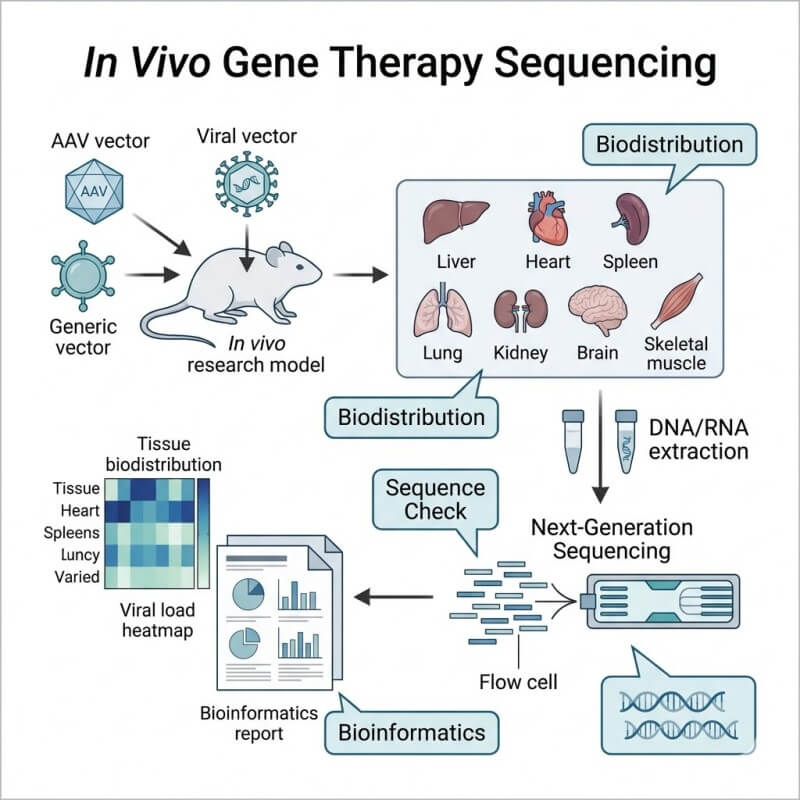
After sequencing, we process the data into usable outputs. Depending on the project, this may include raw data and clean data, sample-level QC summary, target-region read support, tissue-level distribution tables, expression matrix, integration-site candidate table where applicable, visual summaries, analysis report notes, and pipeline and parameter records where included.
The final package is built to help your team review the study, compare groups, and decide whether follow-up experiments are needed.
Demo Results: What Your Data Package May Look Like
Demo results help your team understand what the final outputs may look like. The examples below are common result formats that can be included when they match the study design.
Demo 1: Tissue Biodistribution Profile
A tissue biodistribution profile can show how vector-related signal is distributed across selected tissues, groups, or timepoints. A typical table or chart may include sample ID, tissue type, group or dose, timepoint, target signal, normalized output, and QC status. This view helps your team compare target and non-target tissues in one place.
Demo 2: Vector Sequence and Target-Region Confirmation
A sequence confirmation output can show whether reads support the expected vector region, transgene region, or selected target sequence. A typical report view may include target region, read count or read support, coverage summary, sequence match notes, variant or mismatch flags where relevant, and QC interpretation notes.
Demo 3: Expression and Integration-Related Outputs
For projects that include RNA or integration-related questions, a combined output may show expression patterns and candidate insertion information. A typical output may include tissue or sample group, transgene expression level, host response markers if included, candidate insertion location where applicable, genomic feature annotation, supporting read information, and QC comments.
FAQ: Planning an In Vivo Gene Therapy Sequencing Project
1. Which readout should I choose first?
Start with the question you need to answer. If you need tissue-level presence, start with biodistribution. If you need sequence support, add targeted or vector sequencing. If you need expression evidence, add RNA-level analysis. If insertion-related events matter, integration-site analysis may be useful.
2. Can tissue, blood, DNA, and RNA samples be included in one project?
Yes, but they may require different handling, QC checks, and sequencing workflows. We review the sample types first, then align each sample group with the correct readout.
3. When is sequencing more useful than qPCR or ddPCR alone?
Sequencing is useful when copy-related detection is not enough. It can add target-region support, vector sequence information, expression profiling, integration-related evidence, or broader genomic context.
4. Can you help with AAV genome confirmation?
Yes. For AAV-related work, we can help assess whether AAV genome sequencing or target-region sequencing fits the project. The best option depends on the vector design, sample type, and question being asked.
5. When should integration-site analysis be considered?
Consider it when the delivery system can integrate, when insertion-related questions are part of the study, or when genomic location information is needed. It is not necessary for every biodistribution project.
6. What information should I send before requesting a project plan?
Useful information includes vector type, species, tissue list, timepoints, sample format, target sequence, construct map, desired readouts, and any existing DNA or RNA QC data.
7. What bioinformatics outputs can be included?
Depending on the project, outputs may include QC summaries, tissue-level tables, target-region read support, expression matrices, candidate insertion tables, visualizations, and report notes.
8. Can this solution support multi-tissue, multi-timepoint designs?
Yes. Multi-tissue and multi-timepoint designs are often a good fit for this solution when sample quality, grouping, and readout goals are planned before sequencing begins.
Compliance Disclaimer
N2Jenomics Lab Pvt. Ltd. services are for Research Use Only (RUO). They are not intended for clinical diagnosis, treatment decisions, patient management, direct-to-consumer genetic testing, or individual health assessment.
Address:Registered Office: 150, Patparganj Industrial Area, New Delhi – 110092, India
Operational Address:National Institute of Plant Genome Research (BRIC - NGGF)
Lab No. 206 and 207, Aruna Asaf Ali Marg, P.O. Box No. 10531,
New Delhi – 110067, India