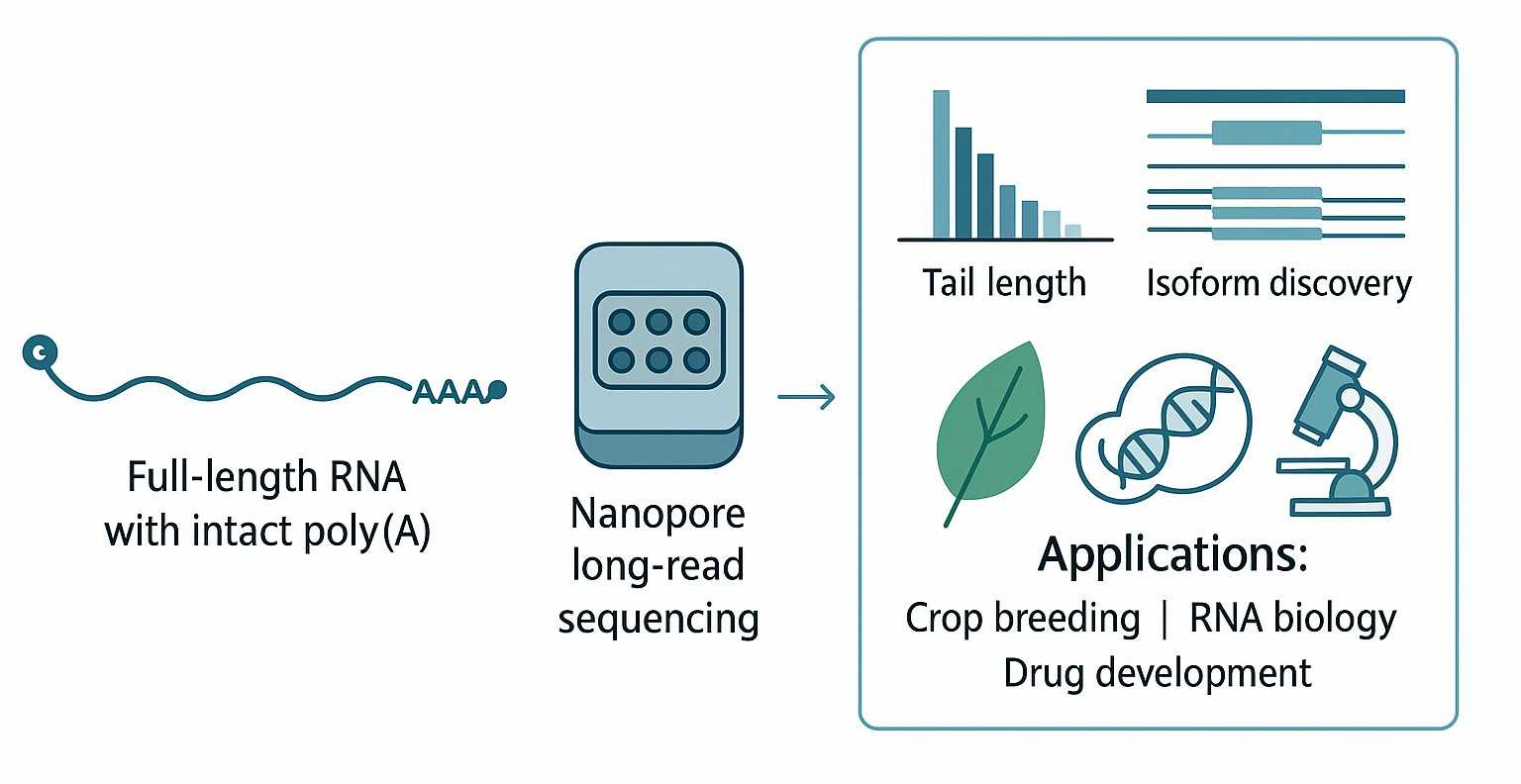
TAIL Iso-seq service from N2 Jenomics Lab Pvt. Ltd. provides a complete solution for understanding RNA poly(A) regulation.
Using Nanopore long-read sequencing, we capture full-length transcripts with intact poly(A) tails. This enables direct analysis of poly(A) tail length, alternative polyadenylation (APA) sites, and isoform-specific regulation in one workflow. Our service supports researchers in biochemistry, pharmaceutical R&D, agriculture, and academic laboratories who need reliable insights into RNA stability, translation efficiency, and regulatory mechanisms.
Key Features:
Poly(A) tails are more than simple RNA extensions. They act as key regulators of mRNA lifespan, stability, and translation. Standard RNA-seq methods often discard or overlook this information, missing valuable regulatory signals.
TAIL Iso-seq addresses this gap. It captures full-length cDNA, including intact poly(A) tails, and provides a direct view of poly(A) length, heterogeneity, and associated APA events. Researchers can link 3'UTR changes to miRNA binding, identify isoform-specific APA usage, and explore how tail length affects gene expression.
This makes TAIL Iso-seq a valuable tool for:
TAIL Iso-seq captures the complete transcript, including 5'UTR, coding region, 3'UTR, and poly(A) tail. This eliminates assembly errors common in short-read RNA-seq and provides isoform-level resolution.
Our service quantifies poly(A) tail length distributions across the transcriptome and detects non-A residues (U, G, C) that affect RNA stability and translation efficiency. This allows researchers to study RNA dynamics with unmatched detail.
TAIL Iso-seq identifies alternative polyadenylation (APA) sites and characterises 3'UTR length changes. This helps link APA to changes in miRNA binding, RNA localisation, and post-transcriptional regulation.
We deliver publication-ready reports with tail length distributions, APA maps, isoform catalogues, and pathway enrichment analyses. Visual outputs simplify interpretation and can be integrated into multi-omics projects.
N2 Jenomics Lab Pvt. Ltd. provides a complete TAIL Iso-seq workflow, from RNA extraction to bioinformatics reporting. Each step is optimised for accuracy and reproducibility, ensuring reliable insights into poly(A) regulation and isoform diversity.
RNA QC: Input RNA is assessed for integrity (RIN ≥7) and purity.
Full-length cDNA capture: Protocols preserve intact poly(A) tails and barcodes can be added for multiplexed projects.
Nanopore long-read sequencing: Reads cover entire transcripts, including 5'UTR, CDS, 3'UTR, and poly(A) tails.

TAIL Iso-seq workflow: from RNA QC, library preparation, and Nanopore long-read sequencing to comprehensive bioinformatics analysis and publication-ready reports.
| Method | Platform | What it measures | Non-A residues | Throughput / Cost (relative) | Typical strengths | Typical limitations | Good for |
|---|---|---|---|---|---|---|---|
| TAIL-seq | Illumina (3' end sequencing) | Genome-wide tail length at 3' ends; 3' terminome | Detects terminal U/G additions | High / $$ | Sensitive mapping of 3' ends; links tail length to decay | Raw signal processing and custom analysis required; not full-length isoforms | Deadenylation/uridylation studies; stability assays |
| PAL-seq | Illumina + fluorescence standards | Tail length using calibrated fluorescence; 3' end features | Indirect | High / $$ | Internal standards for calibrated tail length; robust bulk profiling | Added biochemistry; specialised setup; not full-length | Calibrated bulk tail length distributions; method benchmarking |
| Poly(A)-seq | Illumina (direct reading of poly(A) in cDNA) | Global profiling of poly(A) tails; per-gene median tail | Not primary focus | High / $ | Simpler library vs TAIL-seq; scalable cohorts | Isoforms not resolved; homopolymer challenges | Large-cohort screening of tail length shifts |
| FLAM-seq | PacBio (long-read cDNA) | Full-length mRNA including poly(A) tail | Reports non-A residues | Moderate / $$–$$$ | Links isoform structure + tail length per molecule | PacBio access; longer run times | Isoform-resolved tail biology; tail composition per isoform |
| PAIso-seq / PAIso-seq2 | PacBio HiFi | Transcriptome-wide tail length from low input; full-length | Can capture tail composition | Moderate / $$–$$$ | High-accuracy HiFi reads; low-input (e.g., oocytes) | Platform-specific; method complexity | Precious/low-input samples; accurate tail estimates |
| FLEP-seq2 | Nanopore (long-read cDNA) | Full-length RNA with tail length across tissues/species | Detects tail patterns | Moderate / $$ | Depth-friendly; cross-tissue atlases; nuclear vs cytoplasmic comparisons | Nanopore base-level accuracy trade-offs | Tissue atlases; plant and non-model organisms |
| Nano3P-seq | Nanopore (3' end-capture cDNA) | RNA abundance + tail dynamics (poly(A) and non-poly(A)) | Detects non-A residues | Moderate / $$ | Captures polyadenylated and non-polyadenylated RNAs; per-molecule tails | End-capture bias to 3' end; requires toolchain | Developmental time-course; transcriptome-wide tail dyn |
Our in-house pipeline integrates multiple layers of information:

| Sample Type | Recommended Quantity | Minimum Quantity | Concentration / Quality | Notes |
|---|---|---|---|---|
| Total RNA | ≥ 2 µg | 600 ng | ≥ 30 ng/µL | RIN ≥ 8, OD260/280 ≥ 1.8, DNA-free |
| Cells | ≥ 1 × 10⁶ | ≥ 5 × 10⁵ | High viability (>80%) | Snap-freeze pellets in liquid nitrogen |
| Tissue (animal/plant) | ≥ 50 mg | ≥ 10 mg | RNA integrity RIN ≥ 8 | Remove contaminants, freeze immediately |
| Plant tissue (special) | 50–100 mg per aliquot | – | RNA integrity RIN ≥ 8 | Wash with DEPC water, freeze in liquid nitrogen |
| Bacterial culture | ≥ 1 × 10⁷ cells | – | RNA integrity RIN ≥ 8 | Pellet, wash with PBS, freeze in liquid nitrogen |

What is TAIL Iso-seq and how does it differ from regular Iso-seq or RNA-seq?
TAIL Iso-seq is a long-read sequencing service (Nanopore-based) that captures full-length transcripts including the native poly(A) tail, enabling direct measurement of tail length, APA (alternative polyadenylation) sites, and isoform diversity. Regular RNA-seq often loses tail information and requires read assembly, while standard Iso-seq may capture transcript structure but not always the full poly(A) composition and non-A residues.
Can TAIL Iso-seq detect non-A nucleotides inside or at the end of poly(A) tails?
Yes. The service includes detection of non-adenosine residues (such as U, G, C) both at the terminal position and internally in the poly(A) tail. These non-A residues provide insight into transcript stability, degradation, or deadenylation regulation. Tools like tailfindr, nanopolish, and others support this analysis.
How accurate is poly(A) tail length measurement with Nanopore long reads?
TAIL Iso-seq uses state-of-the-art basecalling and signal processing pipelines to estimate tail length per molecule with high resolution, often at single nucleotide precision for shorter tails and good relative accuracy for longer tails. Accuracy also depends on sample quality, sequencing output (.fast5 retention), and tool choice (tailfindr, nanopolish, etc.).
Do I need a reference genome to use TAIL Iso-seq?
No, but having a reference genome or transcript annotation improves mapping, APA site identification, and isoform resolution. In non-model organisms, de novo long-read assembly combined with reference-free transcript annotation is possible, though some analyses (e.g. miRNA-binding prediction) may be more challenging without good annotation.
What are the input sample requirements for TAIL Iso-seq?
Total RNA of high integrity is required (recommended RIN ≥ 7), free of contaminants, with sufficient quantity depending on organism / tissue; lower input is possible with optimized methods. The RNA must include intact poly(A) tails and minimal degradation for best results.
How do you handle PCR bias or truncation of poly(A) tails in the pipeline?
We minimise bias by using long-read sequencing (which avoids fragment assembly), capturing full-length transcripts, retaining raw signal data (.fast5) for tail length estimation, and employing QC steps to filter truncated or degraded RNA. Usage of tools that work on raw signal helps ensure accurate tail estimation.
What is the difference between poly(A) tail analysis and APA (alternative polyadenylation) analysis?
Poly(A) tail analysis focuses on the length, composition, and modifications of the tail itself at the transcript-end. APA analysis addresses where polyadenylation occurs—i.e. mapping poly(A) cleavage sites, the varying 3' untranslated region (3'UTR) lengths among isoforms, and how that affects regulation (e.g., miRNA binding). Both are complementary.
Can TAIL Iso-seq be used for comparative studies across conditions or species?
Yes. Because it provides per-isoform tail length distributions and APA site usage per sample, TAIL Iso-seq supports comparisons across tissues, treatments, or species. Statistical pipelines can test for differential tail length or APA usage between groups.
How long will I get the results (bioinformatics + deliverables)?
Typical timelines depend on sample number, complexity, and sequencing depth. Reporting includes raw + processed sequencing data, tail length distributions, APA mapping, isoform catalogues, and visualizations. (Specific turn-around times will be provided based on scope in the project quote.)
How does cost scale with sample number, depth, or target transcript complexity?
Costs generally increase with the number of samples, required read depth, and complexity (e.g. non-model organism or low expression transcripts). N2 Jenomics Lab Pvt. Ltd. offers scalable pricing; clients can choose from standard or premium analysis levels depending on how much resolution (isoform discovery, tail composition, APA precision) they require.

Citation: Jia J., Lu W., Liu B., et al. An atlas of plant full-length RNA reveals tissue-specific and monocots–dicots conserved regulation of poly(A) tail length, Nature Plants 2022.
Researchers lacked a comprehensive, full-length transcriptome resource in plants that includes poly(A) tail length information across tissues and species. Prior short-read methods often failed to preserve poly(A) tails or did not link tails to full transcript isoforms. This gap limited insights into how poly(A) length, APA (alternative polyadenylation), and mRNA stability vary between tissues or across plant species.

Figure: Nuclear poly(A) tails are longer than cytoplasmic tails. This shows the distribution of poly(A) tail lengths in nuclear vs cytoplasmic fractions across plant species/tissues.
References: