In Vivo CAR-T Integration Site Analysis Solution
Home
> In Vivo CAR-T Integration Site Analysis Solution
In Vivo CAR-T Integration Site Analysis Solution
Plan integration-site analysis for in vivo CAR-T and vector-engineered immune-cell research. At N2Jenomics Lab Pvt. Ltd. , we help your team connect CAR construct information, sample type, genomic DNA quality, sequencing strategy, integration-site calling, clone abundance analysis, genomic annotation, and bioinformatics reporting into one review-ready research evidence package.
Map CAR/vector integration sites with sequencing support
Turn CAR/vector integration questions into sequencing-ready evidence
In vivo CAR-T and in vivo immune-cell engineering studies often raise questions that a basic sequencing file cannot answer on its own. Your team may need to know whether CAR/vector-related sequences are integrated, where candidate integration sites are located, whether certain sites are enriched, and how the integration profile changes across samples.
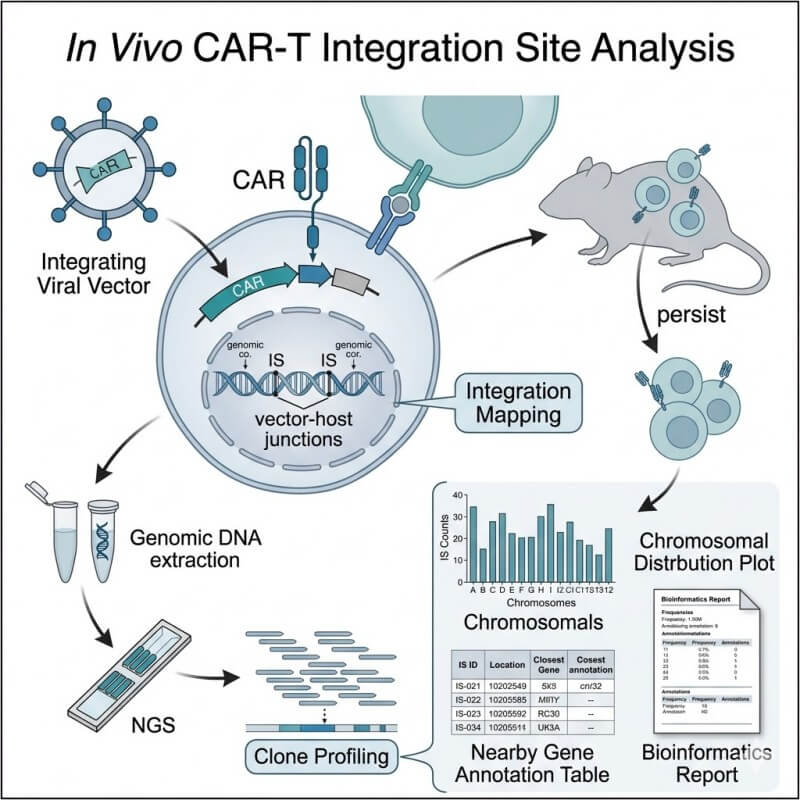
Our in vivo CAR-T integration site analysis solution helps you move from raw sequencing output to a clearer integration profile. The goal is not only to detect sites, but to organize them into genomic coordinates, annotation tables, clone-abundance summaries, QC notes, and review-ready figures.
What this solution helps you answer
Are CAR/vector-related sequences integrated into the host genome?
Where are candidate integration sites located?
Which nearby genes or genomic features are associated with those sites?
Are some integration sites supported by higher read or fragment counts?
Do integration profiles differ across tissues, timepoints, or groups?
What QC and bioinformatics outputs are needed for internal project review?
For many projects, the most useful result is not a site list alone. It is a structured integration profile that links sequence evidence with genomic context.
Why an integration-site list is not enough
A basic integration-site table may show genomic coordinates, but that does not always tell your team how to review the result. A useful report often needs nearby gene annotation, chromosomal distribution, genomic feature categories, clone abundance, sample-level QC, and cross-sample comparison.
We help you plan those outputs before sequencing begins. This makes the final results easier to review and reduces the risk of generating data that are technically valid but difficult to interpret.
Our service capabilities for in vivo CAR-T integration studies
We support in vivo CAR-T integration-site projects as integrated sequencing and bioinformatics studies, not as isolated data-generation tasks. Before the project starts, our team can review your CAR/vector design, sample source, genomic DNA status, expected integration biology, and reporting goals.
That early review matters. The best strategy for a purified engineered-cell sample may not be the same as the strategy for tissue-derived cells, sorted immune cells, or low-input genomic DNA from an in vivo study.
Vector and CAR construct contexts we can support
In vivo CAR engineering research
CAR-T or engineered immune-cell research
Lentiviral or retroviral vector integration profiling
Vector-host junction analysis
CAR/vector construct-related sequencing support
Multi-sample integration profile comparison
Integration-site sequencing and annotation modules
CAR/vector sequence information review
Genomic DNA QC and feasibility review
Integration junction enrichment or targeted library strategy
NGS-based integration-site detection
Candidate site calling and genomic coordinate assignment
Nearby gene and genomic feature annotation
Clone abundance or site-support summary where supported
Cross-sample comparison
Report-ready visualization and bioinformatics notes
Project execution support from sample review to report delivery
A strong project starts with the right information. Before sequencing, we help you review CAR/vector sequence or LTR information, sample type and collection format, genomic DNA amount and concentration, sample grouping and timepoints, expected integration signal, control sample availability, desired annotation categories, and required output tables and figures.
This helps your team align the experimental question with the assay design and bioinformatics plan.
Choose the right integration-site detection strategy
There is no single integration-site method that fits every in vivo CAR-T project. Method choice depends on vector biology, sample quality, DNA input, target sequence information, and whether your team needs sensitivity, genomic context, clone abundance, or structural detail.
Method
Best-fit Question
Input Need
Strength
Limitation
Suggested Use
LAM-PCR
Where are vector-host junctions?
Known LTR/vector sequence; genomic DNA
Enriches integration junctions from known vector ends
May introduce amplification bias
Known integrating vectors with defined junction design
nrLAM-PCR
Can junction detection be improved with reduced restriction bias?
Known vector sequence; genomic DNA
Useful for recovering junctions with less dependence on restriction sites
Still amplification-dependent
Integration-site discovery when junction enrichment is needed
Targeted Capture NGS
Can known CAR/vector regions be captured and mapped?
CAR/vector sequence; genomic DNA
Flexible target design and useful sequence support
Depends on probe or target design
CAR/vector confirmation plus junction evidence
Whole Genome Sequencing
Is broader genomic context needed?
Higher-quality genomic DNA
Genome-wide context and broader variant-level information
Lower sensitivity for rare integration events
Selected samples with adequate DNA and broader genomic questions
Long-read Sequencing
Is long-range structure or complex insertion context important?
Start with the vector biology and the CAR construct information. If your main goal is vector-host junction detection, a junction-enrichment strategy may be appropriate. If your team also needs to verify CAR/vector regions, targeted sequencing can be added. If the question involves broader genomic context, whole-genome or long-read sequencing may be considered for selected samples.
Clone abundance analysis should be planned only when the sample design and sequencing strategy support meaningful comparison. Annotation categories should also be chosen before sequencing begins, so the final output can include nearby genes, genomic features, chromosomal distribution, and sample-level summaries.
Demo results: what your integration profile may include
Demo results help your team understand how integration-site data can be organized. The examples below show common result formats that may be included when they match the study design.
Demo 1: Chromosomal distribution of integration sites
A chromosomal distribution view can show how candidate integration sites are distributed across chromosomes and samples. This can help your team review whether sites appear broadly distributed or concentrated in selected regions. A typical output may include chromosome ID, genomic coordinate, sample ID, supporting read or fragment count, and visualization by chromosome.
Demo 2: Nearby gene and genomic feature annotation
A gene annotation table can show which genes or genomic features are near candidate integration sites. Depending on the selected annotation categories, the report may include gene body, intronic, intergenic, promoter-proximal, repeat-associated, transcription-unit, or other feature labels. This output helps turn coordinates into a more useful genomic context.
Demo 3: Clone abundance and sample comparison
When supported by the assay design, clone abundance or site-support summaries can help compare integration profiles across samples. For example, a report may show candidate clonal patterns across tissues, timepoints, or treatment groups. A typical visualization may include a heatmap, stacked bar chart, or ranked site-support table.
Compliance Disclaimer
N2Jenomics Lab Pvt. Ltd. services are for Research Use Only (RUO). They are not intended for clinical diagnosis, treatment decisions, patient management, direct-to-consumer genetic testing, or individual health assessment.
FAQ: planning an in vivo CAR-T integration-site project
1. Do I need integration-site analysis for every in vivo CAR-T study?
Not always. Integration-site analysis is most useful when the vector system can integrate, when insertion-site location matters, or when your team needs clonal profile information. If the main question is vector presence, expression, or biodistribution, another readout may be more appropriate or may need to be combined with integration-site analysis.
2. What sample type is best for CAR/vector integration-site detection?
Extracted genomic DNA is usually the most direct input. PBMC, sorted immune cells, tissue-derived cells, cell pellets, or cultured engineered cells may also be suitable if enough genomic DNA of acceptable quality can be obtained.
3. Can low-input DNA be used?
Low-input DNA may be possible, but it requires feasibility review. The expected integration level, DNA quality, vector sequence information, and selected method all affect whether the project can proceed.
4. What vector or CAR construct information should I provide?
Useful information includes the CAR/vector map, LTR or vector-end sequence, transgene region, expected integration mechanism, sample groups, and any known target sequences for assay design.
5. What is the difference between vector sequence confirmation and integration-site mapping?
Vector sequence confirmation checks whether expected CAR/vector regions are supported by sequencing. Integration-site mapping looks for vector-host junctions and assigns candidate insertion sites to genomic coordinates. Some projects need both.
6. Can clone abundance be estimated from integration-site data?
Clone abundance or site-support summaries may be included when the assay design and sequencing data support it. The result should be interpreted as a research profile, not as a standalone conclusion.
7. Can integration profiles be compared across tissues or timepoints?
Yes, if the study design includes comparable samples and sufficient data quality. Cross-sample comparison may show differences in candidate integration-site patterns, site support, or clonal profile across tissues, timepoints, or groups.
8. What bioinformatics outputs can be included?
Outputs may include candidate integration-site tables, genomic coordinates, nearby gene annotation, genomic feature distribution, chromosomal distribution plots, clone-abundance summaries, sample-level QC summaries, and report notes.
9. Can this solution support lentiviral and retroviral vector studies?
Yes. Lentiviral and retroviral vector studies are common contexts for integration-site analysis because vector-host junction detection and clonal profile review may be important for research interpretation.
10. Can N2Jenomics Lab Pvt. Ltd. help decide which method is appropriate?
Yes. We can review your vector type, CAR construct, sample source, DNA amount, expected integration profile, and reporting goals to help select a fit-for-purpose strategy.
Compliance Disclaimer
N2Jenomics Lab Pvt. Ltd. services are for Research Use Only (RUO). They are not intended for clinical diagnosis, treatment decisions, patient management, direct-to-consumer genetic testing, or individual health assessment.
Address:Registered Office: 150, Patparganj Industrial Area, New Delhi – 110092, India
Operational Address:National Institute of Plant Genome Research (BRIC - NGGF)
Lab No. 206 and 207, Aruna Asaf Ali Marg, P.O. Box No. 10531,
New Delhi – 110067, India