iPSC Gene Editing and Quality Control Solution
Home
> iPSC Gene Editing and Quality Control Solution
iPSC Gene Editing and Quality Control Solution
Plan iPSC gene editing and quality control with clone-level validation and sequencing-supported evidence. At N2Jenomics Lab Pvt. Ltd. , we help your team connect editing goals, guide and donor design, monoclonal screening, target-site confirmation, genome-wide QC options, bioinformatics analysis, and final deliverables into one practical project plan.
Plan KO, KI, correction, or reporter editing
Screen and compare edited iPSC clones
Validate target-site edits with sequencing support
Build edited iPSC clones with sequencing-supported QC from the start
Gene editing in induced pluripotent stem cells can support disease modeling, isogenic control generation, functional genomics, and drug discovery model development. But an edited iPSC project is rarely just an editing task. Your team also needs clone-level validation, sample tracking, sequencing evidence, and a clear QC plan before downstream experiments begin.
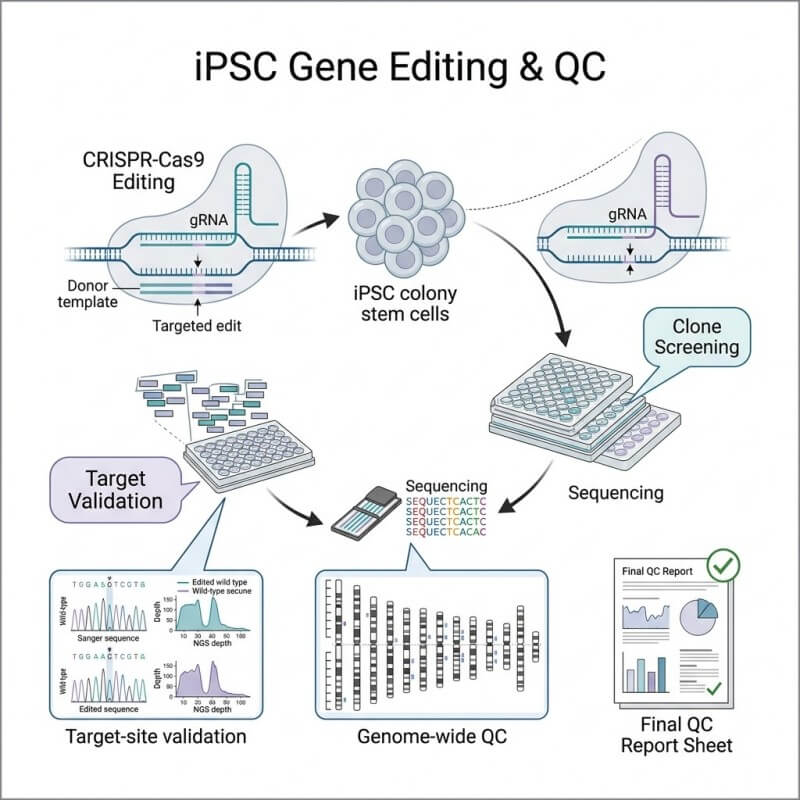
Our iPSC gene editing and quality control solution is designed to help you plan the project as one connected workflow. We help you think through the editing goal, target sequence, donor template, screening strategy, target-site validation, optional genome-wide QC, and report-ready deliverables before cells or extracted DNA enter the project.
What this solution helps you answer
Is my iPSC line suitable for the planned editing goal?
Should the project use a KO, KI, point mutation, correction, or reporter strategy?
Is a donor template needed?
Which clones carry the intended edit?
Is Sanger confirmation enough, or should amplicon, targeted, or whole-genome sequencing be added?
What QC outputs are needed before downstream disease modeling, differentiation, or functional studies?
The goal is to help your team move from "we need an edited clone" to "we understand which clone is better supported by sequencing and QC evidence."
Why edited iPSC projects need more than target-site confirmation
Target-site confirmation is important, but it may not be enough for every edited iPSC project. A clone can appear correct by a short PCR or Sanger readout while still requiring deeper review for allele status, larger on-target events, donor insertion structure, copy number changes, or other genome-wide QC signals.
That does not mean every project needs the same QC depth. It means QC should match the purpose of the edited clone. A quick exploratory knockout screen may not need the same evidence package as a high-value isogenic disease model or a clone intended for long-term downstream differentiation studies.
We help you define that QC depth early, so the final results are easier to review and easier to use.
Our service capabilities for edited iPSC projects
We support edited iPSC projects as integrated design, validation, sequencing, QC, and reporting workflows. Depending on project scope, our team can help with editing strategy planning, clone screening logic, target-site validation, sequencing-supported QC, and bioinformatics interpretation.
Editing goals we can help plan
Gene knock-out for loss-of-function modeling
Knock-in or reporter insertion
Point mutation introduction
Disease-associated mutation correction
Isogenic control generation
Donor-template-supported editing
Clone-level genotype validation
Sequencing-supported QC before downstream research
For each project, the editing goal should be linked to a validation strategy. A knockout clone may require allele-level indel interpretation, while a knock-in or reporter insertion may require junction validation and donor sequence confirmation.
Clone screening and validation modules
Candidate clone collection and tracking
Clone expansion status review
Target-site genotyping
Sanger or amplicon sequencing where appropriate
Targeted sequencing for higher-resolution edit review
Donor insertion or junction confirmation
Clone comparison table
QC flagging and report notes
These modules help your team compare clones in a structured way rather than reviewing scattered files.
Sequencing-supported QC and reporting options
For selected projects, sequencing-supported QC can go beyond the target site. Depending on the study goal, optional add-ons may include off-target candidate review, whole-genome sequencing-supported QC, CNV/SNV/SV analysis, or large on-target event review.
Choose the right editing and QC strategy for your iPSC line
There is no single QC plan that fits every edited iPSC project. The right strategy depends on the editing goal, donor design, clone number, downstream use, and how much genomic context your team needs.
Strategy
Main Question
Best-Fit Editing Goal
Validation Method
QC Depth
Limitation
Knockout
Was the target gene disrupted?
Loss-of-function iPSC model
Sanger, amplicon sequencing, or targeted sequencing
Target-site validation and clone comparison
May need allele-level interpretation
Knock-in
Was the donor sequence inserted correctly?
Reporter insertion, tag insertion, functional sequence addition
Junction PCR, amplicon sequencing, or targeted sequencing
Was the reporter inserted in-frame and at the correct site?
Reporter iPSC line
Junction validation and sequencing
Target-site plus downstream expression planning
Does not replace cell-state QC
WGS-Supported QC
Are broader genomic changes present?
High-value clone review before downstream studies
Whole genome sequencing and bioinformatics
Genome-wide review, CNV/SNV/SV context where applicable
Not always required for every research clone
For target-site validation, Targeted Region Sequencing may support focused review. For broader genome-wide assessment, Whole Genome Sequencing can be considered when the project requires deeper QC.
Start with the edit you need and the downstream experiment you plan to run. If the edited clone will be used for early exploratory work, target-site validation and clone comparison may be enough. If the clone will support disease modeling, isogenic control studies, or long-term differentiation experiments, a deeper QC package may be useful.
A donor-template project should include donor design review and junction confirmation. A point mutation or correction project may need allele-level sequencing. A clone intended for broader downstream use may need genome-wide QC or off-target candidate review.
We help you choose the level of validation that fits the research goal, without turning every project into an unnecessarily heavy workflow.
Sample-to-report workflow with clone-level QC checkpoints
Our workflow connects editing design, clone screening, sequencing validation, and QC reporting. Each step is designed to reduce uncertainty before the project moves to the next stage.
Step 1: Project intake and editing goal review
We start by reviewing target gene or genomic region, editing type, iPSC source and cell-line background, donor template or construct information where applicable, downstream research use, desired validation depth, number of clones to screen, and expected deliverables.
This step helps us define whether the project needs target-site validation only, clone comparison, off-target candidate review, genome-wide QC, or a combined package.
Step 2: Editing design, guide RNA, and donor template planning
The editing design should match the intended result. Knockout projects may focus on creating frameshift or disruptive indels. Knock-in and reporter projects require donor template planning and junction validation. Point mutation or correction projects require careful sequence-level confirmation.
At this stage, guide RNA, donor template, target sequence, and screening logic are reviewed together. This helps reduce the risk of designing an edit that is technically possible but hard to validate later.
Step 3: Delivery, recovery, and monoclonal screening
The delivery and recovery plan depends on the iPSC line and editing strategy. iPSC lines can be sensitive to editing stress, single-cell handling, and clone expansion. Monoclonal screening helps separate candidate clones and allows each clone to be reviewed independently.
Once clones are available, sample identity, clone labeling, expansion status, and DNA availability become important QC checkpoints.
Step 4: Target-site validation and clone comparison
Target-site validation checks whether the intended edit is present. Depending on the project, this may include Sanger sequencing, amplicon sequencing, targeted sequencing, junction confirmation, allele-level review, or donor insertion support.
Clone comparison brings the results together. Instead of looking at each clone in isolation, your team can compare genotype, edit pattern, zygosity, donor insertion status, QC flags, and sequencing quality in one table.
Step 5: Genome-wide QC, bioinformatics, and final deliverables
For selected projects, additional QC may include whole-genome sequencing-supported review, off-target candidate validation, CNV/SNV/SV analysis, or large on-target event review. Bioinformatics analysis organizes these results into tables, visual summaries, and report notes.
The final deliverables may include edited clone information, sequencing data, QC summaries, clone comparison tables, figures, and analysis notes.
Demo results: what an edited iPSC QC package may include
Demo results help your team understand what a final QC package may look like. These examples show common output formats when they match the project design.
Demo 1: Target-site editing confirmation
A target-site confirmation output can show whether the intended edit is present. Depending on the method, this may include sequence traces, amplicon sequencing summaries, indel profiles, donor junction evidence, or allele-level edit tables.
This helps your team move beyond "edited or not edited" and review the exact sequence-level result.
Demo 2: Clone screening and genotype comparison
Clone comparison is useful when multiple candidate clones are available. A report may compare clone ID, genotype, allele status, edit pattern, expansion status, donor insertion support, and QC flags.
This makes it easier to decide which clones should move forward into deeper QC or downstream assays.
Demo 3: Genome-wide QC and off-target review summary
For higher-value edited iPSC projects, genome-wide QC or off-target review may be added. A summary may include candidate off-target sites, CNV/SNV/SV findings where applicable, genome-wide QC notes, and figure-ready summaries.
The goal is not to overstate what QC can prove. The goal is to provide a stronger research evidence package for clone review.
N2Jenomics Lab Pvt. Ltd. services are for Research Use Only (RUO). They are not intended for clinical diagnosis, treatment decisions, patient management, direct-to-consumer genetic testing, or individual health assessment.
FAQ: planning an iPSC gene editing and QC project
1. Can you work with my existing iPSC line?
Yes. We can review your existing iPSC line, editing goal, available cell information, and QC needs before project setup. Useful information includes cell source, passage history, culture status, mycoplasma status if available, and downstream use case.
2. What editing types can this solution support?
This solution can support planning for knockout, knock-in, point mutation, mutation correction, reporter insertion, and isogenic control projects. The exact workflow depends on target sequence, donor template, cell-line condition, and validation goals.
3. Do I need monoclonal screening?
If your team needs a stable edited iPSC clone for downstream studies, monoclonal screening is usually important. It allows individual clones to be genotyped, compared, and selected based on clone-level evidence.
4. Is Sanger sequencing enough for edited iPSC validation?
Sanger sequencing may be useful for initial target-site screening, but it may not be enough for every project. Amplicon sequencing, targeted sequencing, off-target validation, or WGS-supported QC may be useful when allele-level resolution or broader genomic context is needed.
5. When should WGS be added to edited iPSC QC?
WGS may be considered when a clone will support high-value downstream studies, isogenic disease modeling, long-term differentiation, or projects where genome-wide context is important. It is not required for every edited clone.
6. What sample or project information should I provide?
Useful information includes target gene, editing type, iPSC source, donor template, guide RNA information, target sequence, clone list, available gDNA QC data, desired deliverables, and downstream research use.
7. Can you compare multiple edited clones?
Yes. Clone comparison can include genotype, allele status, target-site edit pattern, donor junction support, QC flags, sequencing quality, and report notes. This helps your team decide which clones should move forward.
8. What bioinformatics outputs can be included?
Outputs may include target-site validation summaries, indel or allele profiles, clone comparison tables, candidate off-target validation tables, CNV/SNV/SV review where applicable, genome-wide QC notes, and final report summaries.
9. Can this solution support disease modeling or isogenic control projects?
Yes. Edited iPSC lines are often used in disease modeling and isogenic control research. We can help plan the editing and QC strategy so that clone-level evidence supports downstream research review.
10. What deliverables can be included?
Depending on project scope, deliverables may include edited clone information, sequencing data, target-site validation results, clone comparison tables, bioinformatics outputs, QC summaries, and final report notes.
N2Jenomics Lab Pvt. Ltd. services are for Research Use Only (RUO). They are not intended for clinical diagnosis, treatment decisions, patient management, direct-to-consumer genetic testing, or individual health assessment.
Address:Registered Office: 150, Patparganj Industrial Area, New Delhi – 110092, India
Operational Address:National Institute of Plant Genome Research (BRIC - NGGF)
Lab No. 206 and 207, Aruna Asaf Ali Marg, P.O. Box No. 10531,
New Delhi – 110067, India