cfDNA Detection and Analysis Platform
Home
> cfDNA Detection and Analysis Platform
cfDNA Detection and Analysis Platform
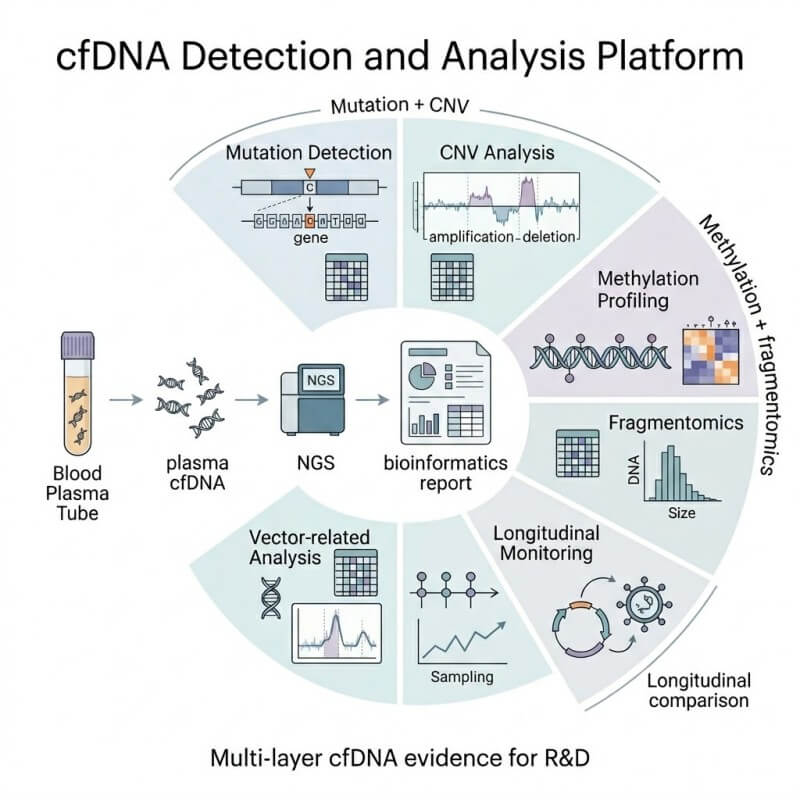
N2Jenomics Lab Pvt. Ltd. provides a cfDNA detection and analysis platform for research teams that need more than a standard mutation panel. We support plasma cfDNA extraction, sequencing strategy selection, mutation and CNV analysis, methylation profiling, fragmentomics, longitudinal comparison, and specialized vector-related applications, with bioinformatics reports built for R&D review.
Profile cfDNA mutations, CNVs, methylation, and fragmentomics
Support longitudinal plasma sample comparison
Add vector-related analysis when research requires it
Receive QC-backed reports and interpretable data outputs
Turn Plasma cfDNA into Multi-Layer Research Evidence
Cell-free DNA is a short-fragment DNA population released into blood and other biofluids. In research settings, cfDNA can carry genomic, epigenomic, fragmentomic, and sample-context information. That makes it useful when teams need molecular evidence from plasma or other biofluid samples, especially when tissue sampling is limited or repeated sampling is important.
Our cfDNA Detection and Analysis Platform is designed to help you move from sample planning to interpretable results. We help your team choose the right assay route, apply cfDNA-specific QC, generate sequencing data, and organize the findings into a report your R&D team can actually use.
Why cfDNA Is More Than a Mutation Signal
Many teams first think of cfDNA as ctDNA mutation detection. That is one important use case, but cfDNA can provide broader research evidence.
Depending on the project, cfDNA may be used to study:
SNVs and indels
Copy number changes
Methylation patterns
Fragment size distribution
Fragment end motifs
Nucleosome-related footprints
Longitudinal signal changes
Vector-related or integration-site evidence
Tissue-origin or cell-type deconvolution research
This wider view is important for oncology biomarker discovery, translational research, CGT safety research, preclinical studies, and serial sample analysis.
Where This Platform Fits in Translational and CGT Research
A cfDNA platform is most useful when your project needs molecular information from plasma or other biofluids, when tissue sampling is difficult, or when multiple timepoints need to be compared under a consistent analysis framework.
We support research questions such as:
Which cfDNA features differ between study groups?
Are mutation or CNV signals detectable in serial plasma samples?
Do methylation patterns suggest tissue-origin or cell-type changes?
Are fragmentomic features useful for sample comparison?
Can plasma cfDNA support preclinical longitudinal monitoring?
Is vector-related analysis needed for CGT or gene therapy research?
For broader liquid biopsy research context, our Liquid Biopsy Solutions page provides additional service background.
What We Can Detect and Analyze from cfDNA
cfDNA analysis works best when the platform is modular. Some studies need targeted mutation detection. Others need low-pass WGS for CNV or fragmentomics. Some require methylation profiling or serial sample comparison. CGT projects may also need vector-related analysis.
We help your team select the assay layer that matches the research question instead of forcing every project into the same workflow.
Mutation and Small Variant Detection
Targeted cfDNA sequencing can support research focused on known genes, hotspots, or custom genomic regions. It is most useful when the study question involves SNVs, indels, selected variants, or defined biomarker regions.
Variant tables
Read support summaries
Allele fraction estimates where applicable
Coverage summaries
Sample-level variant overview
Report notes for research interpretation
This approach is a good fit when your team already knows the genomic regions that matter.
Copy Number and Genome-Wide Signal Analysis
Low-pass WGS or other genome-wide approaches may be used when the research question involves CNV, CNA, broad genomic imbalance, or multi-feature cfDNA analysis.
Genome-wide CNV or CNA plots
Segment-level copy-number tables
Chromosome-level signal summaries
QC notes on coverage and noise
Integration with fragmentomics where appropriate
Low-pass WGS can also support cfDNA fragmentomics when the study is designed around genome-wide fragment-level features.
Methylation and Tissue-Origin Research
cfDNA methylation profiling can help researchers study epigenetic patterns, tissue-origin signals, or cell-type deconvolution in research contexts. This can be useful when sequence variation alone does not provide enough biological context.
Methylation signal tables
Differential methylation results where applicable
Feature matrices for downstream modeling
Tissue-origin or cell-type deconvolution research outputs when supported by the design
Visual summaries of methylation patterns
Fragmentomics and Nucleosome-Related Features
cfDNA fragmentomics examines properties of cfDNA fragments rather than only their sequence. These features may include fragment length, short-to-long fragment ratios, end motifs, breakpoint patterns, nucleosome-related footprints, and genome-wide fragmentation patterns.
Longitudinal Monitoring and Serial Sample Comparison
Many cfDNA studies become more informative when multiple timepoints are included. Serial plasma samples can help researchers compare signal changes over time, across conditions, or between study groups.
Timepoint-level feature tables
Variant or CNV trend plots
Methylation or fragmentomics trend summaries
Sample-to-sample distance visualization
Longitudinal heatmaps
Research interpretation notes
We do not over-interpret serial cfDNA data. Our goal is to organize molecular trends clearly so your team can decide which patterns deserve deeper review.
Vector-Related and Integration Site Research Applications
For CGT, gene therapy, or in vivo cell therapy research, cfDNA may support specialized questions related to vector-derived sequences, vector-genome junction evidence, or integration-site research.
This is one module of the platform, not the whole platform.
Vector-related sequence detection
Vector-genome junction review
Integration-site mapping where technically supported
Clonal abundance trend analysis
Longitudinal comparison across plasma samples
Research reports for safety assessment discussions
This module should be selected only when the research question requires vector-related evidence.
Our Platform Capability Advantage for cfDNA Projects
cfDNA projects are technically sensitive. Sample handling, cfDNA yield, library bias, molecular barcodes strategy, sequencing depth, and bioinformatics preprocessing can all influence interpretation. We help you plan these details before data generation begins, because the best report starts with the right study design.
cfDNA-Specific Wet-Lab Planning
cfDNA is often low-input and fragmented. It can also be affected by hemolysis, genomic DNA contamination, plasma separation conditions, storage, and freeze-thaw history.
Sample type review
Plasma preparation considerations
cfDNA extraction strategy
Input feasibility review
Fragment size QC
gDNA contamination check
Library strategy selection
Sample metadata review
The goal is simple: reduce avoidable variability before sequencing starts.
NGS Strategy Matched to the Research Question
There is no single cfDNA assay that answers every question. A targeted panel, low-pass WGS, methylation workflow, fragmentomics design, or specialized module may be appropriate depending on the project.
Targeted vs genome-wide question
Mutation vs epigenetic feature
Single-timepoint vs longitudinal design
Oncology vs CGT vs preclinical research
Known biomarker vs discovery question
Need for molecular barcodes-aware consensus analysis
Required report outputs
This helps keep the project focused and avoids spending sample or budget on data layers that will not answer the main question.
Bioinformatics That Turns cfDNA Reads into Reviewable Evidence
cfDNA sequencing data require careful processing. Generic tissue-DNA pipelines may not fully address cfDNA-specific biases, fragment features, low-input signal, or serial sample comparison.
Alignment and coverage review
molecular barcodes-aware consensus generation where applicable
Variant calling or CNV/CNA analysis
Methylation signal processing
Fragmentomics feature extraction
Longitudinal comparison
Specialized vector-related analysis
QC and interpretation notes
We structure the outputs so both scientists and bioinformaticians can review the evidence behind the figures.
Flexible Scope Without Overbuilding the Study
A broad platform does not mean every project needs every module. We help you avoid unnecessary complexity while keeping the study strong enough to answer the research question.
Use targeted cfDNA sequencing for defined variants or regions.
Use low-pass WGS for CNV/CNA or fragmentomics.
Use methylation profiling for epigenetic or tissue-origin research.
Use fragmentomics when fragment-level features matter.
Use a longitudinal design when serial samples are the core of the study.
Add vector-related analysis only when the research question requires it.
cfDNA Detection Workflow with QC Checkpoints
Our workflow follows the sample from study design to final report. Each step includes a QC checkpoint because cfDNA data are strongly affected by pre-analytical handling, library strategy, sequencing quality, and analysis choices.
Step 1 — Study Design and Assay Scope Review: We begin by reviewing the biological question and deciding which cfDNA modules are appropriate. We may ask for sample source, disease model or research context, plasma or biofluid type, single-timepoint or longitudinal design, targeted regions or genome-wide analysis needs, methylation or fragmentomics goals, CGT or vector-related research requirements, matched tissue or matched normal availability, and existing data format if reanalysis is requested. QC checkpoint: We confirm that the assay strategy matches the research question and available sample type.
Step 2 — Plasma / Biofluid Sample Intake and cfDNA Extraction: Plasma or other biofluid samples are reviewed before extraction. If whole blood is submitted for plasma preparation, collection tube type and processing conditions should be reviewed in advance. cfDNA extraction focuses on recovering short DNA fragments while reducing contamination from high-molecular-weight genomic DNA. QC checkpoint: We review sample condition, volume, hemolysis risk, extraction feasibility, and metadata completeness.
Step 3 — cfDNA QC and Library Strategy Selection: After extraction, cfDNA quality is reviewed before library construction. Fragment size distribution, yield, and gDNA contamination risk can affect downstream performance. Library design depends on the analysis module, including targeted cfDNA sequencing, low-pass WGS, methylation profiling, fragmentomics, molecular barcodes-aware variant analysis, or vector-related specialized analysis. QC checkpoint: We check whether cfDNA quality and input are suitable for the selected library strategy.
Step 4 — Sequencing and Primary Data QC: Sequencing generates the raw data used for downstream analysis. QC may include read quality, mapping rate, duplication level, coverage profile, on-target rate where applicable, molecular barcodes family structure where applicable, and sample identity review. QC checkpoint: We evaluate whether the sequencing data are suitable for the planned analysis module.
Step 5 — Bioinformatics Analysis and Report Delivery: Bioinformatics converts cfDNA sequencing data into reportable results. Analysis may include variant detection, CNV/CNA analysis, methylation profiling, fragmentomics feature extraction, longitudinal comparison, or specialized vector-related analysis. The final report organizes methods, QC results, feature tables, figures, and interpretation notes. Your team receives both the data outputs and a structured summary for R&D review. QC checkpoint: Before delivery, we review consistency across metadata, QC summaries, result tables, figures, and final interpretation.
Sample Requirements for cfDNA Detection Projects
Sample requirements depend on assay type, project design, biofluid source, and expected cfDNA yield. Final requirements should be confirmed after project review.
Sample Type
Recommended Input
Collection Container
Shipping
QC Checkpoints
Notes
Plasma cfDNA
Input confirmed after project review
cfDNA-compatible tube or plasma aliquot
Cold chain or dry ice as advised
cfDNA yield, fragment size, gDNA contamination
Provide disease model, timepoint, and intended assay module
Whole blood for plasma preparation
Collection volume confirmed after project review
EDTA or cfDNA stabilization tube as advised
Condition depends on tube type and processing plan
Hemolysis, processing time, plasma separation quality
Useful for reanalysis or second-opinion bioinformatics
For serial sampling projects, consistency matters. Differences in tube type, processing time, storage, extraction method, and sequencing strategy can create batch effects that complicate interpretation.
Bioinformatics Analysis and Deliverables
The "analysis" part of a cfDNA platform is not optional. The value of the project depends on how well the sequencing data are transformed into structured, reviewable results.
Minimum Deliverables
Raw sequencing files
Sample and library QC summary
cfDNA fragment size / quality summary
Alignment and coverage summary
Assay-specific result tables
Variant table where applicable
CNV/CNA summary where applicable
Methylation profile where applicable
Fragmentomics feature table where applicable
Longitudinal comparison plots where applicable
Final report with methods, QC, results, and interpretation notes
Optional Add-ons by Research Question
molecular barcodes-aware consensus analysis
Targeted panel design support
Low-pass WGS fragmentomics
Methylation profiling
Tissue-of-origin or cell-type deconvolution research
CNV/CNA analysis
Longitudinal trend analysis
Vector-related or integration-site module
Matched tissue or matched normal comparison
Custom biomarker panel support
Multi-feature modeling-ready data matrix
How Results Are Organized for R&D Review
We organize cfDNA results around the question your team needs to answer.
Variant-focused projects receive variant tables, coverage summaries, and confidence notes.
CNV/CNA projects receive genome-wide plots and segment-level tables.
Methylation projects receive methylation profiles, feature matrices, or deconvolution outputs where supported.
Fragmentomics projects receive fragment-length, end-motif, nucleosome-related, or multi-feature outputs.
Longitudinal projects receive timepoint-level trend plots and sample comparison summaries.
Vector-related projects receive module-specific evidence tables when technically supported.
We avoid unsupported claims. The report is written to support research interpretation and follow-up planning.
Choosing the Right cfDNA Strategy: Targeted Panel, Low-Pass WGS, Methylation, Fragmentomics, or Specialized Analysis
A strong cfDNA project starts with the right assay choice. The best strategy depends on the feature type, sample amount, research goal, and analysis depth required.
Strategy
Biological Question Answered
Best Sample Type
Strengths
Limitations
Typical Deliverables
Targeted cfDNA sequencing
Are known variants or selected regions detectable?
Plasma cfDNA
Focused, efficient, compatible with defined biomarker questions
Limited to selected regions
Variant table, coverage summary, allele fraction where applicable
Low-pass WGS
Are genome-wide CNV/CNA or fragmentomics features informative?
Plasma cfDNA
Genome-wide view, supports CNV and fragment-level features
Lower resolution for small variants
CNV/CNA plots, fragmentomics features
cfDNA methylation profiling
Do methylation patterns suggest epigenetic or tissue-origin signals?
Plasma cfDNA
Captures epigenetic information
Requires appropriate methylation workflow and reference strategy
Methylation matrix, DMR table, deconvolution outputs where applicable
cfDNA fragmentomics
Are fragment size, end motif, or nucleosome-related features informative?
Plasma cfDNA / low-pass WGS data
Adds feature layer beyond sequence variants
Sensitive to library and preprocessing choices
Fragment size, motif, footprint, feature matrix
Standard ctDNA panel
Are oncology-associated variants present in a predefined panel?
Plasma cfDNA
Focused oncology biomarker approach
Not designed for broad multi-feature cfDNA research
Panel report, variant summary
Tissue DNA analysis
What is the tissue-specific genomic context?
Tissue DNA
Local tissue evidence
Not serial liquid biopsy
Variant, CNV, methylation or other tissue-based outputs
Product gDNA / cellular DNA analysis
What is present in a cell product or cellular sample?
Cellular DNA
Useful for product-level genomic evidence
Not blood-based cfDNA monitoring
Product-level genomic results
Specialized integration-site module
Is vector-genome junction evidence needed?
Project-dependent cfDNA or DNA samples
Supports CGT/vector-related research questions
Not needed for most cfDNA projects
Integration-site table, junction evidence, trend analysis where supported
Selection Rules by Research Question
Use targeted cfDNA sequencing when known variants or defined genomic regions are the core question.
Use low-pass WGS when genome-wide CNV/CNA or fragmentomics is needed.
Use methylation profiling when tissue-origin or epigenetic biomarker discovery matters.
Use fragmentomics when fragment size, end motif, nucleosome footprint, or multi-feature modeling is important.
Use longitudinal design when serial plasma samples are central to the project.
Use vector-related integration-site analysis only when the research question involves vector-genome junction evidence.
Use tissue or cellular DNA analysis when local tissue context or product-level genomic evidence is required.
Avoid overbuilding a multi-module platform if the project question can be answered with one focused assay.
Applications in Oncology, CGT, Gene Therapy, and Translational Research
The cfDNA Detection and Analysis Platform can support a broad range of research programs. We tailor the assay strategy to the biological question rather than forcing every project into the same workflow.
1
Oncology Biomarker Discovery
cfDNA can support research into tumor-associated variants, CNV/CNA signals, methylation patterns, fragmentomics, or multi-feature biomarker discovery. The platform can be adapted for defined target regions or broader discovery-oriented workflows.
2
Methylation and Tissue-Origin Research
Methylation profiling can support tissue-origin and cell-type deconvolution research when the assay and reference strategy are appropriate. This may be useful when genomic variation alone does not provide enough biological context.
3
cfDNA Fragmentomics and Multi-Feature Modeling
Fragmentomics can add another layer of information to cfDNA sequencing. Fragment size, end motif, nucleosome-related footprints, and genome-wide fragmentation patterns may support multi-feature research models.
4
CGT, Gene Therapy, and Vector-Related Research
For CGT and gene therapy research, cfDNA can be evaluated as part of a broader safety research strategy. Specialized vector-related analysis may be added when the project involves vector-derived sequences, vector-genome junctions, integration-site research, or longitudinal clonal trend questions.
5
Preclinical and Longitudinal Sample Studies
Animal model and serial plasma studies can benefit from consistent cfDNA workflows. Longitudinal designs allow teams to compare molecular features across timepoints, treatment conditions, or study groups.
The platform is especially useful when a project needs repeatable sample processing, stable analysis rules, and reportable trends across multiple samples.
Demo Results: What Your cfDNA Report May Include
The final report should make cfDNA data easier to inspect and discuss. Demo outputs vary by assay module, but the following examples show the types of visual summaries we can prepare.
Variant and Copy-Number Summary Dashboard
A variant/CNV dashboard can combine targeted variant results with genome-wide or segment-level signal summaries.
Typical outputs may include SNV/indel table, coverage summary, allele fraction view where applicable, CNV/CNA genome plot, sample-level QC notes, and confidence or review flags.
This gives your team a quick view of both molecular findings and the evidence behind them.
Methylation / Fragmentomics Feature Profile
Methylation and fragmentomics projects often require feature-level summaries rather than a single result table.
Typical outputs may include methylation feature matrix, differential methylation summary where applicable, fragment size distribution, fragment length ratio plots, end motif feature table, nucleosome-related feature visualization, and multi-feature modeling-ready matrix.
These outputs help organize feature-rich cfDNA data into patterns that can be reviewed and compared.
Longitudinal cfDNA Monitoring View
For serial samples, results can be organized by timepoint.
Typical outputs may include timepoint-level feature trends, variant or CNV trajectory plots, methylation or fragmentomics trend heatmaps, sample-to-sample distance plots, study-group comparison summaries, and notes on batch effects or sample consistency.
These demo outputs are designed to help your team review patterns, not to make unsupported clinical conclusions.
FAQ: Planning a cfDNA Detection and Analysis Project
1. Is this platform only for ctDNA mutation detection?
No. Mutation detection is one module. We can also support CNV/CNA analysis, methylation profiling, fragmentomics, longitudinal comparison, and specialized vector-related research applications when technically appropriate.
2. What can be analyzed from cfDNA besides mutations?
Depending on the assay design, cfDNA can be analyzed for copy-number changes, methylation patterns, fragment size distribution, end motifs, nucleosome-related features, tissue-origin signals, longitudinal trends, and vector-related evidence.
3. When should we choose targeted cfDNA sequencing?
Choose targeted sequencing when the project focuses on known variants, selected genes, hotspots, or custom genomic regions. It is best when the question is defined and does not require genome-wide feature analysis.
4. When should we choose low-pass WGS?
Choose low-pass WGS when genome-wide CNV/CNA or fragmentomics features are important. It is especially useful when your team wants a broader cfDNA signal beyond a predefined targeted panel.
5. What is cfDNA fragmentomics?
cfDNA fragmentomics studies the properties of cfDNA fragments, such as fragment length, end motifs, genomic positioning, and nucleosome-related patterns. It adds a feature layer beyond mutation detection.
6. When is cfDNA methylation profiling useful?
Methylation profiling is useful when the research question involves epigenetic patterns, tissue-origin inference, or cell-type deconvolution. It should be selected when methylation information directly supports the study goal.
7. Can serial plasma samples be compared?
Yes. Serial plasma samples can be compared when collection, processing, library strategy, and analysis rules are kept consistent. Longitudinal analysis can show how selected cfDNA features change across timepoints.
8. Can the platform support CGT or vector-related research?
Yes, when the project design supports it. Vector-related or integration-site analysis can be added as a specialized module for CGT, gene therapy, or in vivo cell therapy research. It is not required for most general cfDNA projects.
9. What sample types can be used?
Common inputs include plasma cfDNA, whole blood for plasma preparation, animal model plasma, selected other biofluids after feasibility review, and existing sequencing data for reanalysis.
10. What bioinformatics outputs are included?
Outputs may include FASTQ files, BAM or CRAM files where applicable, VCF files where applicable, CNV/CNA tables, methylation matrices, fragmentomics feature matrices, QC reports, plots, and a final PDF report.
Address:Registered Office: 150, Patparganj Industrial Area, New Delhi – 110092, India
Operational Address:National Institute of Plant Genome Research (BRIC - NGGF)
Lab No. 206 and 207, Aruna Asaf Ali Marg, P.O. Box No. 10531,
New Delhi – 110067, India