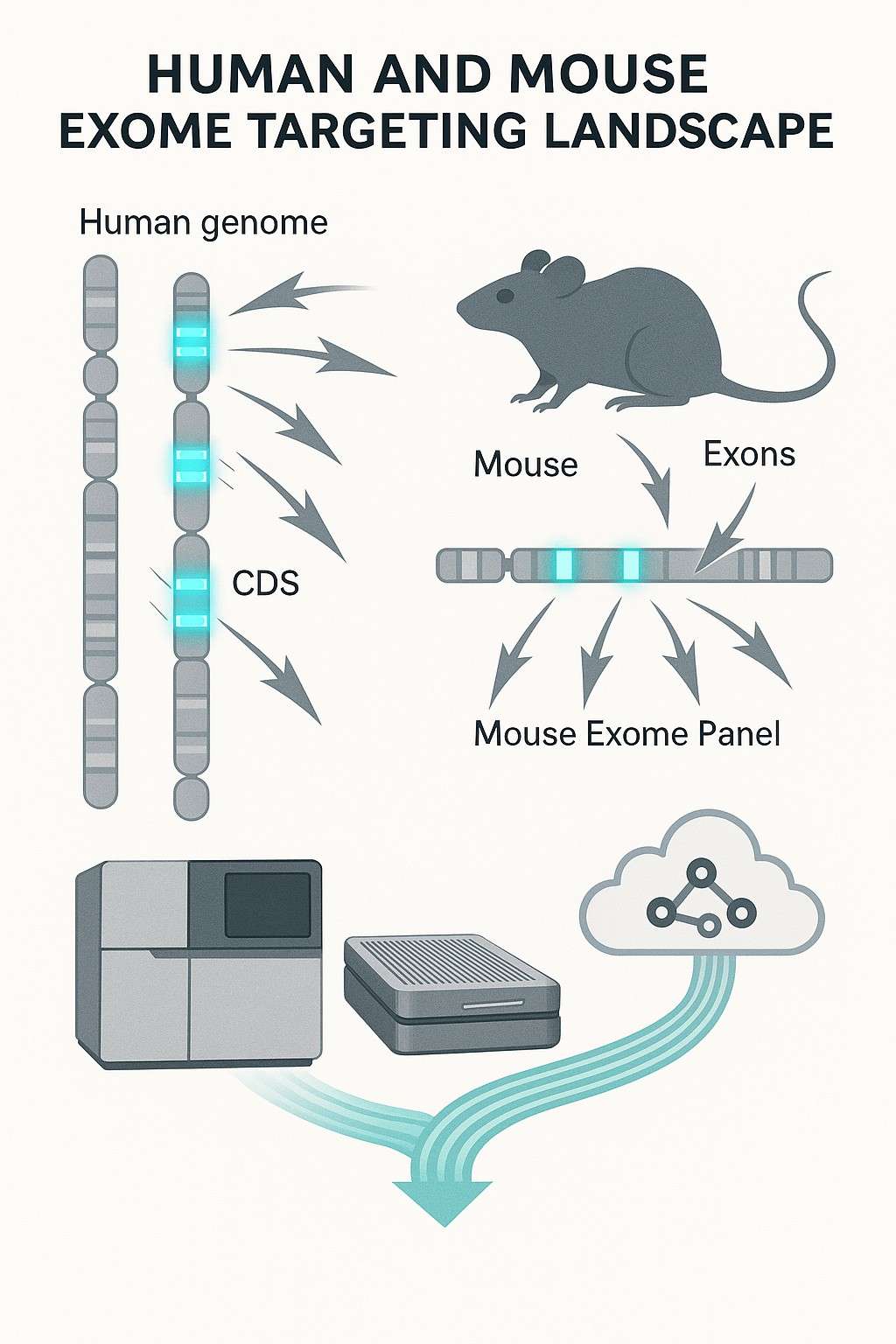
Human and Mouse Exome Sequencing with Precision and Depth
N2Jenomics Lab Pvt. Ltd. provides high-quality human and mouse exome sequencing services using advanced hybrid capture technology and optimized probe panels. Our solutions enable accurate detection of disease-associated genetic variants while offering a cost-effective alternative to whole genome sequencing. Designed for studies of inherited diseases, cancer genomics, and functional gene analysis, our Human and Mouse Exome Panels deliver deep target coverage and high-confidence variant identification to support translational research and drug discovery.
Why Choose Human and Mouse Whole Exome Sequencing?
Whole Exome Sequencing (WES) targets the protein-coding regions (exons), which comprise only 1–2% of the genome but contain the majority of known disease-associated genetic variants. By focusing on these regions, WES provides a cost-effective and efficient alternative to whole genome sequencing while delivering high-value insights into functional mutations.
Whether investigating inherited disorders, cancer genetics, or mouse disease models, WES enables accurate identification of coding variants that influence phenotype and disease progression.
Key Benefits of Whole Exome Sequencing
• Comprehensive detection of SNVs, InDels, and copy number variations (CNVs) within coding regions.
• Cost-effective compared to whole genome sequencing, with reduced data complexity.
• Ideal for human disease studies, cancer research, and mouse model characterization.
• Supports germline, somatic, and population-based variant analysis.
• Comprehensive variant annotation using databases such as RefSeq, ClinVar, GENCODE, CCDS, and MANE.
• N2Jenomics Lab Pvt. Ltd. provides customizable Human, Mouse, Plant, and Animal Whole Exome Sequencing services with flexible sequencing depth, platform selection, and bioinformatics analysis tailored to your research objectives.
Our Human and Mouse Exome Sequencing Services
• Human Whole Exome Sequencing
Our Human Whole Exome Sequencing service is based on the GRCh38 reference genome and captures nearly all clinically relevant coding regions. We offer multiple panel options to match diverse research needs.
Core Panel
- High coverage of protein-coding regions
- Optimized for routine exome studies
Inherited Disease Panel
- Includes ClinVar pathogenic variants, mitochondrial DNA, and CNV backbone regions
- Designed for rare disease research
Cancer Panel
- Covers more than 600 cancer-associated genes, fusion regions, MSI markers, and HLA loci
- Suitable for oncology and precision medicine research
- Supported sample types include blood, tissue, and FFPE, with sequencing depths ranging from 100× to 200×.
• Mouse Whole Exome Sequencing
Our Mouse Whole Exome Sequencing service utilizes a high-performance capture panel based on the mm39 reference genome, covering over 38 Mb of coding regions with excellent capture uniformity.
Applications include:
- Phenotype-to-genotype studies
- Knockout and transgenic mouse validation
- Preclinical disease model research
- Functional genomics and mutation screening
Human and Mouse Exome Sequencing Panels
Species
Service
Target Region
Recommended Data
Applications
Human
Core Exome Panel
~34.4 Mb coding regions (GRCh38)
≥8 Gb (100×)
General exome analysis
Human
Inherited Disease Panel
CDS + ClinVar variants + mtDNA + CNV regions
≥11 Gb (100×)
Rare disease studies
Human
Cancer Exome Panel
Coding regions + cancer genes + MSI + HLA
≥20 Gb (200×)
Oncology research
Mouse
Standard Exome Panel
~38 Mb coding regions (mm39)
≥8 Gb (100×)
Mouse genetics and disease models
Sequencing Platforms
We offer both short-read and long-read sequencing technologies to meet different research requirements.
• Illumina NovaSeq & NextSeq
High-throughput short-read sequencing with excellent accuracy for SNV and InDel detection.
• MGI DNBSEQ
Cost-effective sequencing with reliable coverage, suitable for large-scale exome projects.
• Oxford Nanopore PromethION
Long-read sequencing for structural variant detection, gene fusions, splice variants, and GC-rich genomic regions.
• PacBio Revio / Sequel IIe (HiFi)
High-fidelity long reads for accurate phasing, CNV analysis, repeat resolution, and complex genomic regions.
Recommended Sequencing Depth
Platform
Read Length
Recommended Coverage
Best Suited For
Illumina / MGI
PE150
100–200×
Standard exome sequencing
Nanopore PromethION
5–20 kb
20–40×
Structural variant analysis
PacBio HiFi
10–25 kb
30–50×
Complex variants and phasing
Exome Capture Strategies
• Hybrid Capture
Target enrichment using optimized probe panels for human and mouse exomes, with custom panel design available for disease-specific or targeted studies.
• Low-Input & FFPE-Compatible Workflow
Optimized library preparation protocols for challenging, degraded, or low-input DNA samples.
Whole Exome Sequencing Workflow
Sample Preparation → DNA Extraction → Library Construction → Exome Capture → High-Throughput Sequencing → Quality Control → Bioinformatics Analysis → Variant Annotation & Reporting
Bioinformatics Data Analysis
Our comprehensive analysis pipeline ensures accurate detection and interpretation of coding variants from both human and mouse exome datasets.
Analysis Includes
• Raw data quality assessment and filtering
• Alignment to GRCh38 (Human) or GRCm39 (Mouse)
• Duplicate removal and quality score recalibration
• SNV and InDel identification using industry-standard workflows
• Functional annotation using Ensembl VEP, ClinVar, OMIM, and gnomAD
• Rare variant prioritization and pathogenicity prediction
• Copy number variation (CNV) analysis for high-depth datasets
• Optional tumour analysis, including somatic variant detection, MSI, and TMB analysis
Technical Process
Advanced Technical Process
Advantages of Our Exome Sequencing Services
Our exome sequencing services are designed to deliver accurate, reliable, and flexible solutions for human and mouse genomics research.
• Dual-Species Expertise
Validated human and mouse exome panels covering over 99% of known coding regions using RefSeq, MANE, and CCDS references.
• Multiple Sequencing Platforms
Support for Illumina and MGI short-read sequencing, along with Oxford Nanopore and PacBio long-read technologies.
• Custom Panel Design
Optional inclusion of HLA regions, CNVs, mitochondrial DNA, and disease-specific target regions.
• High Capture Performance
Excellent exon coverage, high capture uniformity, and sensitive variant detection.
• Low-Input & FFPE Compatible
Optimized workflows for low-input DNA and challenging FFPE samples.
• Comprehensive Bioinformatics
End-to-end analysis including SNV, InDel, CNV detection, functional annotation, and optional MSI/TMB analysis.
Sample Requirements
Application
Sample Type
Recommended Amount
Minimum Amount
Minimum Concentration
Whole Exome Sequencing
Genomic DNA
≥500 ng
100 ng
10 ng/µL
PCR-Free Exome Sequencing
Genomic DNA
≥1 µg
500 ng
20 ng/µL
FFPE Exome Sequencing
FFPE DNA
≥500 ng
—
DNA fragments >1000 bp
Note: DNA concentration should preferably be measured using fluorometric methods (Qubit or PicoGreen). If measured using NanoDrop, a higher concentration is recommended.
Accepted Sample Types
We accept a broad range of biological samples and also provide DNA extraction services on request.
Sample Type
Recommended Quantity
Shipping Condition
Cells
1 × 10⁶ cells
Dry ice
Fresh Frozen Tissue
10 mg
Dry ice
FFPE Slides
≥4 slides (≥150 mm²)
Room temperature / Blue ice
Blood (EDTA)
2–4 mL
Blue ice or Dry ice
Plasma / Serum
10 mL
Dry ice
Saliva
1 mL
Dry ice or Blue ice
Stool / Soil
100 mg
Dry ice or Room temperature
Swabs
2 tubes per sample
Room temperature
Water Samples
50 mL
Room temperature
Unsure whether your sample is suitable? Our technical team can provide free consultation and sample preparation support.
Project Deliverables
Depending on your project requirements, you will receive:
• Raw sequencing data (FASTQ)
• Sequence alignment files (BAM) and variant files (VCF)
• Quality control, statistical, and annotation reports (PDF & Excel)
• Graphical summaries and visualization results
• Complete project documentation and data interpretation guidance
Whole Exome Sequencing targets the protein-coding regions of the genome, where most known disease-associated variants are found. It provides a cost-effective approach for studying functional genetic mutations with lower sequencing costs and simplified data analysis.
2. What is the difference between Human and Mouse Exome Sequencing?
Our Human Exome Sequencing service is based on the GRCh38 reference genome and is ideal for clinical and disease-related studies. Mouse Exome Sequencing uses the GRCm39 reference genome and is optimized for genetic research, functional genomics, and disease model development.
3. What sequencing depth is recommended?
For germline studies, we typically recommend 100×–150× coverage. Tumor, FFPE, or other challenging samples generally require 200× or higher to ensure reliable variant detection.
4. Do you offer long-read exome sequencing?
Yes. We support long-read exome sequencing using Oxford Nanopore and PacBio HiFi platforms for projects involving structural variants, complex genomic regions, or advanced genomic analysis.
5. Can low-input or FFPE samples be sequenced?
Yes. Our optimized library preparation and bioinformatics workflows are designed to maximize data quality from low-input and FFPE-derived DNA samples.
6. Do you accept pre-prepared exome libraries?
Yes. We accept both purified genomic DNA and pre-enriched exome libraries. Library quality assessment is performed before sequencing.
7. What data will I receive?
Standard deliverables include FASTQ, BAM, and VCF files, along with quality control metrics, annotated variant reports, and optional downstream analyses such as CNV, MSI, or pathway analysis.
8. When should I choose WES over WGS?
Whole Exome Sequencing is ideal for identifying coding-region mutations while minimizing sequencing costs and data volume. Whole Genome Sequencing is recommended when non-coding regions, structural variants, or genome-wide analysis are required.
Address:Registered Office: 138, Patparganj Industrial Area, New Delhi – 110092, India
Operational Address: National Institute of Plant Genome Research (BRIC - NGGF)
Lab No. 206 and 207, Aruna Asaf Ali Marg, P.O. Box No. 10531,
New Delhi – 110067, India