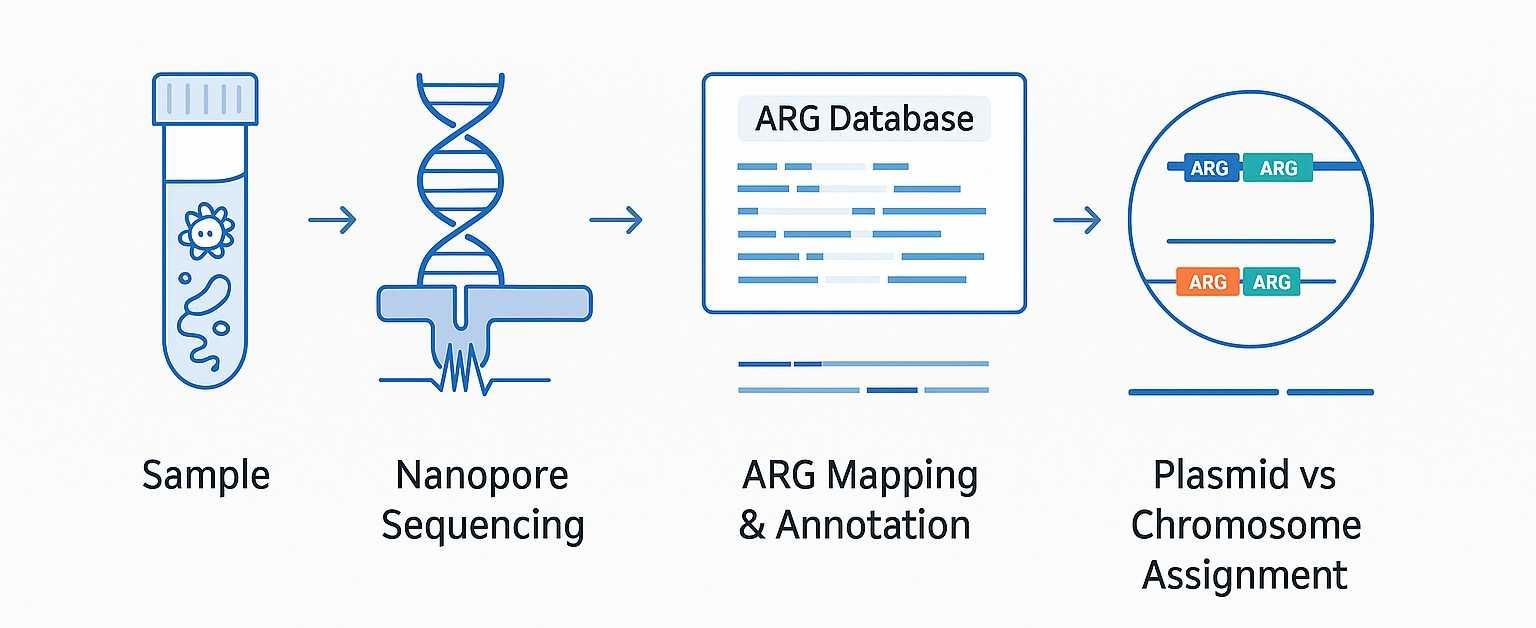
N2 Jenomics Lab Pvt. Ltd. offers a full-service Antibiotic Resistance Gene Analysis using long-read sequencingand next generation sequencing. We detect, classify, and annotate ARGs—including those on plasmids and mobile genetic elements—backed by curated antibiotic resistance gene databases. Our workflow delivers accurate antibiotic resistance gene prediction to support CROs, academic labs, and biotech research.
Problems We Solve:
Antibiotic resistance is recognized by the World Health Organization as one of the top 10 global health threats. Resistant infections increase mortality and treatment failures, while resistance genes persist in the environment, often hidden on plasmids and mobile elements that spread across species. Traditional diagnostic methods are slow, fragmented, and frequently fail to detect low-abundance or novel resistance genes.
N2 Jenomics Lab Pvt. Ltd. ' sequencing-based Antibiotic Resistance Gene Analysis overcomes these barriers. By delivering full-length reads and real-time data, our service enables:
| Step | Description | Key Technical Steps & Tools | Output & Quality Measures |
|---|---|---|---|
| Sample QC & DNA Extraction | Accepts a variety of sample types: isolates, metagenomes, environmental, clinical, agricultural. | Extract high molecular weight DNA; assess purity and integrity; quantify DNA. | QC metrics (yield, purity, fragment size) to ensure downstream accuracy. |
| Library Prep & Sequencing | Prepare samples for sequencing; supports barcoding / multiplexing if needed. | Use appropriate library kits; setup flow cells; optimize for read length. | Raw read datasets with high-quality long reads. |
| Basecalling & Read Processing | Convert raw signals to reads; filter and clean reads before downstream analysis. | Use high-accuracy basecalling (e.g. Guppy), adapter trimming, low-quality/short read filtering. | Cleaned FASTQs; read quality distribution; length metrics. |
| Assembly & Contig Construction (Optional / Hybrid) | If desired, build longer contiguous sequences to resolve complex ARG clusters. | Assemblers (e.g. Flye), polishing (e.g. Racon, Medaka), hybrid polishing if short-reads are involved. | Improved contig N50, more complete gene content, better structural clarity. |
| ARG Detection & Database Annotation | Map reads/contigs against ARG databases; classify resistance types and mechanisms. | Use tools to align to CARD/ARO; cluster similar ARGs; taxonomic identification of hosts. | List of ARGs with classification (gene family, mechanism), species/taxa annotation. |
| Plasmid / Chromosome Assignment & MGE Detection | Determine whether ARGs are located on plasmids or chromosomes; identify mobile genetic elements. | Plasmid detection tools (e.g. MOB-suite or equivalents); detection of integrons, transposons, ICEs; visualization of gene clusters. | Mapping of ARGs to plasmid or chromosomal context; visual gene cluster maps; transferability indicators. |
| Reporting & Visualisation | Generate outputs designed for research, publication, or regulatory use. | Abundance tables; annotated gene maps; plots comparing ARGs across samples; phylogenetic or host contextual info. | Publication-ready figures; full annotation tables; clear visualization of gene location and mobility. |

| Analysis Category | Basic Analysis | Advanced Analysis | Multi-Omics Integrated Analysis |
|---|---|---|---|
| ARG Detection & Annotation | Identify known antibiotic resistance genes (ARGs) by aligning reads/contigs to curated antibiotic resistance gene databases (e.g. CARD, ARO); classify by gene family, resistance mechanism. | Predict novel or low homology ARGs; analyze ARG gene clusters (co-located genes), mobile genetic elements (transposons, integrons); functional annotation of resistance mechanisms. | Combine metagenomic + transcriptomic data to determine which ARGs are expressed; proteomics to verify resistance enzyme production; correlate ARG presence with phenotypic data or expression levels. |
| Host / Taxonomy Mapping | Assign ARGs to taxonomic levels (species, genus, family) using classification tools. | Co-localization of ARGs with host microbial genomes; construct ARG-host network; infer host range and potential spread. | Integrate metatranscriptome or single cell data to see active hosts; combine with 16S/shotgun for diversity; link expression / proteome to host identity. |
| Plasmid vs Chromosome & Mobility | Distinguish whether ARGs are plasmid-borne vs chromosomal; detection of known MGEs. | Detailed mapping of plasmid structures, detection of novel plasmid fusion events; identification of insertion sequences, integrative conjugative elements; estimate plasmid copy number. | Use long-read + short-read (hybrid) sequences plus transcriptomics / proteomics to confirm active mobile element usage; combine with methylation or epigenomic data to assess mobility regulation. |
| Abundance & Diversity Profiling | Quantify ARG abundance (normalized counts), diversity metrics (e.g. Shannon, Simpson), compare across samples. | Differential abundance across conditions; co-occurrence network of ARG classes; machine learning to detect marker ARGs; trend detection. | Compare metagenome vs metatranscriptome: abundance vs expression; correlate environmental/clinical metadata with ARG diversity; integrate metabolomics / environmental variables to detect selection pressures. |
| Visualization & Reporting | Basic visual outputs: bar plots, heat maps, ARG classification tables. | ARG cluster maps, plasmid vs chromosome diagrams, host-ARG network graphs, mobile element context visualisations. | Multi-omics visual dashboards: expression vs gene copy number, co-occurrence across omics, PCA/PCoA / network diagrams showing omics relationships. |
| Quality Control & Confidence | Filtering by read quality, minimum alignment identity and coverage; thresholding to reduce false positives; use of curated antibiotic resistance gene databases. | Validation of low abundance ARGs; coverage depth support; cross-validation among reads/assemblies; assessment of gene context; use of multiple databases / models. | Cross-omic validation: expression confirmation, proteomic evidence; consistency across datasets; environmental or phenotypic validation where available. |
Our ARG Analysis service supports a wide range of research, surveillance, and applied science applications. Below are key use cases for academic labs, CROs, and institutions.

Q: What is an Antibiotic Resistance Gene Analysis service and how can it help my research?
Antibiotic Resistance Gene Analysis is a service that uses sequencing (e.g. Nanopore long reads) and bioinformatics to detect, classify, and annotate antibiotic resistance genes (ARGs) in your samples; it helps labs, CRO clients, and academic institutions to discover ARG types (plasmid-borne or chromosomal), predict resistance mechanisms, track mobile genetic elements, and quantify ARG abundance to support surveillance, diagnostics, or agricultural/environmental studies.
Q: How accurate is ARG classification and annotation using curated resistance gene databases?
When using curated antibiotic resistance gene databases (like CARD/ARO/SARG), combined with high-quality long reads (e.g. from Nanopore), the annotation and classification of ARGs are very accurate; matching thresholds (identity, coverage) ensure genes are correctly assigned, and plasmid vs chromosome assignment gives context for mobile ARGs, reducing misclassification and helping in resistance prediction.
Q: Can you distinguish ARGs on plasmids from those on chromosomes, and why does this matter?
Yes, part of the analysis workflow involves plasmid vs chromosome assignment by detecting plasmid sequences and mobile genetic elements (MGEs), so we can tell if an ARG is likely transferable; this distinction matters because plasmid-borne ARGs spread more readily between bacteria, increasing risk, and knowing the location improves understanding of gene mobility and epidemiology.
Q: Do I need a higher volume or special quality of DNA for ARG detection?
To achieve reliable detection, especially for low-abundance ARGs or plasmid localization, high molecular weight DNA with good purity is preferred; though we can work with a range of sample types, quality filtering and library prep steps are optimized to reduce noise and improve confidence in antibiotic resistance gene prediction.
Q: How do you ensure low false positives in ARG detection and prediction?
We use stringent bioinformatics pipelines including basecalling quality control, read trimming, alignment to curated antibiotic resistance gene databases, filtering by sequence identity and coverage thresholds, and verification of gene context (neighboring mobile elements or chromosome/plasmid assignment) so that predictions of antibiotic resistance genes are robust and reliable.
Q: Can this service be used for both clinical samples and environmental or agricultural samples?
Yes, this ARG analysis is applicable to a variety of sample types—clinical isolates, wastewater, soil, livestock microbiomes, etc.—since the methods detect ARGs across diverse microbial communities; the same classification, annotation, and plasmid assignment capabilities apply, though sample preparation and depth may vary depending on environment or matrix type.
Q: What kind of outputs and reports will I receive from the ARG analysis service?
You will receive annotated tables of ARGs (gene name, mechanism/class, host taxa), abundance and diversity profiling, plasmid vs chromosome localization maps, visualizations (heat maps, gene cluster diagrams, network plots), raw and processed sequence files, and methods/QC documentation for reproducibility.
Q: What related sequencing services can complement the ARG Analysis?
Services like Nanopore Ultra-Long Sequencing, Nanopore Amplicon Sequencing, Nanopore Target Sequencing, Nanopore Full-Length lncRNA Sequencing, Nanopore Full-Length Transcript Sequencing, Nanopore Direct RNA Sequencing, and the general Nanopore Sequencing Overview are all complementary offerings that can enhance ARG detection (for example, ultra-long reads help resolve large plasmids, amplicon or targeted approaches help validate specific genes) enhancing the overall understanding of antibiotic resistance gene plasmid location, classification, and annotation.

Source: Frontiers in Antibiotics (2025)
DOI: 10.3389/frabi.2024.1489356
Antimicrobial resistance is a critical global health challenge. Hospitalized patients are particularly vulnerable due to antibiotic exposure and altered microbiomes. This study investigated the gut resistome and microbiome composition of patients admitted to a hospital in southern Brazil, a region with intensive livestock activity that increases environmental ARG exposure.

Figure. Resistome composition in hospitalized patients, comparing admission and discharge samples. Aminoglycoside, tetracycline, and mcr gene classes are highlighted as dominant contributors.
References: