DNA Barcoding Services
Home
> DNA Barcoding Services
Reliable DNA Barcoding Services for Species Identification
At N2 Jenomics Lab Pvt. Ltd. , we offer advanced DNA barcoding services that enable researchers and professionals to accurately identify species using standardized DNA barcodes. By harnessing the power of molecular biology, our service provides fast, reliable species identification for a wide variety of organisms, including plants, animals, fungi, and microbes. Whether you're dealing with pure isolates or environmental samples, we offer customized solutions to fit your specific research needs. Our state-of-the-art technology and efficient workflows ensure accurate results delivered in the shortest time possible.
What We Solve:
Slow and unreliable traditional species identification methods: Traditional methods, such as morphological analysis, can be time-consuming and prone to errors. DNA barcoding eliminates these issues with faster and more accurate identification.
Need for a quick, non-invasive way to authenticate biological samples: DNA barcoding provides a rapid and non-destructive solution for sample authentication, crucial for applications like food safety, environmental monitoring, and forensic analysis.
Species identification from fragmented, damaged, or mixed samples: Whether your sample is incomplete, degraded, or mixed with DNA from multiple organisms, DNA barcoding ensures precise identification, even from difficult samples.
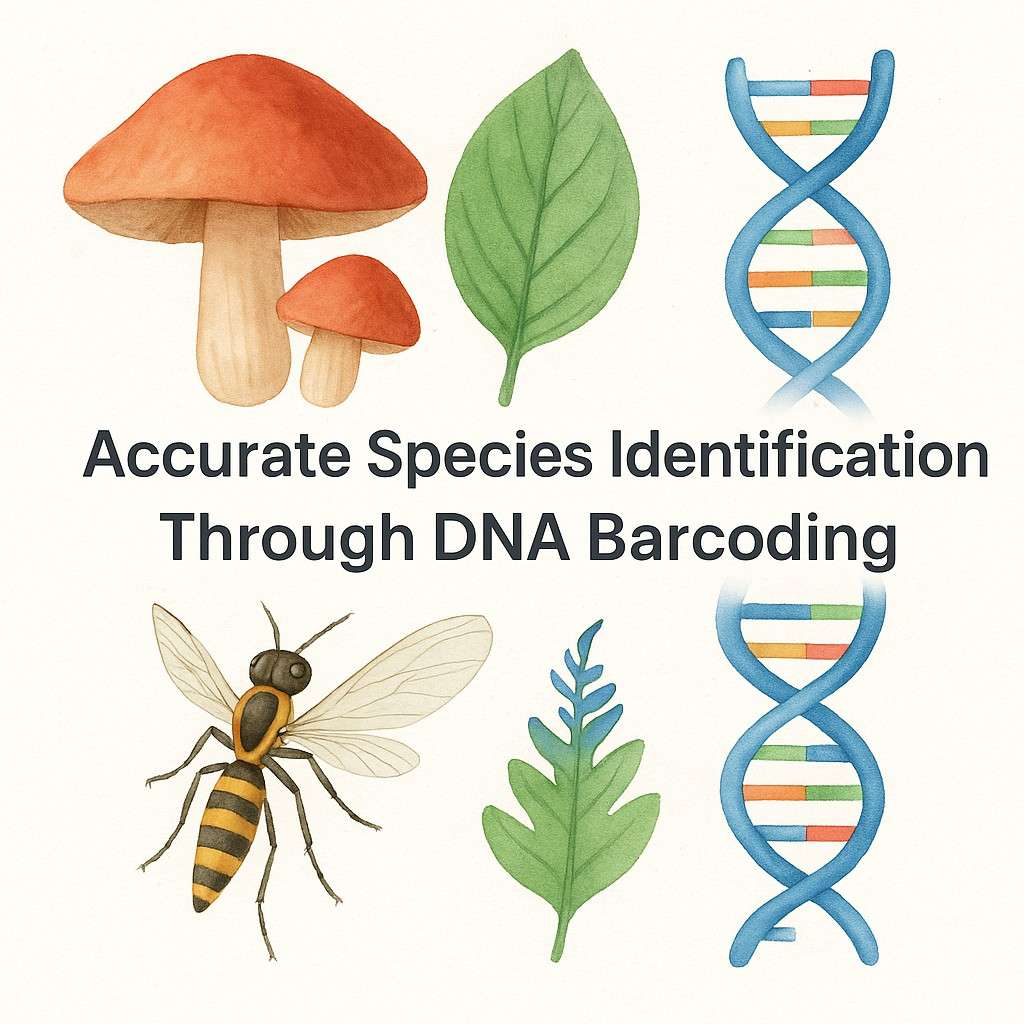
DNA barcoding is a powerful method used to identify species by analyzing a small, unique segment of DNA from each organism. This DNA sequence acts as a "barcode" that allows researchers to accurately identify species quickly and efficiently.
The concept of DNA barcoding was introduced by Dr. Paul Hebert in 2003. He proposed using the CO1 gene (cytochrome c oxidase subunit 1) from mitochondrial DNA to distinguish animal species. For plants, scientists commonly use other genetic markers such as rbcL, matK, and ITS2 as barcodes.
DNA barcoding works by selecting a DNA segment from a region of the genome that is both conserved (similar across species) and variable (sufficiently different to distinguish species). This balance makes it possible to apply the same DNA region across a wide range of species, from bacteria to animals.
In animals, the CO1 gene is the most commonly used DNA barcode. For plants, the rbcL and matK genes are typically used, while the ITS region is the barcode of choice for fungi. This method is versatile and can be applied to various sample types—whether a whole organism, tissue fragment, or even environmental samples containing traces of DNA from multiple species.
Key Benefits of DNA Barcoding
Speed and Efficiency: Traditional species identification methods, like morphological analysis, can be slow and require expert knowledge. DNA barcoding, however, enables faster species identification, even when working with damaged or incomplete samples.
Accuracy: By focusing on specific, standardized DNA sequences, DNA barcoding significantly reduces errors that may occur due to visual identification or environmental factors.
Wide Application: DNA barcoding is highly adaptable and can be used to identify a variety of biological materials, including plants, fungi, animals, and environmental samples like soil or water.
Our DNA Barcoding Process
At N2 Jenomics Lab Pvt. Ltd. , we follow a precise, streamlined process to ensure reliable DNA barcoding results. Here's a breakdown of the steps involved:
1
Sample Collection
You provide a sample from your organism of interest—whether it's a plant, animal, fungus, or microbe. The sample can be anything from a whole organism to a small fragment (e.g., leaf, tissue, or even environmental DNA).
2
DNA Extraction
We begin by extracting DNA from your sample. Our protocols are optimized for different types of biological material, ensuring that high-quality DNA is obtained, ready for analysis.
3
PCR Amplification
Next, we use Polymerase Chain Reaction (PCR) to amplify the DNA barcode region. This step creates millions of copies of the target sequence, ensuring enough material for sequencing.
4
Sequencing
Once the DNA is amplified, we perform Sanger sequencing, which generates high-quality, accurate sequence data for the barcode region.
5
Analysis & Species Identification
The final step involves comparing the obtained sequence against reference databases, such as GenBank, to identify the species. We provide a detailed report that includes your sequence data and the top matches from the database.
DNA Barcoding Applications
DNA barcoding provides a quick, reliable method for species identification, benefiting fields like biodiversity, food safety, forensics, and agriculture. As technology advances, its applications continue to expand:
1. Biodiversity and Ecology
DNA barcoding helps track species in ecosystems, allowing for biodiversity assessments without physical observation. It's especially useful in remote or difficult-to-study environments, such as marine ecosystems or dense forests.
2. Food Safety
In food industries, DNA barcoding ensures the authenticity of ingredients, detecting species substitution and contamination. It is particularly important for products like seafood, where mislabeling is common.
3. Pharmaceutical Research
DNA barcoding verifies the authenticity of plant-based raw materials used in pharmaceuticals, ensuring the quality and efficacy of herbal medicines.
4. Forensic Science
Used in wildlife forensics, DNA barcoding identifies species in illegal trade or poaching cases, helping authorities trace illicit activities and protect endangered species.
5. Environmental DNA (eDNA)
eDNA uses DNA barcoding to monitor species in water, soil, and air samples. It's effective for detecting elusive or invasive species without direct sampling.
6. Agriculture and Pest Management
In agriculture, DNA barcoding identifies pest species, tracks their spread, and helps manage agricultural diseases or pest resistance.
DNA Requirements
Genomic DNA
Minimum sample volume
At least 15μL, with a concentration of 50-100 ng/μL.
Quality Check
2% agarose gel electrophoresis should show a clear main band with no degradation.
DNA Purification
Use a DNA purification kit or magnetic beads.
DNA Solvent
Dissolve in TE buffer or sterilized deionized water.
Visual Inspection
Ensure no visible impurities after dissolution.
Plant Materials
Sample Type
Fresh tissue; leaves dried using silica gel or transported with dry ice.
Animal Materials
Sample Type
Fresh tissue, preserved in anhydrous ethanol and transported at low temperature.
Demo Results
DNA Barcoding Services FAQs
1. What sample types are required for DNA barcoding?
We accept a variety of sample types, including fresh or frozen tissues, leaves, seeds, or even environmental samples like soil or water. Samples should preferably be stored in 70-80% alcohol to preserve DNA integrity.
2. What is the typical turnaround time (TAT)?
Our typical turnaround time is 7-10 working days, depending on the complexity of the sample and the analysis required.
3. What sequencing method do you use?
We use Sanger sequencing, which is known for its high accuracy and reliability in generating quality DNA barcodes.
4. Can I use a different marker for DNA barcoding?
While we primarily use standardized markers for species identification (e.g., CO1 for animals, rbcL for plants), custom markers can be used on a case-by-case basis. Please contact us to discuss your specific needs.
5. What do I receive after the analysis?
You will receive a comprehensive report that includes:
A summary of the identification results.
Your sequence data in FASTA format.
The top 10 species matches from the BLAST results.
If requested, raw electropherogram files.
Related Publications
DNA Barcoding of Terrestrial Plants
In a recent study, DNA barcoding was used to enhance the detection of parasitic pathogens in blood samples. By employing restriction enzyme digestion to break down host DNA, targeted amplicon sequencing was applied, increasing detection accuracy and sensitivity. This method enabled comprehensive identification of plant species involved in disease transmission.
DNA Barcoding of 5,200 German Flies and Midges (Insecta: Diptera)
A significant DNA barcoding library was developed for 5,200 German flies and midges, contributing to environmental monitoring and biological research. The project involved cataloging the species' metabolic protein-coding genes, providing valuable insights into insect biodiversity and environmental health. This DNA barcode library has become an essential tool in ecological studies and public health surveillance.
Dual DNA Barcoding for Identification of Invasive Fungal Pathogens
Dual DNA barcoding was applied to identify and differentiate invasive fungal pathogens in clinical samples. The method used two distinct DNA barcode regions, improving the identification accuracy of pathogens responsible for infections. This approach has proven essential for monitoring fungal biodiversity and managing clinical infections.
Genome Skimming for DNA Barcoding and Phylogenetic Studies
Genome skimming technology was employed to gather high-quality DNA sequences from specimen samples for both DNA barcoding and phylogenetic studies. This approach allowed for the analysis of gene regions crucial for species identification while simultaneously providing insights into the evolutionary relationships between species. The technique has advanced both barcoding applications and systematic genomics research.
WJ, Erickson DL. DNA barcodes: genes, genomics, and bioinformatics. Proc Natl Acad Sci U S A. 2008 Feb 26;105(8):2761-2. doi: 10.1073/pnas.0800476105. Epub 2008. doi: 10.1073/pnas.0800476105
Kress WJ, Erickson DL. DNA barcodes: methods and protocols. Methods Mol Biol. 2012;858:3-8. DOI: 10.1007/978-1-61779-591-6_1
Address:Registered Office: 150, Patparganj Industrial Area, New Delhi – 110092, India
Operational Address:National Institute of Plant Genome Research (BRIC - NGGF)
Lab No. 206 and 207, Aruna Asaf Ali Marg, P.O. Box No. 10531,
New Delhi – 110067, India