Fast, Accurate VH/VL Antibody Sequencing for Clone Validation, Engineering, and IP Protection.
Hybridoma instability and contamination remain the leading causes of irreversible antibody loss, yet more than 35% of research hybridomas worldwide exhibit genetic drift within five years. Without verified VH/VL sequences, clone identity, engineering potential, and IP security remain vulnerable.
N2 Jenomics Lab Pvt. Ltd. provides high-accuracy VH/VL sequencing using optimized 5' RACE, Sanger, and NGS workflows—designed to:
Secure permanent genetic records of your monoclonal antibodies
Ensure clone authenticity and eliminate mispaired chains
Enable recombinant production across HEK293, CHO, and multiple isotypes
Support antibody humanization, affinity maturation, and sequence optimization
Maintain business continuity even if the original hybridoma is lost
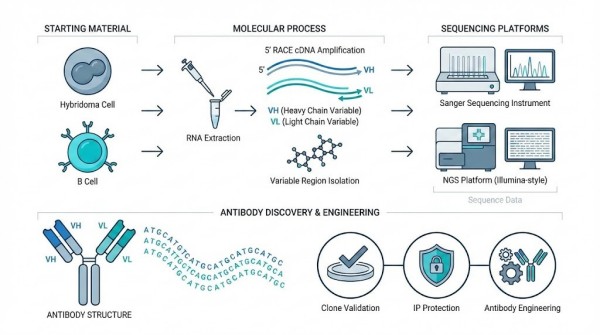
Antibody sequencing is the process of identifying the nucleotide sequences encoding the variable heavy (VH) and variable light (VL) domains of monoclonal antibodies produced by hybridomas, B cells, or single B cells. Unlike protein-level de novo sequencing, which relies on mass spectrometry, VH/VL antibody sequencing directly analyzes the genetic material, ensuring complete and unambiguous recovery of the original antibody sequence.
Hybridoma technology has enabled the large-scale production of monoclonal antibodies; however, hybridoma cell lines are vulnerable to contamination, genetic drift, mispairing events, and cell loss—all of which can compromise antibody stability and reproducibility. Once a hybridoma is lost, the antibody may become unrecoverable unless its genetic sequence has been preserved.
VH/VL sequencing solves these challenges by creating a permanent digital record of the antibody's genetic identity. Through optimized 5' RACE, Sanger sequencing, or NGS-based workflows, researchers can obtain complete variable region sequences, enabling:
Accurate clone verification
Recombinant antibody expression in HEK293 or CHO systems
Antibody humanization and engineering workflows
Isotype switching and antibody format conversion
Long-term archiving and IP support
Ultimately, antibody sequencing provides the definitive genetic blueprint required to preserve, reproduce, and optimize high-value monoclonal antibodies for research applications.
Why Choose Antibody Sequencing?
N2 Jenomics Lab Pvt. Ltd. ' antibody sequencing offers distinct advantages over protein-level de novo antibody sequencing. It serves as a powerful tool for distinguishing antibodies produced by hybridoma cells, thereby preventing the loss of genetic information.
Preserves Antibody Diversity: Antibody sequencing directly analyzes antibodies secreted by hybridoma cells, capturing the full spectrum of the original immune repertoire.
Time and Cost Efficiency: Antibody sequencing offers significantly faster turnaround and lower costs compared to resource-intensive de novo sequencing methods.
Built-in Quality Control & Verification: Sequences derived directly from the hybridoma cell line provide intrinsic verification that the antibody is produced by the intended clone.
Seamless Compatibility with Established Cell Lines: Hybridoma cell lines feature well-documented histories, characterized properties, and traceable regulatory documentation.
Eliminates Ambiguous Amino Acid Resolution: Antibody sequencing goes straight to the cDNA source in antibody-producing cells – delivering consistently precise and reliable results.
Method Comparison: VH/VL Sequencing vs. Protein de novo Sequencing
Category
Hybridoma Antibody Sequencing (VH/VL DNA Sequencing)
Protein de novo Antibody Sequencing (Mass Spectrometry)
Primary Input
mRNA / cDNA from hybridoma, B cells, or single B cells
Purified antibody protein
Data Output
Full-length VH and VL nucleotide + amino acid sequences
Peptide fragments assembled into predicted amino acid sequence
Accuracy of Variable Regions
★★★★★ – Complete reconstruction of VH/VL including full CDR1–CDR3
★★★☆☆ – Potential ambiguity in isobaric residues; gaps possible
Chain Pairing Certainty
Guaranteed correct VH–VL pairing
Requires inference; pairing uncertainty possible
Best For
Clone validation, recombinant expression, engineering, IP
Limited unless validated through additional experiments
QC & Verification
Intrinsic genetic-level confirmation
Requires extra validation assays
Typical Use Case
Hybridoma rescue, recombinant antibody development
Legacy antibodies with no cell source available
VH/VL antibody sequencing is the preferred method when hybridoma or B-cell material is available, offering precise, complete, and engineering-ready antibody sequences.
Protein-based de novo sequencing remains valuable when the antibody source is only available as a purified protein but may require additional verification for downstream engineering.
Tailored options for non-standard organisms, library-based workflows, or specialized engineering requirements.
Applications: rare species antibodies, chimeric constructs, novel antibody formats.
Antibody Sequencing Service Workflow
1. Sample Receipt & Quality Assessment
Hybridoma cells, B cells, or RNA samples are evaluated for integrity to ensure successful downstream amplification.
2. RNA Extraction & cDNA Synthesis
High-quality RNA is isolated from antibody-producing cells, followed by cDNA generation to capture the expressed VH/VL transcripts.
3. 5' RACE Amplification of VH and VL Regions
Full-length variable regions are selectively enriched using optimized 5' RACE (Rapid Amplification of cDNA Ends), enabling complete recovery of VH and VL sequences without requiring prior knowledge of somatic mutations.
4. Sanger or NGS Sequencing
Sanger sequencing for stable monoclonal hybridomas
NGS sequencing for complex samples, unstable clones, or heterogeneous populations
Sequencing strategy is tailored to project complexity and data needs.
5. Bioinformatics Processing & Annotation
Data undergo QC, assembly, V(D)J assignment, CDR/FW annotation, and mutation analysis to generate a comprehensive sequence report.
6. Delivery of Final VH/VL Sequences & Expert Consultation
Annotated sequence files, QC reports, and analysis summaries are delivered along with optional scientific consultation for recombinant expression or engineering planning.
Antibody Sequencing Bioinformatics Analysis
N2 Jenomics Lab Pvt. Ltd. delivers end-to-end bioinformatic solutions – from raw data processing to bespoke analytical pipelines – tailored to your project's complexity.
Table 1: Sanger Sequencing Analysis
Focus: High-accuracy analysis for single clones, monoclonal antibodies, or small-scale batches.
Analysis Item
Description
Raw Data Quality Assessment
Evaluates read quality, base distribution, and background noise to ensure reliable downstream analysis.
Sequence Trimming & Filtering
Removes low-quality bases, primer/adaptor contamination, and artifacts from 5' RACE amplification.
Sequence Assembly
Assembles overlapping reads to produce full-length VH and VL sequences.
Germline V(D)J Assignment
Identifies the closest germline genes for variable, diversity, and joining segments to support engineering and documentation.
CDR & Framework Annotation
Precisely defines CDR1/2/3 and framework regions (FR1–FR4) for structural and functional interpretation.
Amino Acid Translation & Structural Insights
Provides amino acid sequences and highlights regions relevant for antibody modeling or engineering.
Focus: High-throughput analysis for antibody libraries, repertoires, hybridoma screening, and diversity profiling.
Analysis Item
Description
Raw Data Quality Assessment
Evaluates read quality (Q30 scores), base distribution, and background noise across millions of reads.
Sequence Trimming & Filtering
Removes low-quality bases, primer/adaptor contamination, and artifacts from 5' RACE amplification.
Sequence Assembly
Assembles overlapping reads (e.g., Paired-End reads) to produce full-length VH and VL sequences.
Clone Frequency Profiling
(NGS Specific) Identifies dominant and minor VH/VL variants within heterogeneous hybridomas or mixed cell populations.
Germline V(D)J Assignment
Identifies the closest germline genes for variable, diversity, and joining segments to support engineering and documentation.
CDR & Framework Annotation
Precisely defines CDR1/2/3 and framework regions (FR1–FR4) for structural and functional interpretation.
Somatic Hypermutation (SHM) Analysis
(NGS Specific) Quantifies mutation rates relative to germline sequences to assess affinity maturation.
Chain Pairing Validation
(NGS Specific) Confirms correct VH/VL pairing to detect mispaired or contaminating clones (requires single-cell or specialized library prep).
Amino Acid Translation & Structural Insights
Provides amino acid sequences and highlights regions relevant for antibody modeling or engineering.
Custom Analysis (Optional)
(NGS Specific) Includes repertoire-level profiling, diversity analysis, motif detection, or specialized annotations upon request.
Applications of Antibody Sequencing
Antibody sequencing delivers critical value across the antibody discovery and engineering workflow by enabling the accurate recovery of VH/VL sequences, clone authentication, and long-term antibody preservation. Below are the key research applications supported by our VH/VL sequencing services.
Intellectual Property Protection
Secure and define your monoclonal antibody with definitive VH/VL sequences.
Accurate antibody sequencing establishes a permanent genetic record of your antibody's unique variable regions. This supports patent filing, sequence-based IP protection, and clear differentiation from competing antibodies in research and development.
Recombinant Antibody Production
Enable expression in HEK293, CHO, and multiple antibody formats.
Once VH/VL sequences are identified, recombinant antibodies can be rapidly generated in well-characterized expression systems. This supports isotype switching, scFv / Fab conversion, and batch-to-batch reproducibility—independent of hybridoma stability.
Antibody Engineering & Optimization
Create research-grade engineered antibodies using verified VH/VL sequences.
High-quality sequence data enables downstream engineering workflows such as humanization, affinity maturation, and framework optimization. Verified sequences ensure precision when modifying functional regions like CDRs.
Clone Verification & Identity Assurance
Confirm that hybridomas produce the intended monoclonal antibody.
Hybridomas can suffer from chain mispairing, contamination, or drift. VH/VL sequencing provides genetic confirmation of antibody identity, ensuring experimental reliability and reproducibility across long-term research projects.
Business Continuity & Antibody Preservation
Prevent permanent antibody loss due to hybridoma instability.
Sequencing safeguards valuable antibodies by creating a digital archive of complete VH/VL sequences. Even if hybridoma cells fail due to contamination or cryostorage issues, the antibody can be fully regenerated via recombinant expression.
Research Documentation & Quality Control
Support regulatory and publication requirements with validated sequence data.
Comprehensive VH/VL annotation, V(D)J usage profiles, and QC metrics assist in method validation, scientific reporting, and collaborative project documentation.
Why Choose N2 Jenomics Lab Pvt. Ltd. for Antibody sequencing?
Industry-Leading Accuracy
Advanced high-resolution mass spectrometry + expert bioinformatics ensure reliable VH/VL sequences from hybridoma, serum, ascites, or single B cells.
Challenging Sample Expertise
Optimized protocols overcome low expression, low purity, complex mixtures (e.g., polyclonal sera), or heavy PTMs.
Beyond data: Reports include CDR mapping, germline origin, PTM alerts, and scientist support for informed decisions.
Trusted by Innovators
Proven partner for global biopharma leaders and academic pioneers across development stages.
Integration with Hybridoma Antibody Sequencing
Phage display screening identifies promising antibody candidates at scale. Once candidate clones are selected, hybridoma or recombinant expression systems can be used for production, followed by VH/VL antibody sequencing for sequence confirmation, engineering, and IP protection.
N2 Jenomics Lab Pvt. Ltd. provides both phage display screening and hybridoma VH/VL sequencing, enabling a seamless workflow from antibody discovery to sequence validation.
Sample Requirements for Antibody Sequencing
Type
Requirements
Cell types
Hybridoma cells, B cells, Single B cells
Amount
>1×10⁶ cells
Schedule a consultation with our antibody scientists to optimize your sample strategy or discuss custom service workflows.
What You'll Receive(Deliverables)
N2 Jenomics Lab Pvt. Ltd. provides a complete deliverables package for every antibody sequencing project, ensuring your VH/VL data is accurate, well-documented, and ready for downstream analysis or recombinant antibody expression.
Deliverables Include:
Raw Sequencing Data (FASTQ Files)
High-quality raw reads from Sanger or NGS platforms for full transparency and independent validation.
Alignment Files (BAM Format)
Mapped VH/VL antibody sequencing data aligned to germline references for streamlined downstream analysis.
Full-length variable region sequences with clearly defined framework (FR) and CDR regions.
V(D)J Gene Assignment Report
Comprehensive analysis of heavy and light chain germline origins, supporting antibody engineering and IP documentation.
CDR & Framework Annotation Charts
Graphical summaries of CDR boundaries, mutation hotspots, and structural insights relevant to binding specificity and maturation.
Statistical & QC Summary (PDF + Excel)
Includes read quality, coverage, amplification success, clone frequency (NGS), and integrity metrics of VH/VL sequences.
Bioinformatics Interpretation & Recommendations
Expert review and optional consultation to support recombinant antibody development, sequence cloning, or downstream engineering.
Project Documentation & Operation Notes
Workflow details, primer strategies, sequencing method, and recommended next steps for long-term sample management.
References:
Ruberti, F., Cattaneo, A. Bradbury, A. The use of the RACE method to clone hybridoma cDNA when V region primers fail. J Immunol Methods 173, 33–39 (1994). https://doi.org/10.1016/0022-1759(94)90280-1
Zaroff, S. & Tan, G. Hybridoma technology: The preferred method for monoclonal antibody generation for in vivo applications. BioTechniques 67, 90–92 (2019). https://doi.org/10.2144/btn-2019-0054
Demo Results
Base quality distribution for antibody VH/VL sequencing reads. Consistently high Phred scores across the read length indicate clean amplification and high-confidence sequence reconstruction.
Clone frequency distribution of VH/VL variants detected by NGS. The dominant clone represents the functional antibody sequence, while low-frequency variants reveal hybridoma heterogeneity or mispaired chains.
V(D)J gene assignment for the monoclonal antibody. The heavy and light chain rearrangements were mapped to their closest germline genes, providing insights into antibody origin and engineering potential.
Annotated VH and VL sequences showing framework (FR) and complementarity-determining regions (CDRs). This map provides a visual summary of antibody-binding regions and is essential for engineering and recombinant expression
Antibody Seq FAQs
Q: What is antibody sequencing based on?
A: We employ 5' Rapid Amplification of cDNA Ends (RACE) to amplify full-length variable region transcripts. This PCR-based method captures complete VH/VL sequences independent of somatic hypermutation.
Q: Why is antibody sequencing critical for antibody development?
A: Hybridomas generate monoclonal antibodies with high specificity and batch-to-batch consistency. Antibody sequencing provides definitive genetic sequences essential for antibody engineering. It simultaneously verifies that selected clones produce target antibodies, ensuring development accuracy while enabling rapid customization for downstream research applications, including preclinical antibody optimization.. Furthermore, hybridomas offer unlimited expansion capacity for continuous antibody production. These advantages establish their indispensable role in therapeutic antibody research and manufacturing.
Q: Can antibody sequencing determine antibody affinity and therapeutic potential?
A: Antibody sequencing can inform affinity predictions but does not directly determine therapeutic utility. The technology primarily resolves antibody genetic sequences, enabling researchers to model antigen-binding interactions. However, confirming therapeutic potential requires additional validation including functional assays, in vitro/in vivo efficacy evaluations, and safety assessments. Thus, while essential for discovery, sequencing constitutes only one component of therapeutic evaluation. Critical factors like stability, immunogenicity, pharmacokinetics, and biodistribution equally impact clinical translatability.
Q: Can phage display–identified antibodies be sequenced using your hybridoma VH/VL sequencing service?
A: Yes. After phage display screening identifies high-affinity antibody candidates, N2 Jenomics Lab Pvt. Ltd. provides VH/VL sequencing to obtain definitive genetic sequences. This supports recombinant expression, antibody engineering, and IP filing.
Q: What sequencing methods do you use for VH/VL recovery?
A: We use 5′ RACE amplification, Sanger sequencing, and NGS-based workflows depending on sample complexity and hybridoma stability:
Sanger sequencing for stable monoclonal hybridomas
NGS for heterogeneous samples, low-expression clones, or hybridoma rescue
5′ RACE for unbiased amplification of full VH/VL transcripts
All workflows include comprehensive bioinformatics analysis and V(D)J assignment.
Q: Can you sequence unstable, contaminated, or low-producing hybridomas?
A: Yes.
NGS antibody sequencing enables:
Recovery of dominant and minority VH/VL variants
Detection of mispaired chains
Identification of contaminating clones
Reconstruction of the correct antibody sequence for recombinant expression
This is often used in hybridoma rescue workflows to prevent permanent antibody loss.
Q: For what applications can sequenced VH/VL antibodies be used?
A: Applications include:
Recombinant antibody expression (HEK293 / CHO)
Antibody engineering and reformatting
Isotype switching
Structural studies
Research-based functional assays
Archival sequence preservation
All services are for research use only (RUO) and not for clinical diagnosis or therapy.
Antibody Seq Case Studies
1. Background
Hybridoma-derived monoclonal antibodies remain essential reagents in research and biotechnology, but their long-term utility is threatened by genetic drift, loss of productivity, and potential clone instability. To enable recombinant antibody production and ensure long-term preservation, full-length VH/VL sequence recovery is required.
Döring et al. (2025) addressed these challenges by developing a cost-effective two-step sequencing workflow, validated against Illumina RNA-Seq (NGS) to confirm accuracy. This makes the study an ideal real-world example for antibody sequencing applications.
2. Methods
A monoclonal antibody (clone BAM-CCMV-29-81) produced by hybridoma cells was sequenced using a streamlined workflow:
Step 1 — Variable Region Recovery
Total RNA extracted from hybridoma cells
5′ RACE-like cDNA synthesis using chain-specific primers
PCR amplification of VH / VL regions
Sanger sequencing of multiple clones
V(D)J assignment using IgBLAST
Step 2 — Full-Length Constant Region Sequencing
CDR3-anchored primers designed from Step 1
Targeted amplification of constant heavy and kappa light-chain domains
Sanger sequencing and assembly into full-length antibody sequence
Validation Against NGS
Full-length VH/VL sequences compared to RNA Illumina sequencing performed by an external service provider
100% sequence identity was observed, confirming accuracy
Schematic overview of the two-step workflow for full-length sequencing of hybridoma-derived monoclonal antibodies.
3. Results
3.1 Accurate Recovery of VH/VL Variable Domains
VH region showed 98.6% identity to IgBLAST reference sequences
Productive κ-light chain identified
A non-functional κ-chain variant was also detected—highlighting the importance of clone-level QC
3.2 Successful Amplification of Constant Domains
Full heavy-chain constant region (~1300 bp) and κ-light-chain constant region (~600 bp) were obtained (Figure 3 from paper)
Sanger sequences showed correct frame and subclass identity (IgG2c)
3.3 NGS Validation
Sanger-derived VH and VL sequences showed 100% alignment accuracy with Illumina RNA-Seq data, demonstrating that:
✔ hybridoma shipment is unnecessary
✔ Sanger-based workflows can match NGS-level accuracy
✔ cost and turnaround time are significantly reduced
4. Conclusions
This study demonstrates that full-length monoclonal antibody sequencing from hybridoma cells can be achieved:
Accurately (validated by NGS)
Cost-effectively
Without reliance on complex NGS pipelines
Within ~10 working days
For sequencing service providers, this real-world case highlights the reliability of combining targeted PCR, Sanger sequencing, and optional NGS validation for VH/VL identification, isotype classification, and recombinant antibody development.
Address:Registered Office: 150, Patparganj Industrial Area, New Delhi – 110092, India
Operational Address:National Institute of Plant Genome Research (BRIC - NGGF)
Lab No. 206 and 207, Aruna Asaf Ali Marg, P.O. Box No. 10531,
New Delhi – 110067, India