PhIP-Seq Service — Proteome-Wide Antibody Profiling by Phage Immunoprecipitation Sequencing
PhIP-Seq (Phage ImmunoPrecipitation Sequencing) is a high-throughput platform that maps antibody binding specificities across hundreds of thousands of peptide targets in a single experiment, enabling comprehensive immune exposure profiling, autoantigen discovery, and epitope-level serology at cohort scale. At N2 Jenomics Lab Pvt. Ltd. , we provide end-to-end PhIP-Seq services — from peptide library design and phage propagation through immunoprecipitation, next-generation sequencing, and full bioinformatics delivery — so your team can focus on the biology, not the bench work.
Proteome-scale antibody profiling from a single serum or plasma sample
Pre-built libraries: human proteome, virome, allergenome, or custom peptidomes
Multiplex hundreds of samples per run with barcoded NGS
Complete bioinformatics: enrichment calling, hit annotation, pathway analysis
Phage ImmunoPrecipitation Sequencing is an immunological technology that links the power of phage display with the depth of next-generation sequencing. The platform encodes proteome-scale peptide libraries — hundreds of thousands of overlapping peptide tiles — into T7 bacteriophage genomes using oligonucleotide library synthesis (OLS). Each phage particle displays a defined peptide on its surface and carries the corresponding DNA barcode in its genome.
When patient serum or plasma is incubated with the phage library, antibodies bind to phage particles displaying their cognate peptide antigens. These antibody-phage complexes are pulled down using Protein A/G magnetic beads, the captured phage DNA is amplified by PCR, sample barcodes are incorporated, and the enriched pool is sequenced by Illumina NGS. Computational analysis of read counts then identifies which peptides were significantly enriched relative to negative controls — revealing the antibody binding specificities present in each sample.
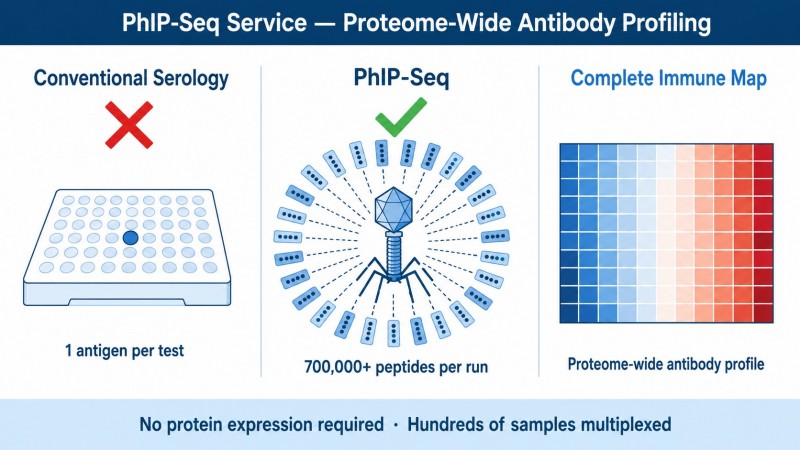
What sets PhIP-Seq apart from conventional serology is scale. Where ELISA tests one antigen per reaction and protein microarrays are constrained by expression logistics, PhIP-Seq interrogates up to 700,000+ peptide targets simultaneously — without requiring any protein expression or purification. Our antibody display sequencing expertise underpins the entire platform, and every run is supported by our validated bioinformatics pipeline for reproducible enrichment calls.
PhIP-Seq Library Types We Support
Our service accommodates the major PhIP-Seq library formats used in published research, as well as fully custom peptidome designs tailored to your target protein set.
Library Type
Peptide Coverage
Typical Peptide Length
Key Applications
Human Proteome
~48,000+ proteins and isoforms
49–90 aa, tiled with overlap
Autoantigen discovery, autoimmune profiling, cancer autoantibody panels
Our workflow follows the validated T7 phage display framework established by Larman et al. and refined through years of published applications, with strict quality checkpoints at every stage.
Get Your Instant Quote
Bioinformatics Analysis
Reliable bioinformatics analysis is what turns raw PhIP-Seq sequencing reads into interpretable immune profiles. Our standard pipeline delivers the following for every project:
Raw Data QC: FastQC metrics on raw FASTQ files; read depth confirmation per sample; library representation assessment
Alignment & Quantification: Reads aligned to the phage library reference; raw count matrices generated per peptide per sample
Normalization: Counts normalized for library composition and sequencing depth; input library representation used as reference
Enrichment Calling: Statistical identification of enriched peptides relative to mock-IP negative controls; support for both Z-score-based and Bayesian (BEER) frameworks
Hit Annotation: Enriched peptides mapped back to source proteins; gene names, UniProt IDs, and functional annotations provided
Protein-Level Summarization: Peptide-level hits rolled up to protein-level reactivity scores
Visualization: Heatmaps of sample × peptide enrichment, volcano plots, and per-protein reactivity summaries
Custom Analysis: On request: population-level seroprevalence analysis, cohort comparisons (case vs control), pathway enrichment, and integration with multi-omics datasets
All deliverables are provided in standard formats (CSV, TSV, PDF report). Raw FASTQ files are included. Our scientists are available for data interpretation support and collaborative publication.
Applications of PhIP-Seq
The breadth of PhIP-Seq's peptide coverage makes it applicable across a wide range of immunological research questions.
Autoimmune Disease & Autoantigen Discovery
Proteome-wide IgG reactivity profiling against the complete human proteome
Novel autoantigen discovery in MS, type 1 diabetes, rheumatoid arthritis, APS1, IPEX
Case-control cohort studies with high statistical power
Infectious Disease Serology & Virome Profiling
Simultaneous profiling against 200+ vertebrate viruses from a single serum sample
Population-level viral exposure history and seroprevalence analysis
SARS-CoV-2 cross-reactivity and endemic coronavirus antibody mapping
Vaccine Immunogenicity & Epitope Mapping
Epitope-level resolution of vaccine-induced antibody responses
Identification of dominant IgG-reactive regions within vaccine antigens
Longitudinal tracking of antibody response evolution post-immunization
Allergen Profiling
IgE and IgG reactivity mapping against 1,800+ allergen protein sequences
Component-resolved allergy diagnostics support (RUO)
Biomarker Discovery & Cancer Immunology
Tumor-associated autoantibody identification for candidate cancer biomarker panels
Large pre-diagnosis biobank cohort screening to identify early immune signatures
Integration with our antibody discovery workflows for downstream validation
How PhIP-Seq Compares to Other Antibody Profiling Methods
Selecting the right serology platform depends on the scale, resolution, and throughput your research requires. The table below positions PhIP-Seq against the most widely used alternatives.
Feature
PhIP-Seq
ELISA
Protein Microarray
Peptide Array
Luminex Multiplex
Targets per assay
100,000–700,000+ peptides
1
1,000–20,000 proteins
5,000–50,000 peptides
50–500 proteins
Requires protein expression
No
Yes
Yes
No
Yes
Epitope resolution
Linear peptide level
Protein level
Protein level
Linear peptide level
Protein level
Sample volume
~1–5 µL serum/plasma
10–100 µL
10–50 µL
10–50 µL
10–50 µL
Multiplexing (samples/run)
Hundreds
Low
Low
Low
Moderate
Detects novel antigens
Yes
No
Partial
Partial
No
Conformational epitopes
No
Yes
Yes
No
Yes
Best for
Proteome-wide discovery, large cohorts
Single-target quantification
Targeted proteome multiplex
Defined epitope mapping
Moderate-scale multiplex
Recommended workflow: use PhIP-Seq for discovery-phase screening of large cohorts; validate top hits using antibody sequencing or targeted ELISA. For questions about which platform fits your study, contact our scientists directly.
Sample Requirements
Sample Type
Minimum Volume
Quality
Notes
Human Serum
≥50 µL
Standard serum quality
Preferred; store at −80°C
Human Plasma (EDTA)
≥50 µL
Avoid hemolysis
EDTA or heparin anticoagulant
Human Plasma (Citrate)
≥50 µL
Avoid hemolysis
Citrate acceptable
Mouse Serum / Plasma
≥20 µL
Standard quality
For murine proteome library runs
Cerebrospinal Fluid (CSF)
≥200 µL
Cell-free
Pre-confirmed Ig presence recommended
Other biological fluids
Contact us
Contact us
Saliva, BAL, synovial fluid evaluated case by case
Freeze-thaw cycles: Maximum 3 cycles recommended; aliquot samples before storage.
Heat inactivation: Not required; discouraged as it may affect antibody integrity.
Negative controls: Mock-IP controls are included in every run; no additional controls required from the customer.
Cohort shipments: Ship all samples together on dry ice where possible.
For full sample submission requirements, please refer to our Sample Submission Guidelines.
Why Choose N2 Jenomics Lab Pvt. Ltd. for PhIP-Seq
We combine validated phage display infrastructure, deep NGS expertise, and rigorous bioinformatics — delivering reproducible, publication-ready PhIP-Seq datasets for academic and industry partners worldwide.
Pre-built and custom libraries: Access validated human proteome, virome, and allergenome libraries — or we design a custom peptidome from your protein sequences.
End-to-end service: A single point of contact from sample receipt through data delivery; no outsourcing of any pipeline step.
Rigorous negative controls: Every run includes mock-IP controls; enrichment is always calculated relative to these controls, not arbitrary thresholds.
Scalable multiplexing: Barcoded sample pooling dramatically reduces per-sample cost for large cohort studies.
Collaborative bioinformatics: Our scientists support data interpretation, custom analyses, and manuscript preparation.
From pilot experiments to population-scale immune profiling, N2 Jenomics Lab Pvt. Ltd. ' end-to-end antibody screening and sequencing capabilities make us your trusted partner in understanding the humoral immune landscape.
References
Mohan, Divya, et al. "PhIP-Seq characterization of serum antibodies using oligonucleotide-encoded peptidomes." Nature Protocols 13.9 (2018): 1958–1978. https://doi.org/10.1038/s41596-018-0025-6
Sundell, Gustav N., and Sheng-Ce Tao. "Phage immunoprecipitation and sequencing — a versatile technique for mapping the antibody reactome." Molecular & Cellular Proteomics 23.9 (2024): 100831. https://doi.org/10.1016/j.mcpro.2024.100831
Huang, Ziru, et al. "PhIP-Seq: methods, applications and challenges." Frontiers in Bioinformatics 4 (2024): 1424202. https://doi.org/10.3389/fbinf.2024.1424202
Tiu, Charles Kevin, et al. "Phage ImmunoPrecipitation Sequencing (PhIP-Seq): the promise of high throughput serology." Pathogens 11.5 (2022): 568. https://doi.org/10.3390/pathogens11050568
Demo Results
Peptide enrichment heatmap across patient cohort (Z-score scale)
Volcano plot: enrichment fold-change vs statistical significance
Virome profiling: antibody hits per pathogen family (VirScan-type analysis)
PhIP-Seq FAQs
1. What type of antibody is detected in standard PhIP-Seq runs?
Our standard protocol captures IgG antibodies using Protein A/G magnetic beads. For IgA, IgM, or IgE profiling, we offer isotype-specific pull-down using the relevant anti-isotype capture reagent — please indicate your isotype of interest when requesting a quote.
2. How many samples can be processed in a single run?
We use barcoded PCR primers to multiplex samples, which substantially reduces per-sample sequencing cost. Typical run sizes range from 24 to 96 samples, and we can accommodate larger cohorts by pooling across runs. Contact us to discuss optimal batch sizing for your study.
3. Can PhIP-Seq detect conformational epitopes?
PhIP-Seq displays linear peptide tiles and is optimized for linear B-cell epitopes. Conformational or discontinuous epitopes — such as those formed by disulfide-bonded loops — are not captured by this platform. For antigen targets where conformational epitopes are predominant, we recommend combining PhIP-Seq discovery with protein-based validation assays. Our antibody screening sequencing team can advise on the most appropriate complementary approach.
4. What bioinformatics deliverables are included in the standard service?
Standard deliverables include raw FASTQ files, a read count matrix per peptide per sample, normalized enrichment scores, statistically called hits with fold-change and p-values, protein-level reactivity summaries, and a QC report. Visualization outputs (heatmaps, volcano plots) and annotation files (UniProt mapping, gene names) are also included. Custom analyses — cohort comparisons, pathway enrichment, integration with other omics data — are available on request.
5. How should I ship samples to N2 Jenomics Lab Pvt. Ltd. ?
Samples should be shipped on dry ice in clearly labeled, leak-proof cryovials. Please contact your project manager before shipment to receive a sample submission form and shipping instructions. All samples should be accompanied by a completed sample information sheet detailing sample type, collection date, storage history, and number of freeze-thaw cycles.
PhIP-Seq Case Studies
Literature Highlight
Phage Immunoprecipitation and Sequencing — a Versatile Technique for Mapping the Antibody Reactome
Characterizing the antibody reactome — the full set of antigens a person's antibodies bind — can reveal current or prior infection, allergy status, and autoimmune disease processes. This 2024 perspective by Sundell and Tao at Shanghai Jiao Tong University provided the most comprehensive contemporary review of PhIP-Seq library design, statistical analysis strategies, and applications across disease states. The study served as a definitive technical reference for the field, cataloguing all major published PhIP-Seq libraries and their experimental applications in health and disease.
Methods
Library Design
T7 phage display format
OLS-encoded peptide libraries
Human proteome, virome, allergenome, pathogen-specific, and custom libraries reviewed
Experimental Workflow
Protein A/G magnetic bead immunoprecipitation
Barcoded PCR amplification
Illumina NGS sequencing
Statistical Analysis
Z-score-based enrichment calling
Bayesian BEER framework
Mock-IP negative control normalization
Results
The study confirmed that PhIP-Seq demonstrates high sensitivity and specificity — above 97% and 90% respectively — with strong reproducibility between technical replicates and between separate experimental runs. The review documented successful applications across autoimmune disease (novel autoantigen discovery in multiple sclerosis, APS1, and IPEX), infectious disease (virome-wide exposure mapping at population scale), vaccinology (epitope-level characterization of vaccine-induced IgG), allergy research (allergenome profiling), and cancer immunology (tumor-associated autoantibody discovery). The authors further demonstrated that the platform's multiplexing capacity dramatically reduces per-sample sequencing cost in large cohort studies, making population-scale immune profiling feasible.
Conclusion
This study affirms PhIP-Seq as a mature, high-throughput platform for comprehensive antibody profiling. Its combination of proteome-scale coverage, minimal input requirements (~1–5 µL serum), and flexible library design makes it the method of choice for researchers seeking to characterize the full landscape of humoral immune responses across diverse disease contexts. The authors conclude that continued integration of PhIP-Seq with multi-omics datasets will further expand its role in biomedical research.
Reference
Sundell, Gustav N., and Sheng-Ce Tao. "Phage immunoprecipitation and sequencing — a versatile technique for mapping the antibody reactome." Molecular & Cellular Proteomics 23.9 (2024): 100831. https://doi.org/10.1016/j.mcpro.2024.100831
Case study figure: Fig. 1 from Sundell GN & Tao SC, Mol Cell Proteomics 2024, DOI: 10.1016/j.mcpro.2024.100831. Image to be sourced from the published paper by the web team.
For Research Use Only. Not intended for any clinical or diagnostic use.
Address:Registered Office: 150, Patparganj Industrial Area, New Delhi – 110092, India
Operational Address:National Institute of Plant Genome Research (BRIC - NGGF)
Lab No. 206 and 207, Aruna Asaf Ali Marg, P.O. Box No. 10531,
New Delhi – 110067, India