Cell Line Identification
Home
> Cell Line Identification
Cell Line Identification and Authentication via STR Profiling
Secure Your Research Integrity with Gold-Standard STR Profiling
Is the cell line in your dish truly what you think it is? Data integrity begins with sample identity. With over 30% of cell lines in circulation estimated to be cross-contaminated or misidentified, the risk of irreproducible results and retracted publications is a critical threat to biomedical research.
N2 Jenomics Lab Pvt. Ltd. provides a definitive solution. We offer expert Cell Line Identification (Authentication) services using Short Tandem Repeat (STR) profiling—the industry standard mandated by the NIH, FDA, and ATCC. Whether you are validating Human, Mouse, or Vero cells, our high-precision capillary electrophoresis platform delivers the "genetic fingerprint" of your biological models. We help researchers, CROs, and pharmaceutical developers verify cell origin, detect cryptic cross-contamination, and meet stringent journal requirements with speed and accuracy.
Core Advantages:
Prevent Retractions: Eliminate the risk of using misidentified cells (e.g., HeLa contamination) before publication.
Regulatory Compliance: Data fully compliant with ATCC and ICLAC guidelines.
High Sensitivity: Successful profiling from low-input samples to preserve your precious cell stock.
In the era of precision medicine, the reproducibility of scientific data is non-negotiable. Yet, cell line misidentification remains a "silent epidemic" in laboratories worldwide. Statistics from the International Cell Line Authentication Committee (ICLAC) and other bodies indicate that approximately 18% to 30% of cell lines currently used in research are either cross-contaminated or entirely misidentified.
This widespread issue typically arises from:
Cross-Contamination: Fast-growing cell lines (such as HeLa) accidentally introduced into slower-growing cultures.
Mislabeling: Errors during routine cell culture, cryopreservation, or shipping.
Genetic Drift: Instability in cell lines passaged for extended periods.
The Regulatory Landscape: Mandates for STR Profiling
To combat this, authentication is no longer optional—it is a requirement.
Journal Requirements: Major publishers (Nature, Cell, Science, AACR journals) now require proof of cell line authentication as a prerequisite for manuscript acceptance.
Funding Agencies: The NIH and other grant-giving bodies require authentication plans for grant applications involving cell lines.
FDA Guidance: For therapeutic product development, the FDA recommends STR profiling at key stages: early culture (first week), before cryopreservation, and periodically (every 2 months) during active culture.
N2 Jenomics Lab Pvt. Ltd. empowers you to meet these standards effortlessly. By integrating our authentication services into your workflow, you safeguard your project's validity, ensuring that your conclusions are drawn from the correct biological model.
When We Need Cell Line Identification?
To ensure the accuracy and reliability of cell-based research, authentication should be performed under the following recommended scenarios:
At the beginning or conclusion of a research project involving cell-based experiments.
Prior to cryopreservation or after cells have been in continuous culture for 2-3 months.
Before submitting research for publication or applying for grant funding.
If cell lines exhibit unstable performance or yield results significantly divergent from expectations.
Whenever multiple cell lines are used within a laboratory, it is strongly recommended to authenticate all lines to rule out potential cross-contamination.
Technical Superiority: The N2 Jenomics Lab Pvt. Ltd. Difference
Our Cell Line Identification service is built on a foundation of rigor and technological excellence. We do not simply run a PCR; we provide a comprehensive identity verification solution.
1. Ultra-High Sensitivity & Sample Conservation
We understand that some cell models are difficult to grow or limited in quantity. Our optimized protocol requires only a minimal template of 1 ng of DNA. This allows you to authenticate early-passage primary cells or slow-growing lines without expanding them purely for QC purposes. Furthermore, our platform achieves a 10% cross-contamination detection rate. This sensitivity is crucial for identifying "early-stage" contamination, where an invasive cell line (like HeLa) is just beginning to overtake your target culture.
2. Comprehensive Species & Locus Coverage
We offer one of the industry's most versatile portfolios, covering 95% of common research models.
Human: We analyze 20 STR loci plus the Amelogenin gender marker. This exceeds the standard 8-locus panels used by many competitors, offering higher discrimination power for closely related lines.
Mouse: Validated 18-locus panel designed to differentiate between unique mouse cell lines.
Our workflows are compatible with major capillary electrophoresis instruments, ensuring that our data is directly comparable to global standards. We provide 100% reproducible results, giving you data you can trust for regulatory submissions or patent filings.
Service Options: Tailored Identification Strategies
We categorize our services to meet specific research needs, from basic origin verification to complex interspecies contamination screening.
1. Human Cell Line STR Authentication
Target Audience: Researchers submitting to journals or establishing cell banks.
Methodology: Multiplex PCR followed by Capillary Electrophoresis (20 STR loci + Amelogenin).
Deliverables:
Complete STR profile (allele table).
Database Matching: We compare your profile against major repositories (ATCC, DSMZ, JCRB, COG) to confirm identity.
Contamination Analysis: Detection of multi-allelic patterns indicating mixture with another human line.
2. Cell Line Variation Testing (Human)
Target Audience: Labs monitoring genetic drift or comparing donor-derived clones.
Application: This service compares two specific samples (e.g., "Passage 5" vs. "Passage 50") to determine if they are genetically identical or if significant drift/mutation has occurred.
3. Mouse Cell Line Authentication
Target Audience: Immunology and Oncology researchers using murine models.
Methodology: Mouse-specific STR Profiling (18 loci + 2 species markers).
Key Feature: This assay serves a dual purpose. It generates a unique genetic ID for the mouse line and simultaneously screens for human cross-contamination using species-specific primers.
Interpretation:
Uncontaminated: Single or double peaks at all 18 mouse loci.
Contaminated: Presence of human peaks or three+ peaks at mouse loci (indicating mouse-mouse mixture).
4. Monkey (Vero) Cell Line Authentication
Target Audience: Vaccine developers and Virology labs.
Methodology: Vero-specific STR Profiling (8 loci + 1 species marker + 1 gender marker).
Application: Confirms the identity of Chlorocebus aethiops (African Green Monkey) lines and detects contamination from human or other non-Vero primate cells.
5. Species Contamination Testing (Interspecies Screening)
Target Audience: Core facilities or labs handling multiple animal models.
Methodology: Multiplex PCR with species-specific primers.
Scope: We detect the presence of foreign DNA from a broad spectrum of 15 species:
Rodents: Mouse, Rat, Chinese Hamster, Syrian Hamster.
Primates: Human, African Green Monkey, Rhesus Macaque.
We have optimized our process to minimize your effort and maximize data speed.
Project Consultation: Our technical team confirms your cell type and selects the appropriate STR panel.
Sample Quality Control (QC): We verify the quantity and integrity of your DNA or cell pellet upon receipt to ensure successful amplification.
STR Region Amplification: Utilizing fluorescently labeled primers, we amplify the target microsatellite regions.
Fragment Analysis: Capillary electrophoresis separates the PCR products with single-base pair resolution.
Data Analysis & Reporting: Our bioinformaticians interpret the peaks, perform database matching, and generate a comprehensive PDF report.
Figure 1. The N2 Jenomics Lab Pvt. Ltd. Authentication Workflow.
Sample Requirements for Cell Line Identify
Sample Type
Submission Requirements
Shipping Conditions
Cell pellet or suspension
≥5×10⁵ cells, volume: 18 μL – 2 mL
Shipped with ice pack Shipped with ice pack
Genomic DNA
Concentration ≥50 ng/μL, volume ≥20 μL
Tips:
Ship samples on blue ice to preserve integrity.
DNA extraction services available upon request.
For special sample types or low-input scenarios, contact us for a customized plan.
Expert Guide: Interpreting Your STR Report
Understanding your data is critical. Here is how to interpret the results provided by N2 Jenomics Lab Pvt. Ltd. .
1. The "Clean" Profile (Homozygous/Heterozygous)
A pure cell line will display one or two peaks at each STR locus.
One Peak: The cell is homozygous at this locus (inheriting the same allele length from both parents).
Two Peaks: The cell is heterozygous (inheriting different allele lengths).
2. The "Contaminated" Profile (Multi-Allelic)
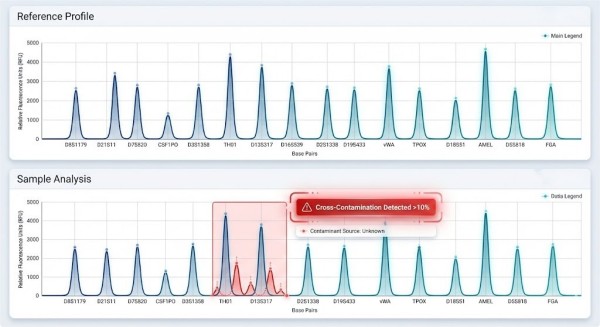
If the analysis reveals three or more peaks at multiple loci, this is the hallmark of cross-contamination.
The Science: The height of the peak reflects the amount of DNA. In a mixture, the "dominant" cell line will show high peaks, while the "contaminant" (e.g., HeLa) will appear as smaller, secondary peaks48.
Threshold: If >2 alleles are found at $\ge$ 3 loci (for mouse) or multiple loci (for human), the sample is flagged as contaminated49494949.
3. The Match Score
≥ 80% Match: The cell line is authenticated. This threshold allows for minor genetic drift common in cultured cells50.
< 80% Match: The cell line is likely misidentified or significantly genetically drifted. Immediate action (discarding the line or re-sourcing) is recommended51.
Demo Results
Mouse Cell Line Authentication: The goal is to confirm the cell line's identity as mouse and detect any potential human contamination.
Results Interpretation:
· Normal, Uncontaminated Mouse Cells: No peaks detected in human loci, and all 18 mouse loci show either single peaks (homozygous) or double peaks (heterozygous).
· Mouse-Mouse Cross-Contamination: No peaks detected in human loci, but at least three of the 18 mouse loci will show three or more peaks.
Distribution of base quality.
Human Cell Line Contamination Analysis: We use a 20-locus STR profiling system to detect cross-contamination in human cell lines.
Results Interpretation: The analysis shows a tri-allelic pattern at the loci D6S1043, D3S1358, D13S317, and TPOX. This indicates the cell line is a mixture of human cells, confirming cross-contamination from two distinct human cell sources.
Cell Line Identification FAQs
1. Which cell line most commonly contaminates others?
HeLa cells pose the highest risk of contamination. Widely used in medical and biological research for over 50 years, HeLa's rapid growth allows it to easily overgrow other cultures. If cells in a flask begin to proliferate aggressively and are subsequently passaged, there is a high likelihood of HeLa contamination. Notably, as early as 1967, geneticist Stanley Gartler identified popular cell lines such as HEp-2 and INT 407 as HeLa derivatives.
2. Which cell lines have been contaminated by HeLa?
Documented cases of HeLa contamination include over 100 cell lines, such as: INT-407, HEp-2, WISH, Acc-M, Bcap-37, HAC-84, Hepatoma, HUL-42, CNE, SPC-A-1, Tca-8113, and YTMLC.
3. How is cell line identity verified?
Authentication follows the International Cell Line Authentication Committee (ICLAC) standards. This involves multiplex fluorescent PCR analysis of 8 human STR loci and 1 amelogenin gender-determining locus. Detailed genetic profiles for these markers are provided in the table below.
4. How is cross-contamination detected via STR profiling?
Cross-contamination is identified by the presence of multiple peaks (more than two alleles) at several STR loci. Peak height correlates with DNA concentration; thus, in mixed samples, the major cell line exhibits dominant peaks, while the contaminant shows minor peaks. Notably, multi-allelic patterns may mimic genetic instability, which is common in cancer cell subpopulations. Expert interpretation by experienced molecular biologists is essential to differentiate true contamination from intrinsic genetic heterogeneity.
5. How is cell line identity confirmed using STR data?
The sample's STR profile is compared to reference databases. Identity is confirmed if ≥80% of alleles match the reference profile across all loci. Matches below 80% indicate potential mislabeling, contamination, or genetic drift. If contamination or misidentification is confirmed, authenticate earlier-passage stocks or acquire a new line from a certified source.
6. What if no database match is found?
If no reference profile is found, establish a unique genetic signature for your cell line. This baseline profile will allow for future authentication against your internal cell bank.
7. What impact do misidentify, or cross-contaminated cells have on research?
The impact is significant. Using compromised cells wastes time, resources, and funding, often leading to irreproducible or inconsistent results. Studies conducted with such cell lines may require repetition with authenticated cells before publication or further development.
Address:Registered Office: 150, Patparganj Industrial Area, New Delhi – 110092, India
Operational Address:National Institute of Plant Genome Research (BRIC - NGGF)
Lab No. 206 and 207, Aruna Asaf Ali Marg, P.O. Box No. 10531,
New Delhi – 110067, India