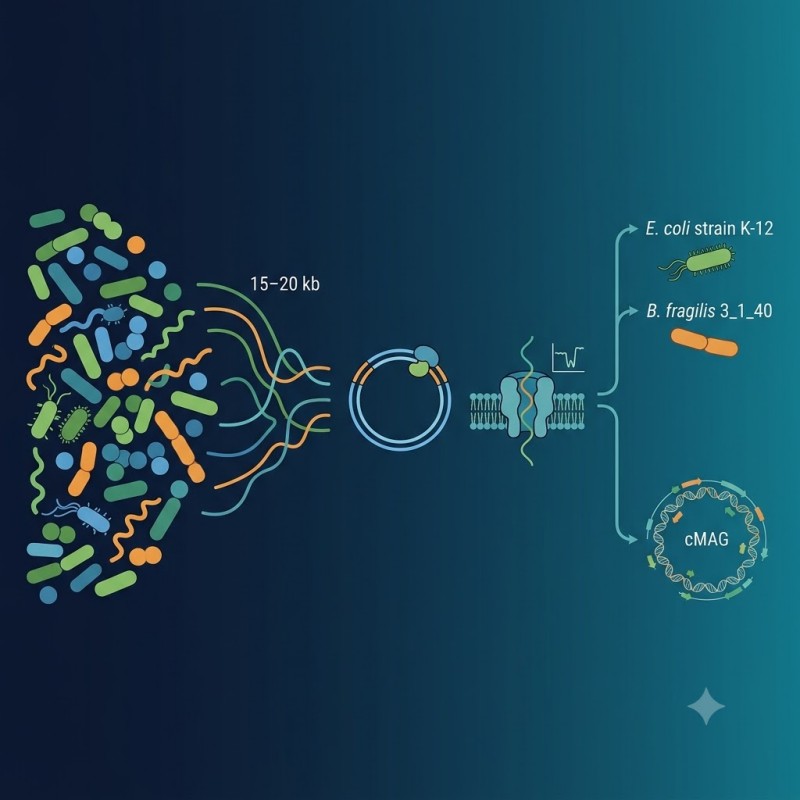
Short-read metagenomics gives you genus-level taxonomy and fragmented MAGs. Long-read metagenomic sequencing changes that: PacBio HiFi CCS reads deliver QV ≥30 accuracy at 15–20 kb, enabling species- and strain-level classification directly from raw reads — no assembly necessary. Oxford Nanopore adds ultra-long reads for the largest gene clusters and real-time monitoring. N2 Jenomics Lab Pvt. Ltd. provides end-to-end long-read metagenomics on both platforms, from sample QC through taxonomic and functional annotation. Looking for amplicon-based microbiome profiling? See our Full-Length 16S/18S/ITS Amplicon Sequencing service.
What we provide:
Trust: SOP-driven QC · HiFi reads with QV ≥30 · publication-ready deliverables
If you are running short-read (Illumina) shotgun metagenomics, you know the limits. Short reads (2×150 bp or 2×300 bp) fragment genomes into thousands of contigs. The result: fragmented metagenome-assembled genomes (MAGs), genus-level taxonomic resolution at best, and functional gene annotation that often stops at the domain level — because the full gene context is lost.
Long reads solve these problems:
Species- and strain-level classification without assembly. Each PacBio HiFi read spans enough of the 16S rRNA gene, or a species-specific marker region, to classify directly at the species level. For many bacterial genomes, a single HiFi read can cover an entire operon or mobile genetic element — preserving the genomic context that short reads fragment.
Higher-quality MAGs. HiFi-based circular MAGs (cMAGs) consistently outperform short-read MAGs in completeness, contamination, and N50. Nanopore ultra-long reads can further improve MAG contiguity for the most complex communities.
Complete gene clusters and ARG context. Biosynthetic gene clusters (BGCs) and antimicrobial resistance genes (ARGs) often span 10–50 kb — well within a single HiFi read. When you can capture a full BGC or ARG cassette in one read, you know exactly which species it belongs to, what the neighboring genes are, and whether it is on a plasmid or chromosome.
Where long reads add the most value over short-read metagenomics.
Environmental microbiology
Profile soil, water, sediment, and extreme-environment microbial communities at species-level resolution. Track keystone species, functional guilds, and biogeochemical pathway distributions.
Human microbiome research
Resolve gut, oral, skin, and vaginal microbiome composition to the strain level. Link specific strains to metabolites, host phenotypes, or disease states — resolution that genus-level short-read profiling cannot deliver.
Antimicrobial resistance (AMR) surveillance
Capture full ARG cassettes in single long reads. Identify the host species, plasmid context, and co-localized resistance genes simultaneously — critical for tracking ARG transmission.
Industrial and agricultural microbiology
Optimize fermentation consortia, screen for novel enzymes and BGCs, and monitor soil or rhizosphere microbiomes for biocontrol and plant-growth-promoting organisms.

| Sample type | Recommended amount | Minimum | Notes |
|---|---|---|---|
| Metagenomic DNA | ≥2 μg, ≥30 ng/μL | 1 μg | A260/280 1.8–2.0; RNase-treated |
| Soil / Sediment | 6 g | 2 g | Freeze immediately; avoid thawing |
| Fecal / Gut contents | 5 g | 2 g | Sterile tube; −80°C |
| Water filter membrane | 6 membranes | 2 membranes | 0.22–0.45 μm; −80°C |
| Swabs | 10–20 swabs | 6 swabs | Use preservation buffer |
| Tissue | 2 g | 1 g | Snap-freeze in liquid N₂ |
| Fermentation liquid | 6–10 mL (pellet ≥2 g) | 2 mL (pellet ≥1 g) | Ship pellet on dry ice |
Standard (included)
Optional add-ons

| Category | Deliverables |
|---|---|
| Raw data | HiFi reads or ONT reads (FASTQ/BAM), demultiplexed per sample |
| QC report | Yield, read-length N50, Q-score distribution, CCS pass count, barcode assignment |
| Taxonomy | Species- and genus-level abundance tables (TSV), stacked bar charts, Krona plots |
| Function | KEGG pathway abundance, eggNOG/COG annotation, CAZy enzyme families, CARD ARG profiles |
| MAGs | Binned MAGs (FASTA), CheckM2 quality report (completeness, contamination, strain heterogeneity) |
| Comparative | Alpha/beta diversity, PCoA/NMDS, differential abundance (DESeq2/ALDEx2), heatmaps |
| Project report | Methods, parameters, results, figure-ready plots |
Need help interpreting your metagenomics data? Explore our Bioinformatics Services or Genomic Data Analysis options.
Which approach fits your metagenomics project? Here is how PacBio HiFi, Oxford Nanopore, and short-read (Illumina) metagenomics compare on the dimensions that matter for microbial community analysis.
| Dimension | Short-Read (Illumina) | PacBio HiFi | Oxford Nanopore |
|---|---|---|---|
| Read length | 2×150 bp or 2×300 bp | ~15–20 kb HiFi | 10–100 kb routine; ultra-long to 2 Mb+ |
| Per-read accuracy | ≥99.9% | QV ≥30 (≥99.9%) | Q10–Q20 raw; depth-dependent |
| Taxonomic resolution | Genus (16S copy-number distorted) | Species, often strain — directly from raw reads | Species/strain with sufficient depth |
| Assembly-free taxonomy | No — requires assembly first | Yes — CCS reads classify directly | Requires depth or consensus |
| MAG quality | Fragmented, many chimeras | Circular cMAGs, higher completeness | Longer contigs; more polishing |
| Full operon / BGC capture | Assembly-dependent, often broken | Single-read capture (15–20 kb spans most operons) | Single-read capture; ultra-long covers largest clusters |
| ARG host identification | Contig-level, host usually unknown | Read-level: host species + plasmid context | Read-level; longer = more context |
| Real-time monitoring | No | No | Yes — stop run when data sufficient |
| Field deployment | No | No | Yes (MinION) |
| Bioinformatics maturity | Most mature | Mature HiFi tools (HiFi-MAG, metaMDBG) | Growing ONT metagenomics ecosystem |
N2 Jenomics Lab Pvt. Ltd. offers all three platforms. We help you choose based on sample type, community complexity, and target resolution.

Species-Level Taxonomic Classification — HiFi reads classify directly at species and strain level without assembly

cMAG Quality Assessment — HiFi circular MAGs: higher completeness, lower contamination than short-read MAGs

HiFi Read-Length Distribution — 15–20 kb reads capture full operons and ARG cassettes in single molecules
1. Why use long reads instead of short-read metagenomics?
Long reads deliver species- and strain-level taxonomy directly from raw reads — no assembly needed. Short-read metagenomics typically stops at genus level and requires assembly for functional annotation, which introduces chimeras and fragmentation. Long reads also capture full operons and ARG cassettes in single reads, preserving genomic context.
2. PacBio HiFi vs Nanopore — which is better for metagenomics?
Both have strengths. HiFi gives you higher per-read accuracy (QV ≥30), which translates to more accurate taxonomic classification and higher-quality MAGs. Nanopore can produce ultra-long reads useful for large plasmids and prophages, and supports real-time and portable sequencing. For most projects, HiFi is the first choice for taxonomy and MAGs; Nanopore adds value when ultra-long structural context or field capability matters.
3. Can long reads classify at the species or strain level without assembly?
Yes. Because HiFi reads are 15–20 kb long and QV ≥30 accurate, a single read can span enough of the 16S rRNA gene or species-specific markers for direct classification. This is a key advantage over short reads, which require assembly before taxonomy.
4. What types of samples do you accept?
Soil, sediment, water (filtered), fecal/stool, gut contents, swabs, tissue, fermentation liquids, and extracted metagenomic DNA. See the Sample Requirements table for amounts and shipping conditions. Contact us for low-biomass, FFPE, or challenging samples.
5. How much data do I need per sample?
Typically 5–10 Gbp per sample for species-level taxonomic profiling. For high-quality MAG recovery from complex communities, 10–20 Gbp. We scope coverage during project consultation based on your sample type and expected community complexity.
6. What bioinformatics do you provide?
Standard delivery includes taxonomic profiling (Kraken2/Bracken), functional annotation (KEGG, eggNOG, CAZy, CARD), diversity analysis, and differential abundance testing. Optional add-ons: MAG binning and QC (CheckM2), BGC prediction, custom database construction, and multi-omics integration.
7. Can you do both PacBio HiFi and Nanopore metagenomics on the same project?
Yes. Hybrid PacBio + Nanopore metagenomics is a powerful strategy: use HiFi for accurate taxonomy and high-quality MAGs, and Nanopore ultra-long reads for capturing large plasmids, prophages, and complex genomic regions. We design hybrid workflows during project consultation.
8. How does this differ from 16S amplicon sequencing?
16S amplicon sequencing targets only the 16S rRNA gene and provides genus-level taxonomy at best — no functional information. Long-read metagenomic sequencing captures all DNA in the sample, providing species-level taxonomy AND functional gene annotation (metabolic pathways, ARGs, BGCs) from the same dataset.
Open Access Publication Highlight
Decomposing a San Francisco estuary microbiome using long-read metagenomics reveals species- and strain-level dominance from picoeukaryotes to viruses
Journal: mSystems (ASM), 2024 | DOI: 10.1128/msystems.00242-24
Background
Estuarine microbiomes are highly complex ecosystems shaped by dynamic freshwater and marine inputs. Understanding their species- and strain-level composition is essential for predicting ecosystem responses to environmental change, but short-read metagenomics often fails to resolve closely related species and strains due to fragmented assemblies.
Methods
This study applied Oxford Nanopore long-read metagenomic sequencing (~150 Gbp total) to water samples from the San Francisco estuary. Long-read data were analyzed using a combination of taxonomic classification (Kraken2/Bracken), metagenome-assembled genome (MAG) generation (Flye + metaMDBG), and strain-level profiling. Both short-read (Illumina) and long-read data were generated from the same samples for direct platform comparison.
Results

Figure 2 from mSystems, 2024. Species-level taxonomic composition by long-read metagenomic sequencing.
Conclusion
This study demonstrates that long-read metagenomic sequencing provides species- and strain-level resolution that is inaccessible to short-read approaches, particularly for complex environmental microbiomes. The ability to recover complete MAGs and viral genomes from a single long-run demonstrates the power of Nanopore metagenomics for comprehensive ecosystem profiling — the same approach we apply in our long-read metagenomic sequencing service.
Reference