Multiplex PCR Sequencing
Home
> Multiplex PCR Sequencing
Fast, accurate SNP genotyping with high-plex Multiplex PCR Sequencing.
N2 Jenomics Lab Pvt. Ltd. delivers expert Multiplex PCR Sequencing services for accurate, high-throughput SNP genotyping. Our optimized assays simultaneously amplify and sequence dozens to hundreds of target SNPs in a single reaction, drastically reducing costs and time compared to single-plex methods. Leveraging Illumina NGS platforms and proprietary bioinformatics, we provide researchers in genetics, pharmacogenomics, agriculture, and disease studies with reliable, scalable data for critical variant discovery and validation. Ideal for targeted panels, validation studies, and biomarker screening.
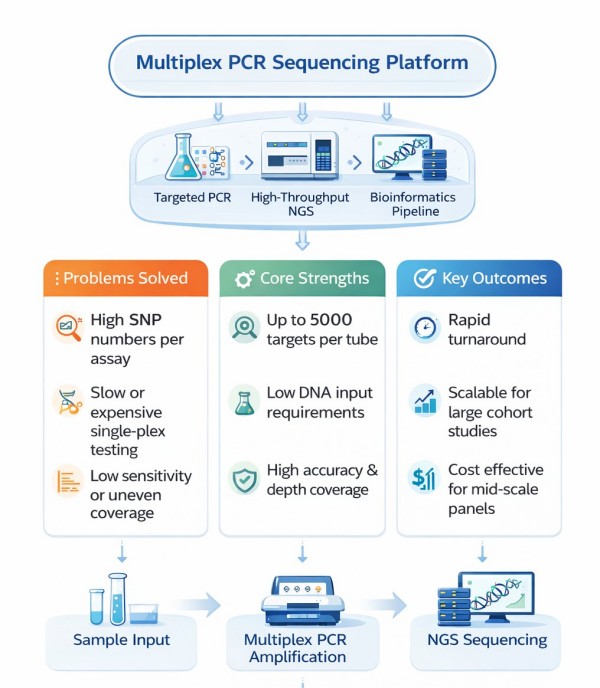
N2 Jenomics Lab Pvt. Ltd. Multiplex PCR Sequencing combines multiplex polymerase chain reaction (PCR) with next-generation sequencing (NGS). It uses multiple primer pairs in a single reaction tube to amplify numerous specific genomic regions (containing target SNPs) simultaneously. The pooled amplicons are then sequenced on high-throughput NGS platforms (like Illumina MiSeq/NovaSeq), enabling parallel genotyping of hundreds of SNPs across many samples. This method is highly specific, sensitive, and efficient for focused studies.
We use its proprietary AIdesign and MFEprimer software for multiplex primer design and QC, developed with the guidance of internationally recognized experts. This cutting-edge solution provides whole-genome-specific primers based on thermodynamic stability algorithms, tailored to meet your research needs. With the ability to multiplex up to 5,000 reactions in a single tube and input requirements as low as 100 pg of gDNA, this method quickly and efficiently enriches target regions for precise sequencing. We offer two flexible design formats—single-tube or multiple-tube—based on your target region type.
Primer design and multiplex PCR workflow. The flowchart outlines the process of selecting and optimizing primers for PCR amplification, ensuring no hairpins or dimers, and the generation of specific amplicons. The diagram on the right illustrates primer pools for target DNA amplification.
Choose the Right SNP Typing Method for Your Research
Choosing the right genotyping approach is critical for efficiency and accuracy. While options range from low-throughput Sanger to broad-coverage WGS, Multiplex PCR Sequencing strikes the optimal balance for targeted studies: high-throughput, cost-effective, and flexible for panels of moderate-scale SNPs. Whether validating biomarkers, screening cohorts, or running agrigenomics trials, it eliminates the trade-offs of traditional methods.
Method
Throughput
Cost/Sample
Speed
Flexibility
Best For
Multiplex PCR Seq
High
$$
Fast
High
Targeted panels (10-500 SNPs), validation, large cohorts
Multiplex PCR sequencing is a targeted, high-throughput method that efficiently analyzes specific genomic regions. It delivers scalable, sensitive results across key applications including:
Population genetics and breeding:
High-throughput SNP genotyping for diversity, QTL mapping, genomic selection, and marker-assisted breeding; platforms integrate targeted amplicons with GBS.
Human identification and forensics: Targeted amplicon sequencing kits type iiSNPs, aiSNPs, piSNPs, and microhaplotypes; works on degraded or low-template DNA where STRs may fail.
Clinical research panels: Germline and somatic variant panels (oncology, inherited disease) with rapid, economical workflows and uniformity across difficult regions. Research use only.
Infectious disease and outbreak genomics: Tiled multiplex PCR enables whole-genome viral sequencing to identify mutations and track variants.
Editing & targeted assays: Sensitive detection of CRISPR edits, hotspot variants, and rare alleles; COLD-PCR and molecular barcodes options enrich/quantify low-frequency variants.
Multiplex PCR Sequencing Service Workflow
At N2 Jenomics Lab Pvt. Ltd. , we provide a seamless, end-to-end Multiplex PCR Sequencing service to ensure consistent, high—quality results. Our standardized workflow—from sample submission to data delivery—is built to support reproducibility, streamline research, and accelerate discovery across all types of genomic studies:
Sample Submission & QC:
Receive and audit your DNA samples (blood, tissue, cells, swabs, saliva). Conduct quality control to confirm quantity and purity meet requirements for multiplex amplification.
Primer Design & Panel Optimization:
Use advanced software tools and expert design algorithms to create optimized multiplex primer panels tailored to your target SNP regions, ensuring high specificity and balanced amplification.
Multiplex PCR Amplification:
Perform highly multiplexed PCR amplification to enrich dozens to thousands of target regions in a single reaction or pooled tubes, maximizing throughput while maintaining uniform coverage.
Next—Generation Sequencing:
Sequence the PCR amplicons on high-throughput NGS platforms (e.g., Illumina MiSeq/NovaSeq) to generate deep, accurate reads for each target region.
Data Processing & Bioinformatics:
Process raw sequencing data into standardized formats (FASTQ, BAM, VCF). Apply alignment, variant calling, and annotation pipelines to deliver reliable genotyping results.
Reporting & Interpretation:
Provide comprehensive outputs including summary statistics, annotation reports (PDF + Excel), graphical visualizations, and usage guidance to support your downstream research or publication needs.
Multiplex PCR Sequencing Bioinformatics Analysis
To ensure accurate results and meaningful insights, our bioinformatics team employs a comprehensive workflow tailored to multiplex PCR sequencing, enabling seamless data processing and in-depth analysis of genomic variations.
For personalized bioinformatics analysis or specific research needs, please reach out to our experts for professional advice and support tailored to your project's requirements.
Sample Requirements for Multiplex PCR Sequencing
Sample Type
Quantity Recommended
Shipping Method
Genomics DNA
≥ 100ng, OD260/280 in 1.8~2.0, RNase-treated
blue ice
Cell
1×10⁶ cells
dry ice
Fresh Frozen Tissue
10 mg
dry ice
Swabs
2 tubes/sample, 1 swab/tube
room temperature
Saliva
1 mL
dry ice or blue ice
Whole Blood
1 mL Fresh blood in EDTA tube
dry ice
4 mL Frozen blood in EDTA tube
dry ice
Note: These are general recommendations. For project-specific needs, contact our technical team for tailored guidance.
From advanced sequencing platforms to high-quality data delivery, N2 Jenomics Lab Pvt. Ltd. offers an efficient, end-to-end solution tailored to diverse research needs. Our team ensures reliable results with flexible support.
Proven Scientific Expertise: Supported by a team of PhD-level scientists and seasoned bioinformaticians, we have successfully assisted numerous research institutes and agricultural enterprises in achieving their genotyping goals.
Optimized Primer Design: Our proprietary primer design algorithms are engineered to maximize specificity and minimize off-target effects, ensuring balanced amplification even in complex genomic regions.
Comprehensive Quality Control: We implement strict quality assurance protocols at every stage, from sample validation to library preparation and sequencing, ensuring data integrity and reproducibility.
Flexible Customization: Whether you need a small targeted panel or high-density screening, we offer fully customizable solutions with dedicated technical support to align with your specific research objectives.
References:
Onda, Yu, et al. "Multiplex PCR Targeted Amplicon Sequencing (MTA-Seq): Simple, Flexible, and Versatile SNP Genotyping by Highly Multiplexed PCR Amplicon Sequencing." Frontiers in Plant Science 9 (2018): 201. https://doi.org/10.3389/fpls.2018.00201
Sato, Mana, et al. "A highly flexible and repeatable genotyping method for aquaculture studies based on target amplicon sequencing using next-generation sequencing technology." Scientific Reports 9 (2019): 6904. https://doi.org/10.1038/s41598-019-43336-x
Wang, Xiaoming, et al. "A new SNP genotyping technology, target SNP-seq, and its application in genetic analysis of cucumber varieties." BMC Genomics 21 (2020): 24. https://doi.org/10.1038/s41598-020-62518-6
Ruff, T. M., Marlowe, K., Hooker, M. A., Liu, Y., & See, D. R. (2023). Genotyping by Multiplexed Sequencing (GMS) Using SNP Markers. In Methods in Molecular Biology (Vol. 2638, pp. 9–21). Humana. https://doi.org/10.1007/978-1-0716-3024-2_2
Demo results
Demo results from Multiplex PCR Sequencing, showing SNP genotyping, variant coverage, and applications in agriculture, disease research, and forensics.
Multiplex PCR Seq FAQs
1. How many SNPs can I type in one assay?
Modern amplicon chemistries support hundreds to ~6000 amplicons depending on genome complexity, panel design, and pool number. We'll recommend 1–4 pools to maintain uniformity.
2. What DNA amount do I need?
Most primer panels work well with ~10 ng per pool; range 1–100 ng is supported. For highly complex or low-quality samples, higher inputs may improve uniformity.
3. How does multiplex PCR sequencing compare with hybrid capture?
Amplicon offers faster, lower-cost enrichment with high depth, while capture provides more uniform coverage across very large or GC-rich regions with fewer dropouts. Choice depends on target size and sensitivity requirements.
4. Can you handle FFPE DNA?
Yes. Shorter amplicons (125–175 bp) and optimized conditions improve success on fragmented/FFPE DNA.
5. What accuracy can I expect for SNP calls?
Published data show ~95–98% call accuracy across hundreds of amplicons when designs are optimized; we report per-locus coverage and call rates to document performance.
6. Can I combine targeted amplicons with genome-wide markers?
Hybrid strategies exist—e.g., GTA integrates multiplex amplicons into GBS libraries—useful in breeding pipelines.
7. What if I need extremely high multiplexing beyond PCR limits?
MIP (molecular inversion probe) technology supports tens of thousands of loci and can be considered for very large SNP panels.
8. Do you offer forensics-oriented SNP panels?
We can design iiSNP/aiSNP/piSNP sets or support use of published commercial panels (e.g., ForenSeq) under research-use frameworks.
Multiplex PCR Seq Case Studies
Source: Adapted from Wang, X., et al. (2020). Scientific Reports.
Background
Cucumber (Cucumis sativus L.) breeding requires precise genetic identification to distinguish varieties and ensure seed purity. Traditional methods like KASP are accurate but expensive for large marker sets, while GBS (Genotyping-by-Sequencing) often suffers from missing data. The study aimed to validate a Multiplex PCR Sequencing method (referred to as Target SNP-seq) to fingerprint cucumber varieties efficiently and cost-effectively.
Methods
Researchers designed a custom Multiplex PCR panel to genotype 261 cucumber varieties.
Panel Design: Targeted 163 perfect SNPs with high polymorphism across the genome.
Workflow: A "two-round PCR" strategy was used to amplify target regions and add barcodes in a single workflow.
Sequencing: Amplicons were pooled and sequenced on the Illumina platform.
Validation: Genotypes were compared against KASP assays to verify accuracy.
Results
The Multiplex PCR Sequencing approach delivered superior performance metrics:
High Accuracy: The method achieved a genotyping accuracy of 99.4% compared to KASP.
Efficiency: It successfully identified 4 distinct subpopulations (North China, South China, Europe, and Xishuangbanna types).
Core Marker Discovery: A core set of 24 SNPs was identified that could distinguish >99% of the varieties.
Population structure and PCA analysis of 261 cucumber varieties genotyped using Multiplex PCR Sequencing (Target SNP-seq).
Conclusions
This study demonstrates that Multiplex PCR Sequencing is a robust, flexible, and highly economical tool for crop genotyping. It enables breeders to construct precise DNA fingerprints and screen large germplasm collections rapidly, significantly accelerating molecular breeding programs.
Address:Registered Office: 150, Patparganj Industrial Area, New Delhi – 110092, India
Operational Address:National Institute of Plant Genome Research (BRIC - NGGF)
Lab No. 206 and 207, Aruna Asaf Ali Marg, P.O. Box No. 10531,
New Delhi – 110067, India