Human/Mouse Whole Exome Sequencing
Home
> Human/Mouse Whole Exome Sequencing
Human and Mouse Exome Sequencing with Precision and Depth
N2 Jenomics Lab Pvt. Ltd. offers high-qualityhuman and mouse exome sequencing services powered by optimized probe panels and advanced hybrid capture technology. Our solutions help researchers identify disease-causing mutations, accelerate gene discovery, and reduce time and cost compared to whole genome sequencing. Whether you're studying inherited disorders, tumour driver mutations, or functional gene variants, our Human Exome Panel and Mouse Exome Panel deliver deep coverage and reliable variant calls for translational research and drug discovery.
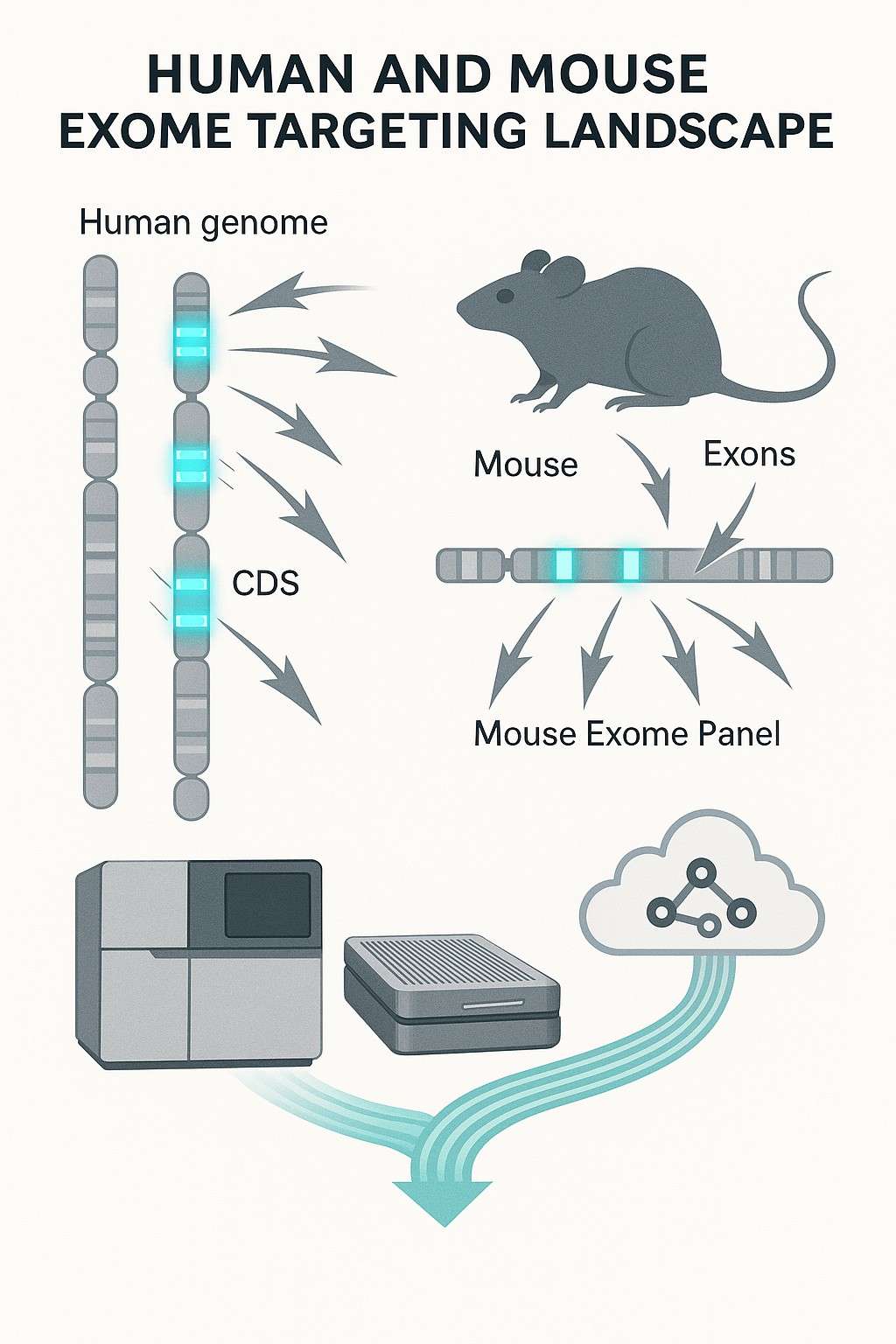
Whole exome sequencing (WES) focuses on the coding regions (exons) of the genome, which represent just 1–2% of the human or mouse genome yet contain over 85% of known disease-related variants. By selectively sequencing only these high-value regions, WES provides a cost-effective alternative to whole genome sequencing (WGS) without sacrificing discovery power for most functional mutations.
Whether you're studying rare inherited disorders, tumour mutations, or developing disease models in mice, exome sequencing offers deep insight into protein-coding changes that drive phenotype and pathology.
Key Advantages of Exome Sequencing:
Efficient and high-resolution: Pinpoints single-nucleotide variants (SNVs), insertions/deletions (InDels), and copy number variations (CNVs) across all protein-coding regions.
Cost-effective alternative to WGS: Delivers actionable data at a fraction of the cost and data volume.
Ideal for human disease and mouse model research: Enables comparative genomics, mutation screening, and translational insights across species.
Flexible for research needs: Supports germline and somatic variant discovery, population studies, and targeted functional analysis.
Enhanced variant annotation: Leverages comprehensive databases including RefSeq, ClinVar, CCDS, and GENCODE.
At N2 Jenomics Lab Pvt. Ltd. , we offer both Human/Mouse Whole Exome Sequencing and Plant/Animal Whole Exome Sequencing, with customizable depth, platform, and analysis options to suit your specific research goals.
Our Human and Mouse Exome Sequencing Services
Human Exome Sequencing Service
Our Human Whole Exome Sequencing is based on GRCh38 and captures up to 99.9% of known protein-coding regions across RefSeq, MANE, CCDS, and ClinVar databases. Choose from standard or disease-focused Human Exome Panels:
Core Panel: Optimized for high exonic coverage and efficient data yield.
Cancer Panel: Includes 600+ tumour-associated genes, fusion regions, HLA loci, and MSI markers.
We support flexible sequencing depths (100X–200X) with options for FFPE, blood, or tissue samples.
Mouse Exome Sequencing Service
Our Mouse Whole Exome Sequencing uses a proprietary Mouse Exome Panel designed from the mm39 genome, covering over 38 Mb of CDS regions with high capture uniformity. This allows for efficient, low-input sequencing with excellent depth (100X+) using just 8 Gb of data.
Use our mouse platform for:
Phenotype-to-genotype studies
Transgenic and knockout mouse validation
Preclinical disease model analysis
Human and Mouse Exome Sequencing Panels at N2 Jenomics Lab Pvt. Ltd.
At N2 Jenomics Lab Pvt. Ltd. , we provide comprehensive exome sequencing using both short-read and long-read platforms to meet diverse project requirements in disease research, drug discovery, and functional genomics.
Supported Platforms
Illumina NovaSeq & NextSeq Industry-standard short-read sequencing for high-depth, high-throughput applications. Ideal for detecting single nucleotide variants (SNVs) and small insertions/deletions (InDels) across coding regions.
MGI DNBSEQ A cost-effective alternative to Illumina, offering comparable accuracy and coverage uniformity. Suitable for mouse exome projects requiring scalability and rapid turnaround.
Nanopore PromethION Long-read sequencing platform capable of capturing extended exons, fusion events, and complex structural variants. Useful for characterizing splicing isoforms, gene fusions, and hard-to-map GC-rich exons.
PacBio Revio / Sequel IIe (HiFi reads) Enables high-fidelity long reads (HiFi) for precise exon-level phasing, CNV detection, and de novo assembly in targeted regions. Especially beneficial in capturing full-length transcripts and resolving repeats in human and mouse models.
Read Lengths and Coverage
Platform
Typical Read Length
Recommended Depth
Application Notes
NovaSeq / DNBSEQ
PE150
100–200X
Standard exome variant discovery
PromethION
5–20 kb
20–40X
Structural variants, phasing, rare isoforms
PacBio HiFi
10–25 kb
30–50X
CNV resolution, clean exon boundaries
Exome Capture Strategies
Hybridization-based Capture Optimized probe sets designed to enrich coding sequences from human and mouse genomes. Custom panel options available upon request for focused disease gene sets or orthologous regions.
Amplicon-Free Workflows For degraded or FFPE samples, we employ enzymatic fragmentation and low-input protocols to ensure robust performance.
Workflow
Data Analysis
Our bioinformatics pipeline delivers high-confidence variant calls and comprehensive interpretation for both human and mouse exomes. Each dataset is analysed using gold-standard algorithms to ensure reliable detection of clinically and functionally relevant variants.
What's Included in Our Exome Data Analysis:
Quality control of raw sequencing reads (Phred score, adapter trimming, contamination filtering)
Alignment to reference genome (GRCh38 for human, GRCm39 for mouse) using BWA-MEM
Duplicate marking and base quality recalibration with GATK Best Practices
Variant calling (SNVs and small InDels) using GATK HaplotypeCaller
Functional annotation with Ensembl VEP and ClinVar/OMIM/gnomAD
Rare variant filtering based on allele frequency thresholds
Pathogenicity prediction using tools like SIFT, PolyPhen-2, MutationTaster
CNV calling (for high-coverage samples) using CNVkit or XHMM
Tumor samples (optional): MSI/TMB analysis and somatic mutation calling
Technical Process
Advanced Technical Process
Advantages of Our Exome Sequencing Services
Our exome sequencing services are optimized for precision, flexibility, and cross-species compatibility. Whether you're studying rare diseases, cancer, or functional genomics in mouse models, we deliver high-quality data—fast.
Dual-Species Expertise
Validated human and mouse exome panels covering >99% coding regions (RefSeq, MANE, CCDS).
Flexible Platforms
Illumina, MGI for short reads; Nanopore, PacBio for long reads and complex regions.
Customizable Targets
Add HLA, CNV scaffolds, mitochondrial genome, or disease-specific regions.
High Uniformity & Sensitivity
Excellent exon-level coverage with low dropout and high capture efficiency.
Low Input & FFPE Compatible
Optimized for challenging samples with as little as 50 ng input DNA.
Full Bioinformatics Pipeline
Includes SNV, InDel, CNV detection, and optional MSI/TMB analysis.
Sample Requirements
Application
Sample Type
Recommended Quantity
Minimum Quantity
Minimum Concentration
Human/Mouse Whole Exome Sequencing
Genomic DNA
≥ 500 ng
100 ng
10 ng/μL
PCR-Free Exome Sequencing
Genomic DNA
≥ 1 µg
500 ng
20 ng/μL
FFPE Exome (Degraded DNA)
FFPE DNA
≥ 500 ng
-
Fragment > 1000 bp
Note:Concentrations should be determined by fluorometry (Qubit, PicoGreen). If using spectrophotometry (e.g. NanoDrop), double the concentration values.
We accept a wide range of sample types and offer extraction services upon request.
Sample Type
Quantity
Shipping Condition
Cells
1×10⁶
Dry ice
Fresh Frozen Tissue
10 mg
Dry ice
FFPE Slides
≥4 slides (≥150 mm²)
Room temp / Blue ice
Blood (EDTA tube)
2–4 mL
Blue ice / Dry ice
Plasma / Serum
10 mL
Dry ice
Saliva
1 mL
Dry ice / Blue ice
Stool / Soil
100 mg
Dry ice / Room temp
Swabs
2 tubes / sample
Room temperature
Water
50 mL
Room temperature
Not sure if your sample qualifies? Contact us for free consultation and extraction support.
What You'll Receive
Deliverables are tailored based on your project scope:
A: Whole exome sequencing (WES) focuses on the ~1–2% of the genome that codes for proteins but captures ~85% of disease-causing mutations. It's a cost-effective solution when your research target involves gene-level functional variation.
Q2: What's the difference between your Human Exome and Mouse Exome Sequencing services?
A: Both services include probe-based capture of protein-coding regions (CDS), high-throughput sequencing, and variant interpretation. The Human Exome Panel is aligned to GRCh38 and includes ClinVar annotation, while the Mouse Exome Panel targets GRCm39 and supports disease model studies.
Q3: What depth of coverage do you recommend for human or mouse exome sequencing?
A: We recommend 100X–150X for germline studies and ≥200X for tumor/FFPE samples. For mouse whole exome sequencing, deeper coverage may be required for mosaic or chimeric models.
Q4: Do you support long-read exome sequencing using Nanopore or PacBio SMRT?
A: Yes. For select applications requiring structural variant detection or highly repetitive regions, we offer long-read exome capture using Nanopore or SMRT platforms. Please contact us for customized protocols.
Q5: How do you ensure variant accuracy in FFPE or low-input samples?
A: We use optimized library prep kits with UMI (unique molecular identifiers), FFPE-aware capture panels, and tailored bioinformatics pipelines to improve sensitivity and reduce artefacts.
Q6: Can I submit pre-enriched exome libraries for sequencing only?
A: Yes. We accept both raw genomic DNA and pre-captured libraries. Please contact us for library QC requirements.
Q7: What deliverables will I receive after analysis?
A: You'll receive raw data (FASTQ), aligned files (BAM), variant calls (VCF), annotated variant lists (Excel), and optional CNV or pathway reports.
Q8: How do I choose between whole exome and whole genome sequencing?
A: Choose whole genome sequencing if your study requires analysis of non-coding variants, structural variations, or intergenic regulatory elements. For gene-level mutation discovery, human whole exome sequencing offers higher depth at lower cost.
Human/Mouse Whole Exome Seq Case Studies
Customer Publication Highlight
Case Study: Integrated Exome & Optical Mapping in Clear Cell Renal Cell Carcinoma
Title: Optical genome and epigenome mapping of clear cell renal cell carcinoma Journal:NAR Cancer Published: March 4, 2025 DOI: 10.1093/narcan/zcaf008
Background
Clear cell renal cell carcinoma (ccRCC) is the most common form of kidney cancer, often driven by complex genomic events such as the loss of chromosome 3p and inactivation of the VHL gene. However, epigenetic factors—including DNA methylation and hydroxymethylation—also play critical roles in tumor progression. Capturing both types of variation in a single workflow is challenging with traditional sequencing methods.
Project Objectives
Hybrid Characterization: Combine short-read exome sequencing with optical genome mapping to detect both coding mutations and large-scale structural variations (SVs).
Epigenetic Profiling: Measure single-molecule methylation (5mC) and hydroxymethylation (5hmC) changes in tumor vs. normal tissue.
Clinical Insight: Tie genetic and epigenetic alterations to functional gene changes for ccRCC pathogenesis.
Analysis: GATK-based variant calling (SNV/InDel) with focused annotation of VHL, PBRM1, SETD2, and other epigenetic driver genes.
2. Optical Genome/Epigenome Mapping
(This component was conducted by the research team)
Structural variant detection with single-molecule resolution
Single-molecule methylation profiling using labelled DNA molecules
3. Integrated Analysis
Cross-validation of exome-detected variants with copy number and structural findings from optical mapping
Comparative epigenomic profiling of 5mC and 5hmC levels in key tumor suppressors
Key Findings
Co-occurring Genetic & Epigenetic Events
Identification of a 3p deletion encompassing VHL and PBRM1 confirmed by optical mapping.
Exome-sequencing detected non-synonymous mutations in SETD2 and BAP1 consistent across both tumor stages.
Epigenetic Dysregulation
Global reduction of 5hmC in tumor compared to normal tissue.
Hypo-/hypermethylation patterns in promoter/enhancer regions of VHL, PRCC, and PBRM1 correlated with reduced expression.
Functional Genomic Insights
Combined data revealed disrupted metabolic and hypoxia pathways that contribute to ccRCC progression.
This panel shows the structural variant map of chromosome 3p (tumor vs control), clearly displaying the 3p deletion detected through optical genome mapping.
Implications
Comprehensive Profiling: Combining exome sequencing with optical genome mapping enables complete coverage—from point mutations to large structural changes.
Enhanced Clinical Insight: Epigenetic markers (5hmC/5mC) provide additional layers of tumor biology previously hidden to NGS-only approaches.
Strategic Approach in Cancer Research: This dual-modality method effectively addresses why whole exome sequencing alone might miss critical alterations in cancers like ccRCC.
Why This Matters for You
This case underscores the power of integrating Human Exome Sequencing (for SNVs and InDels) with long-range structural and epigenetic mapping to fully unravel cancer genomes. At N2 Jenomics Lab Pvt. Ltd. , we can help you implement such integrative strategies—leveraging both exome panels and long-read platforms like Nanopore or PacBio, complemented by optical genome mapping partnerships.
Address:Registered Office: 150, Patparganj Industrial Area, New Delhi – 110092, India
Operational Address:National Institute of Plant Genome Research (BRIC - NGGF)
Lab No. 206 and 207, Aruna Asaf Ali Marg, P.O. Box No. 10531,
New Delhi – 110067, India